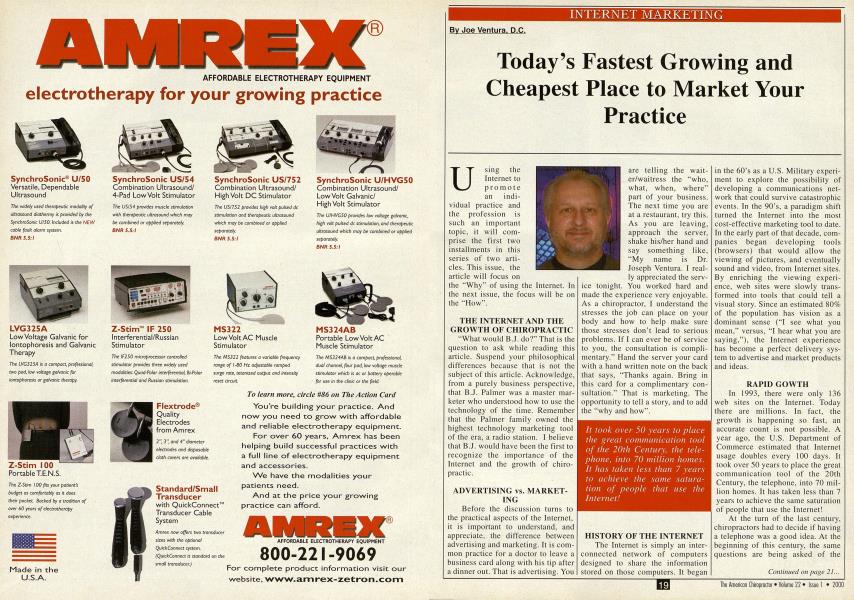
Using the Internet to promote an individual practice and the profession is such an important topic, it will comprise the first two installments in this series of two articles. This issue, the article will focus on the "Why" of using the Internet. In the next issue, the focus will be on the "How". THE INTERNET AND THE GROWTH OF CHIROPRACTIC "What would B.J. do?" That is the question to ask while reading this article. Suspend your philosophical differences because that is not the subject of this article. Acknowledge, from a purely business perspective, that B.J. Palmer was a master marketer who understood how to use the technology of the time. Remember that the Palmer family owned the highest technology marketing tool of the era, a radio station. I believe that B.J. would have been the first to recognize the importance of the Internet and the growth of chiropractic. ADVERTISING vs. MARKETING Before the discussion turns to the practical aspects of the Internet, it is important to understand, and appreciate, the difference between advertising and marketing. It is common practice for a doctor to leave a business card along with his tip after a dinner out. That is advertising. You are telling the waiter/waitress the "who, what, when, where" part of your business. The next time you are at a restaurant, try this. As you are leaving, approach the server, shake his/her hand and say something like, "My name is Dr. Joseph Ventura. I really appreciated the serv- ice tonight. You worked hard and made the experience very enjoyable. As a chiropractor, I understand the stresses the job can place on your body and how to help make sure those stresses don't lead to serious problems. If I can ever be of service to you, the consultation is complimentary." Hand the server your card with a hand written note on the back that says, "Thanks again. Bring in this card for a complimentary consultation." That is marketing. The opportunity to tell a story, and to add the "why and how". HISTORY OF THE INTERNET The Internet is simply an interconnected network of computers designed to share the information stored on those computers. It began in the 60's as a U.S. Military experiment to explore the possibility of developing a communications network that could survive catastrophic events. In the 90's, a paradigm shift turned the Internet into the most cost-effective marketing tool to date. In the early part of that decade, companies began developing tools (browsers) that would allow the viewing of pictures, and eventually sound and video, from Internet sites. By enriching the viewing experience, web sites were slowly transformed into tools that could tell a visual story. Since an estimated 80% of the population has vision as a dominant sense ("I see what you mean," versus, "I hear what you are saying,"), the Internet experience has become a perfect delivery system to advertise and market products and ideas. RAPID GOWTH In 1993, there were only 136 web sites on the Internet. Today there are millions. In fact, the growth is happening so fast, an accurate count is not possible. A year ago, the U.S. Department of Commerce estimated that Internet usage doubles every 100 days. It took over 50 years to place the great communication tool of the 20th Century, the telephone, into 70 million homes. It has taken less than 7 years to achieve the same saturation of people that use the Internet! At the turn of the last century, chiropractors had to decide if having a telephone was a good idea. At the beginning of this century, the same questions are being asked of the Continued on page 21... ...from page 19 practicality of being on the Internet. Before asking, "What would B.J. do?", consider this. Last month, about 20,000 people purchased cars over the Internet. Last week, about 20,000 airline tickets were booked. Yesterday, about 25 million people went on-line to gather information and to send and receive e-mail. If the reader has any doubts about the Internet being a viable place to market, count the number of commercials during prime time that reference only a web site address (www.something.com). These companies are spending millions of dollars a month in attempt to attract only people who can access information via the Internet. Not because they expect customers to be there next year, but because they know the customers are on the Internet now! The next great leap in Internet usage will happen when an enterprising individual or company creates the first Yellow Pages type of printed directory devoted to local web sites. A reference guide to look up local products/services solely by web addresses delivered to every household, like a phone book. It will happen, probably within the next year. WHY MARKET A CHIROPRACTIC PRACTICE ON THE INTERNET? The answers are quite simple. • The Internet is a cost-effective ■ method of advertising/marketing. Imagine having 100 full page color Yellow Pages ads. Instead of $700.000/mo. you pay about $l,200/year! • The Internet is open 24-hours a day. Web Trends, a company that : tracks Internet usage, has shown that most visits to web sites occur between the hours of 10:00PM and 2:00AM. • Most importantly, "A hundred years later, they still don't know what you do!" The public still does not fully understand the uniqueness of a doctor of chiropractic. By using a professionally designed site, and the power of marketing concepts to be discussed later, a web site can tell , the chiropractic story more effectively than any other medium, in a leisurely and private setting. The doctor can use the Internet to position himself/herself as a unique health care provider. In future articles, niche marketing will be discussed and how chiropractic and a chiropractic practice can thrive using these proven techniques. SO WHERE ARE THE CHIROPRACTORS? Using advanced software, an Internet search to determine the number of chiropractors with web sites revealed about 700 sites or about 1.5% of the profession. Of these 700 sites, the vast majority were single page sites. The question is this: "Why aren't more chiropractors using the Internet to promote their practices and the profession? " It comes down to three basic objections. First Objection: "Why do I want to market my practice to someone in France? I need patients here." REPLY: A web site is a great marketing tool, if used properly. A hammer is just a paperweight until it is picked up and strikes something. To be effective, a doctor's web site must be marketed in the following manner: 1. In big bold type, the web address must be everywhere the doctor has a telephone number. 2. Place the web address in the Yellow Pages. Even if you don't have a display ad. you can reserve additional space in the standard listing for the web address. When a person opens the Yellow Pages, a buying decision usually follows. Statistics show that 50% of the people using the Yellow Pages have Internet access at work, home or school. The doctor who invites visitors to a web site has an advantage over a doctor who does not. 3. MOST IMPORTANTLY: Actively promote the web address to tne practice s (Jolden Circle. The Golden Circle is the 2-3 miles around the doctor's office where 80% of patients live or work. In most areas, this represents 25,000 individual addresses. In denser populations, it can reach 50,000 or more. If every new patient brings $500-$ 1000 to the clinic in fees, this Golden Circle has a potential of $25-50 million dollars in revenue! Instead of placing that next Yellow Pages ad, costing $2-5 thousand dollars a month, send a direct mail postcard to the Golden Circle, inviting the population to visit the web site to see dynamic web site areas of interest to the community. Instead of spending money that is only returned if the phone book is opened, use a direct mailer to place the information into the hands of potential patients today! It is also possible to reach those potential patients through a direct telemarketing campaign that is both ethical and effective. Information about obtaining a Golden Circle mailing list for your practice can be found at the end of this article. Second Objection: "I'm computer illiterate. I wouldn't know where to start." A computer is no different from a telephone. A number is dialed, a connection is made, the keyboard is used to "talk" and the screen is used to "listen". Today's chiropractor has to accept the idea that the computer isn't going away. It will continue to drive technology advances, and, therefore, change the way a doctor practices. It is prudent that the doctor learn as much about this tool as he/she does any other part of the practice. Want to know a secret? It's not important to know how a computer works. It's only important to know how to make a computer work! This learning process can be accomplished by anyone with the desire to embrace this technology. Books, videos, CD's and community college courses are available to anyone wishing to learn more about the possibilities computer technology brings to a practice. Again, you don't need to know how a computer works, just how to make it work for you! "What would B.J. do?" INTELLECTUAL AWARENESS AND THE INTERNET Third Objection: The next reason most doctors don't jump at the chance to be on the Internet is more esoteric. It's because of a concept called the Prepared Mind, or Intellectual Awareness. The Prepared Mind is the culmination of all learning and life experiences called upon to make an educated decision. Here's an example: One day in 1928, Alexander Fleming walked into his lab and saw that a blue mold had contaminated one of his lab samples. Had one of Fleming's assistants looked at the mold, he might have thought, "Shoot, this sample is contaminated. I'd better prepare another." However, Fleming looked at the petrie dish and instantly recognized that the mold was killing the bacteria he was trying to grow. His Prepared Mind told him that he was seeing a good thing. He was able to make the next leap in logic based on the building blocks his experiences had laid. That "accident" eventually became penicillin. Fleming went on to collect 25 honorary degrees, 26 medals, 18 prizes, 13 decorations, membership in 87 scientific academies and societies, was knighted in 1944 and won the Nobel Prize in 1945. What does this have to do with chiropractic and the Internet? Chiropractors, as a whole, are at the low end of the Prepared Mind Totem pole when it comes to understanding the importance of new technology. So really, it's understandable that the vast majority of doctors just don't "get it" when it comes to understanding the importance of the Internet and marketing a private practice. The next leap in logic can't be made, because the building blocks aren't there, yet. Prepare Your Mind Before making a decision about using the Internet as an advertising and marketing tool, elevate Intellectual Awareness by reading as much information about market-ing-especially Guerrilla Market-ing-as possible. Then, a reasonable decision regarding the benefits of the Internet can be made. The Internet is the most powerful advertising and marketing tool in the history of mankind. Serious consideration should be given to immediately including a web presence in an overall marketing strategy. What would B.J. do? ♦ In the next issue of TAC, the author will discuss the various alternatives available in establishing a, presence on the Web. An option, content-based subscription web sites, pioneered by the author in 1996, will-be examined in detail. Joseph Ventura DC, is owner of, VenturaDesigns, a full service Internet marketing and software development company. He can be reached at (913) 829-0404 or send e-mail to [email protected]. Visit VenturaDesigns at www.venturade-signs.com