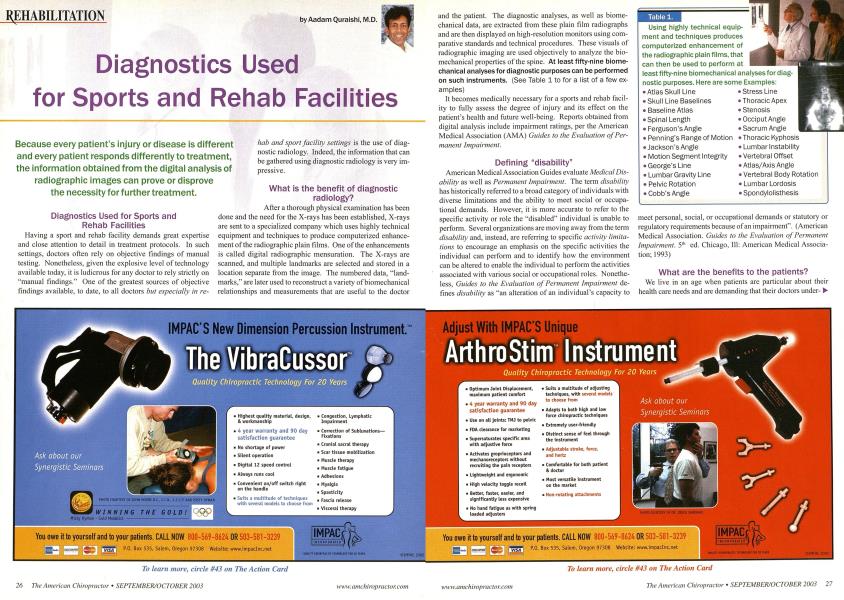
Because every patient's injury or disease is different and every patient responds differently to treatment, the information obtained from the digital analysis of radiographic images can prove or disprove the necessity for further treatment. Diagnostics Used for Sports and Rehab Facilities Having a sport and rehab facility demands great expertise and close attention to detail in treatment protocols. In such settings, doctors often rely on objective findings of manual testing. Nonetheless, given the explosive level of technology available today, it is ludicrous for any doctor to rely strictly on "manual findings." One of the greatest sources of objective findings available, to date, to all doctors but especially in re- hab and sport facility settings is the use of diagnostic radiology. Indeed, the information that can be gathered using diagnostic radiology is very impressive. What is the benefit of diagnostic radiology? After a thorough physical examination has been done and the need for the X-rays has been established, X-rays are sent to a specialized company which uses highly technical equipment and techniques to produce computerized enhancement of the radiographic plain films. One of the enhancements is called digital radiographic mensuration. The X-rays are scanned, and multiple landmarks are selected and stored in a location separate from the image. The numbered data, "landmarks," are later used to reconstruct a variety of biomechanical relationships and measurements that are useful to the doctor and the patient. The diagnostic analyses, as well as biome-chanical data, are extracted from these plain film radiographs and are then displayed on high-resolution monitors using comparative standards and technical procedures. These visuals of radiographic imaging are used objectively to analyze the bio-mechanical properties of the spine. At least fifty-nine biome-chanical analyses for diagnostic purposes can be performed on such instruments. (See Table 1 to for a list of a few examples) It becomes medically necessary for a sports and rehab facility to fully assess the degree of injury and its effect on the patient's health and future well-being. Reports obtained from digital analysis include impairment ratings, per the American Medical Association (AMA) Guides to the Evaluation of Permanent Impairment. Defining "disability" American Medical Association Guides evaluate Medical Disability as well as Permanent Impairment. The term disability has historically referred to a broad category of individuals with diverse limitations and the ability to meet social or occupational demands. However, it is more accurate to refer to the specific activity or role the "disabled" individual is unable to perform. Several organizations are moving away from the term disability and, instead, are referring to specific activity limitations to encourage an emphasis on the specific activities the individual can perform and to identify how the environment can be altered to enable the individual to perform the activities associated with various social or occupational roles. Nonetheless, Guides to the Evaluation of Permanent Impairment defines disability as "an alteration of an individual's capacity to meet personal, social, or occupational demands or statutory or regulatory requirements because of an impairment". (American Medical Association. Guides to the Evaluation of Permanent Impairment. 5lh ed. Chicago, 111: American Medical Association; 1993) What are the benefits to the patients? We live in an age when patients are particular about their health care needs and are demanding that their doctors under- ► Table 1. Using highly technical equipment and techniques produces computerized enhancement of the radiographic plain films, that can then be used to perform at least fifty-nine biomechanicai analyses for diagnostic purposes. Here are some Examples: Atlas Skull Line Skull Line Baselines Baseline Atlas Spinal Length Ferguson's Angle Penning's Range of Motion Jackson's Angle Motion Segment Integrity George's Line Lumbar Gravity Line Pelvic Rotation Cobb's Angle Stress Line Thoracic Apex Stenosis Occiput Angle Sacrum Angle Thoracic Kyphosis Lumbar Instability Vertebral Offset Atlas/Axis Angle Vertebral Body Rotation Lumbar Lordosis Spondylolisthesis ► stand not only the need for specific treatment, but also the findings of the objective testing. Using diagnostic radiology will bring the following benefits to the patient: Films read by a board certified ra diologist Photographic reproduction of the patient's film images, printed with complete measurements and dis played next to comparatively nor mal images, should be shown to the patient to explain the findings and insure patient retention. If the healthcare practitioner has exper tise and is well acquainted with the individual's activities and needs, then he or she must ex press an opinion about the pres ence or absence of the specific disabilityand how this will impact the patient's daily activities. Benefits to a Rehab Center Rehab centers are often made up of exercise physiologists, body trainers, physical therapists (PT's), PT aids, PT assistants, chiropractic practitioners and others. These sports and rehabilitation oriented practitioners, although very knowledgeable in assessing a patient's diagnosis, can greatly benefit by the highly technical, yet diversified, information which is gathered from diagnostic radiology. Because every patient's injury or disease is different and every patient responds differently to treatment, the information obtained from the digital analysis of radiographic images can prove or disprove the necessity for further treatment. This information is then used to customize the most effective treatment protocol for the patient's injury and/or disease and may cut down on or eliminate unnecessary treatment. Biomechanical measurements are vital and are critical to the appropriate diagnosis analysis, treatment, and prognosis of the sports injury patient in a clinical environment. With accurate measurements, a fundamental base line can be determined and can further be explored for an accurate and reliable assessment of the patient's condition and outcome potential. There is also a financial benefit, since the referring doctor gets reimbursed ► ► for the professional confirmatory component above and beyond the X-ray coding. Below are a few samples of indications for diagnostic radiology. Sprains/Strains Trauma Motor vehicular accidents Sports induced injuries Work related injuries On a side note, and as a fundamental basis, DCs often deal with the dynamics of the musculoskeletal system, whether or not the clinical neurological components exist. Simply stated, the science of chiropractic is founded on the premise that adequate nerve supply is of prime importance in regulating body function. Hence, radiographic measurements obtained from diagnostic radiology and utilized in a rehab facility can: Increase Personal Injury referral Enhance reputation Increase patient compliance Support insurance claims with scientific medical proof Provide attorneys with professional documentation Increase collections How to implement diagnostic radiology Determine need for X-rays. Take flexion/extension study of cervical or lumbar area (or both, if needed). Referring doctor reads films and gives brief impression to patient. Films are sent for digitization and for impression by Board Certified Radiologist (licensed in the state where patient is being treated). 5 Analysis is done and returned to referring doctor. Treatment protocol is established and information is given over to patient. Service is billed for consultation to proper carrier. In conclusion, other procedures (i.e., NCV, SSEP, MRI, US, Electromyography, etc.) should always be correlated to clinical history, physical examination and ra-diographic findings for a more comprehensive and complete picture of the patient's status. Digitized radiology has shown reliability, accuracy and benefit paralleled to this time in history with respect to spinal radiographic analysis. In determining need for treatment, type of treatment to be administered, and/or monitoring of changes of treatment resulting from re-injury, for prognosis, digitized analysis for radiology is an effective outcome assessment device and methodology for chiropractic services in a rehab facility. EH Aadam Qwaishi, MD, was a clinical instructor at New York University Medical Center. He is board certified in radiology and has additional fellowship trained qualifications. He has seventeen years of medical practice experience. Dr. Quraishi specializes in Vascular and Interventional Radiology MRI (Netiro and Musculosketal), MRA Mammography. Breast Localization. Nuclear Medicine CT and Ultrasound. Dr. Quraishi has board certification in Diagnostic Radiology, and can be contacted at drxilfliiboiitpdi.cain. For more information and/or sample reports, go to KKw.abaulpdLcom.