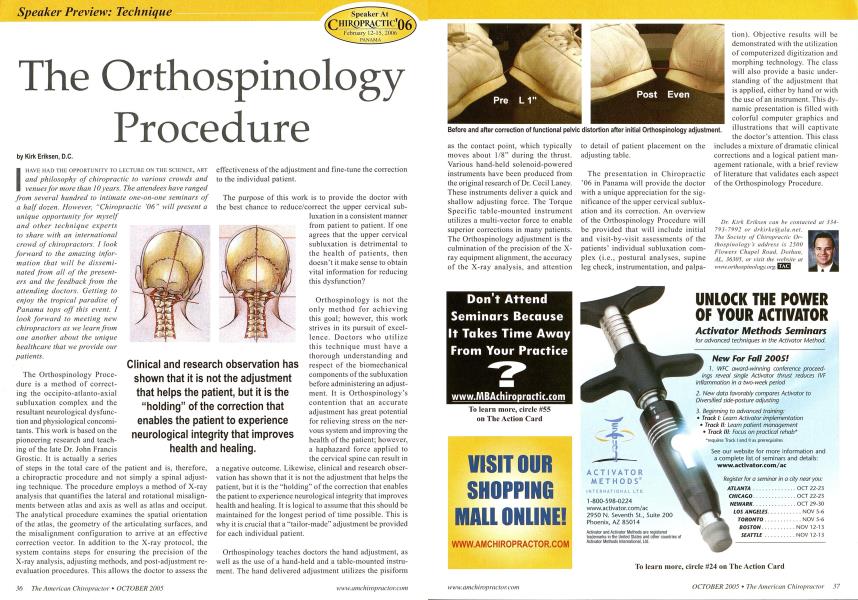
I 1IAVB HAD THE OPPORTUNITY TO LECTURE ON THE SCIENCE, ART and philosophy of chiropractic to various crowds and venues for more than 10years. The attendees have ranged from several hundred to intimate one-on-one seminars of a half dozen. However, "Chiropractic '06" will present a unique opportunity for myself and other technique experts to share with an international crowd of chiropractors. I look forward to the amazing information that will be disseminated from all of the presenters and the feedback from the attending doctors. Getting to enjoy the tropical paradise of Panama tops off this event. I look forward to meeting new chiropractors as we learn from one another about the unique healthcare that we provide outpatients. The Orthospinology Procedure is a method of correcting the occipito-atlanto-axial subluxation complex and the resultant neurological dysfunction and physiological concomitants. This work is based on the pioneering research and teaching of the late Dr. John Francis Grostic. It is actually a series ot steps in the total care ot the patient and is, therefore, a chiropractic procedure and not simply a spinal adjusting technique. The procedure employs a method of X-ray analysis that quantifies the lateral and rotational misalignments between atlas and axis as well as atlas and occiput. The analytical procedure examines the spatial orientation of the atlas, the geometry of the articulating surfaces, and the misalignment configuration to arrive at an effective correction vector. In addition to the X-ray protocol, the system contains steps for ensuring the precision of the X-ray analysis, adjusting methods, and post-adjustment re-evaluation procedures. This allows the doctor to assess the effectiveness of the adjustment and fine-tune the correction to the individual patient. The purpose of this work is to provide the doctor with the best chance to reduce/correct the upper cervical sub- luxation in a consistent manner from patient to patient. If one agrees that the upper cervical subluxation is detrimental to the health of patients, then doesn't it make sense to obtain vital information for reducing this dysfunction? Orthospinology is not the only method for achieving this goal; however, this work strives in its pursuit of excellence. Doctors who utilize this technique must have a thorough understanding and respect of the biomechanical components of the subluxation before administering an adjustment. It is Orthospinology's contention that an accurate adjustment has great potential for relieving stress on the nervous system and improving the health of the patient; however, a haphazard force applied to the cervical soine can result in a negative outcome. Likewise, clinical and research observation has shown that it is not the adjustment that helps the patient, but it is the "holding" of the correction that enables the patient to experience neurological integrity that improves health and healing. It is logical to assume that this should be maintained for the longest period of time possible. This is why it is crucial that a "tailor-made" adjustment be provided for each individual patient. Orthospinology teaches doctors the hand adjustment, as well as the use of a hand-held and a table-mounted instrument. The hand delivered adjustment utilizes the pisiform Speaker At l-cbruary 12-15. 2006 PANAMA as the contact point, which typically moves about 1/8" during the thrust. Various hand-held solenoid-powered instruments have been produced from the original research of Dr. Cecil Laney. These instruments deliver a quick and shallow adjusting force. The Torque Specific table-mounted instrument utilizes a multi-vector force to enable superior corrections in many patients. The Orthospinology adjustment is the culmination of the precision of the X-ray equipment alignment, the accuracy of the X-ray analysis, and attention to detail of patient placement on the adjusting table. The presentation in Chiropractic '06 in Panama will provide the doctor with a unique appreciation for the significance of the upper cervical sublux-ation and its correction. An overview of the Orthospinology Procedure will be provided that will include initial and visit-by-visit assessments of the patients' individual subluxation complex (i.e., postural analyses, supine leg check, instrumentation, and palpa- tion). Objective results will be demonstrated with the utilization of computerized digitization and morphing technology. The class will also provide a basic understanding of the adjustment that is applied, either by hand or with the use of an instrument. This dynamic presentation is filled with colorful computer graphics and illustrations that will captivate the doctor's attention. This class includes a mixture ot dramatic clinical corrections and a logical patient management rationale, with a brief review of literature that validates each aspect of the Orthospinology Procedure. Dr. Kirk Eiiksen can he contacted at 334- 793-7992 or drkirke(wala.net. The Society of Chiropractic Or-thospinology !v address is 2500 Flowers Chapel Road. Diilhan. AL, 36305, or visit the website til www.orthospinology.org.jU5H Clinical and research observation has shown that it is not the adjustment that helps the patient, but it is the "holding" of the correction that enables the patient to experience neurological integrity that improves health and healing. Before and correction of functional pelvic distortion after initial Orthospinology adjustment.