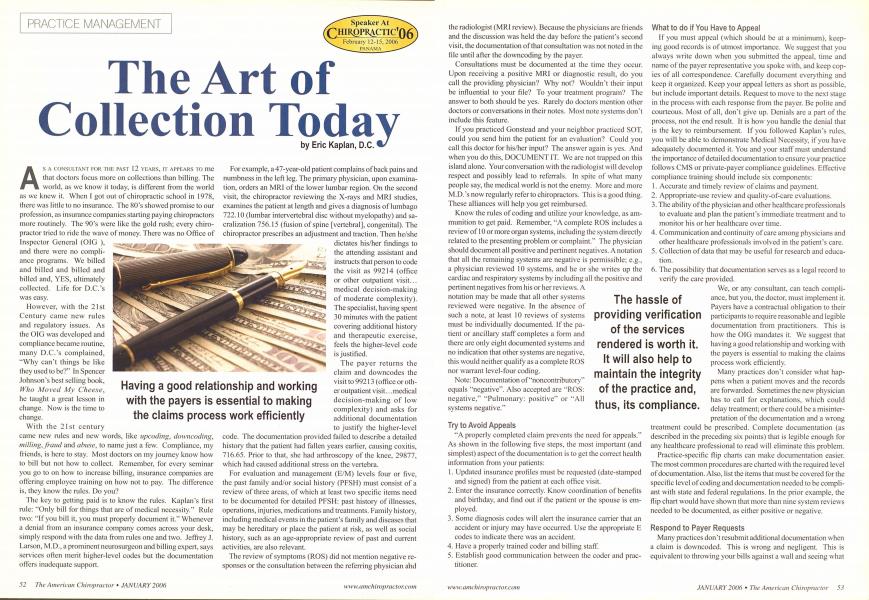
A S A CONSULTANT FOR TIIIC PAST 12 YI-ARS. IT APPIiARS TO 1T1C that doctors focus more on collections than billing. The world, as we know it today, is different from the world as we knew it. When I got out of chiropractic school in 1978, there was little to no insurance. The 80's showed promise to our profession, as insurance companies starting paying chiropractors more routinely. The 90's were like the gold rush; every chiropractor tried to ride the wave of money. There was no Office of Inspector General (OIG ), and there were no compliance programs. We billed and billed and billed and billed and, YES, ultimately collected. Life for D.C.'s was easy. However, with the 21st Century came new rules and regulatory issues. As the OIG was developed and compliance became routine, many D.C.'s complained, "Why can't things be like they used to be?" In Spencer Johnson's best selling book, Who Moved My Cheese, he taught a great lesson in change. Now is the time to change. With the 21st century came new rules and new words, like upending, downcoding, milling, fraud and abuse, to name just a few. Compliance, my friends, is here to stay. Most doctors on my journey know how to bill but not how to collect. Remember, for every seminar you go to on how to increase billing, insurance companies arc offering employee training on how not to pay. The difference is, they know the rules. Do you? The key to getting paid is to know the rules. Kaplan's first rule: "Only bill for things that arc of medical necessity." Rule two: "If you bill it, you must properly document it." Whenever a denial from an insurance company comes across your desk, simply respond with the data from ailcs one and two. Jeffrey J. Larson, M.D., a prominent neurosurgeon and billing expert, says services often merit higher-level codes but the documentation oilers inadequate support. For example, a 47-year-old patient complains of back pains and numbness in the left leg. The primary physician, upon examination, orders an MRI of the lower lumbar region. On the second visit, the chiropractor reviewing the X-rays and MRI studies, examines the patient at length and gives a diagnosis of lumbago 722.10 (lumbar intervertebral disc without myelopathy) and sa-cralization 756.15 (fusion of spine [vertebral], congenital). The chiropractor prescribes an adjustment and traction. Then he/she dictates his/her findings to the attending assistant and instructs that person to code the visit as 99214 (office or other outpatient visit... medical decision-making of moderate complexity). The specialist, having spent 30 minutes with the patient covering additional history and therapeutic exercise, feels the higher-level code is justified. The payer returns the claim and downcodes the visit to 99213 (office or other outpatient visit.. .medical decision-making of low complexity) and asks for additional documentation to justify the higher-level code. The documentation provided failed to describe a detailed history that the patient had fallen years earlier, causing coxitis, 716.65. Prior to that, she had arthroscopy of the knee, 29877, which had caused additional stress on the vertebra. For evaluation and management (E/M) levels four or five, the past family and/or social history (PFSH) must consist of a review of three areas, of which at least two specific items need to be documented for detailed PFSH: past history of illnesses, operations, injuries, medications and treatments. Family history, including medical events in the patient's family and diseases that may be hereditary or place the patient at risk, as well as social history, such as an age-appropriate review of past and current activities, are also relevant. The review of symptoms (ROS) did not mention negative responses or the consultation between the referring physician ahd Speaker At February 12-15.2006 PANAMA the radiologist (MRI review). Because the physicians arc friends and the discussion was held the day before the patient's second visit, the documentation of that consultation was not noted in the file until after the downcoding by the payer. Consultations must be documented at the time they occur. Upon receiving a positive MRI or diagnostic result, do you call the providing physician? Why not? Wouldn't their input be influential to your file? To your treatment program? The answer to both should be yes. Rarely do doctors mention other doctors or conversations in their notes. Most note systems don't include this feature. If you practiced Gonstead and your neighbor practiced SOT, could you send him the patient for an evaluation? Could you call this doctor for his/her input? The answer again is yes. And when you do this, DOCUMENT IT. We arc not trapped on this island alone. Your conversation with the radiologist will develop respect and possibly lead to referrals. In spite of what many people say, the medical world is not the enemy. More and more M.D.'s now regularly refer to chiropractors. This is a good thing. These alliances will help you get reimbursed. Know the ailcs of coding and utilize your knowledge, as ammunition to get paid. Remember, "A complete ROS includes a review of 10 or more organ systems, including the system directly related to the presenting problem or complaint." The physician should document all positive and pertinent negatives. A notation that all the remaining systems are negative is permissible; e.g.. a physician reviewed 10 systems, and he or she writes up the cardiac and respiratory systems by including all the positive and pertinent negatives from his or her reviews. A notation may be made that all other systems reviewed were negative. In the absence of such a note, at least 10 reviews of systems must be individually documented. If the patient or ancillary staff completes a fonn and there are only eight documented systems and no indication that other systems arc negative, this would neither qualify as a complete ROS nor warrant level-four coding. Note: Documentation of "noncontributory" equals "negative". Also accepted are "ROS: negative," "Pulmonary: positive" or "All systems negative." Try to Avoid Appeals "A properly completed claim prevents the need for appeals." As shown in the following fixe steps, the most important (and simplest) aspect of the documentation is to get the correct health information from your patients: Updated insurance profiles must be requested (date-stamped and signed) from the patient at each office visit. Enter the insurance correctly. Know coordination of benefits and birthday, and find out if the patient or the spouse is em ployed. Some diagnosis codes will alert the insurance carrier that an accident or injury may have occurred. Use the appropriate E codes to indicate there was an accident. Have a properly trained coder and billing staff. Establish good communication between the coder and prac titioner. What to do if You Have to Appeal If you must appeal (which should be at a minimum), keeping good records is of utmost importance. We suggest that you always write down when you submitted the appeal, time and name of the payer representative you spoke with, and keep copies of all correspondence. Carefully document everything and keep it organized. Keep your appeal letters as short as possible, but include important details. Request to move to the next stage in the process with each response from the payer. Be polite and courteous. Most of all. don't give up. Denials are a part of the process, not the end result. It is how you handle the denial that is the key to reimbursement. If you followed Kaplan's rules, you will be able to demonstrate Medical Necessity, if you have adequately documented it. You and your staff must understand the importance of detailed documentation to ensure your practice follows CMS or private-payer compliance guidelines. Effective compliance training should include six components: Accurate and timely review of claims and payment. Appropriate-use review and quality-of-care evaluations. The ability of the physician and other healthcare professionals to evaluate and plan the patient's immediate treatment and to monitor his or her healthcare over time. Communication and continuity of care among physicians and other healthcare professionals involved in the patient's care. Collection of data that may be useful for research and educa tion. The possibility that documentation serves as a legal record to verify the care provided. We, or any consultant, can teach compliance, but you. the doctor, must implement it. Payers have a contractual obligation to their participants to require reasonable and legible documentation from practitioners. This is how the OIG mandates it. We suggest that having a good relationship and working with the payers is essential to making the claims process work efficiently. Many practices don't consider what happens when a patient moves and the records are forwarded. Sometimes the new physician has to call for explanations, which could delay treatment: or there could be a misinterpretation of the documentation and a wrong treatment could be prescribed. Complete documentation (as described in the preceding six points) that is legible enough for any healthcare professional to read will eliminate this problem. Practice-specific flip charts can make documentation easier. The most common procedures arc charted with the required level of documentation. Also, list the items that must be covered for the specific level of coding and documentation needed to be compliant with state and federal regulations. In the prior example, the flip chart would have sliown that more than nine system reviews needed to be documented, as either positive or negative. Respond to Payer Requests Many practices don't rcsubmit additional documentation when a claim is downcoded. This is wrong and negligent. This is equivalent to throwing your bills against a wall and seeing what sticks. If it sticks, you get paid. You should expect to receive every penny of what you bill. If your work and treatment were necessary, then you should have a clear conscience in collecting the monies due you. I suggest that you follow up with the payer, and, for a level-four or -five E/M code, be prepared to send additional documentation by having copies ready for rcsubmission. Make sure to include the patient's history or ROS sheet, if the physician refers to it in his or her notes. If you spoke to other doctors, reviewed MRTs or other diagnostic testing, include them in your rebuttal. If you ignore downcoding, you may raise flags to Medicare or private payers, suggesting that there may be an intentional upcoding compliance violation. It is important to respond to show that your office had justification for filing the claim and that you have documentation to prove it. Also send a copy of this to your patient. The insurance company never hesitates to copy the client when denying your claim. Let them know you arc working on their behalf, that the treatment rendered was necessary, and let them see your documentation. Standing up for what is right is never wrong. There is a lot of money lost because practices do not respond to a payer's request for documentation. The hassle of providing verification of the services rendered is worth it. It will also help to maintain the integrity of the practice and, thus, its compliance. This is not only the path of the future, it is the road of today. We, as chiropractors, are well schooled and trained. Let your files and all correspondence with insurance carriers reflect this. By implementing these simple tips you will sec an improvement in your collections, while improving basic compliance. To send a bill and expect to be paid without further documentation is living in the past. Documentation and compliance are here to stay. The future is bright when our vision is guided by the rules. Ultimately, the implementation of the rules will govern your success. Milton said, "The brain is an amazing instrument. It can turn a Heaven into Hell, or a Hell into Heaven." You make the choice. Dr. Eric S. Kaplan, is CEO <>/ Miilliili.sciplinan' Business Applications. Inc. (MBA), a comprehensive coaching firm with a successful, documented history of creating profitable miilliiliscipliiuny practices nationwide. For more information, call 56I-626-5OO-I.