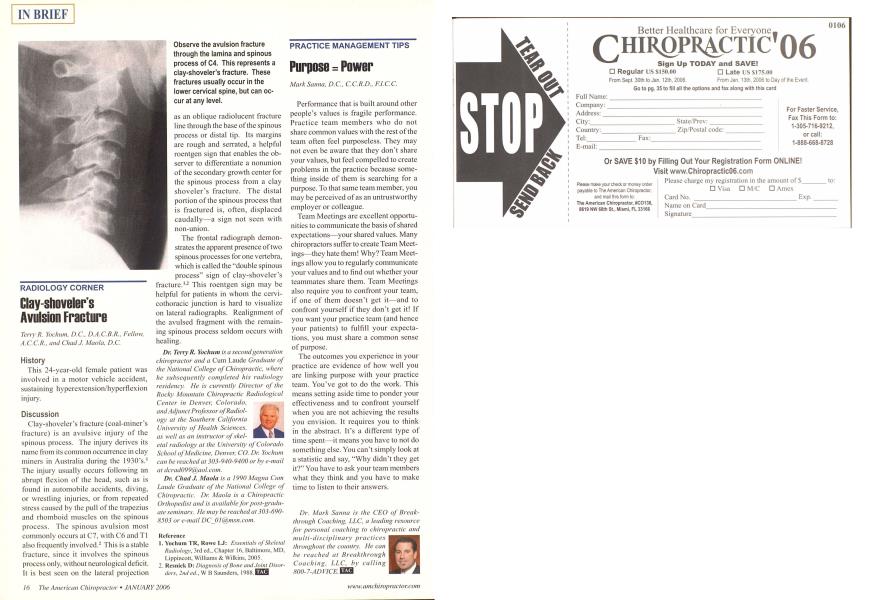
History This 24-year-old female patient was invoked in a motor vehicle accident, sustaining hyperextension/hyperflexion injury. Discussion Clay-shovclcr's fracture (coal-miner's fracture) is an avulsive injury of the spinuus process. The injury derives its name from its common occurrence in clay miners in Australia during the 1930's.1 The injury usually occurs following an abrupt flexion of the head, such as is found in automobile accidents, diving, or wrestling injuries, or from repeated stress caused by the pull of the trapezius and rhomboid muscles on the spinous process. The spinous avulsion most commonly occurs at C7, with C6 and Tl also frequently involved.2 This is a stable fracture, since it involves the spinous process only, without neurological deficit. It is best seen on the lateral projection as an oblique radiolucent fracture line through the base of the spinous process or distal tip. Its margins are rough and serrated, a helpful roentgcn sign that enables the observer to differentiate a nonunion of the secondary growth center for the spinous process from a clay shovelcr's fracture. The distal portion of the spinous process that is fractured is, often, displaced caudally—a sign not seen with non-union. The frontal radiograph demonstrates the apparent presence of two spinous processes for one vertebra, which is called the "double spinous process" sign of clay-shoveler's fracture.1-2 This roentgen sign may be helpful for patients in whom the ccrvi-cothoracic junction is hard to visualize on lateral radiographs. Realignment of the avulsed fragment with the remaining spinous process seldom occurs with healing. Dr. Terry R. Yochum is a second generation chiropractor ant! a Cum Laude Graduate of the National College of Chiropractic, where he subsequently completed his radiology residency. He is currently Director of the Rocky Mountain Chiropractic Radiological Center in Denver, Colorado, and Adjunct Professor of Radiology at the Southern California University of Health Sciences, as well as an instructor of skel- etal radiology at the University of Colorado School of Medicine, Denver, CO. Dr. Yochuni can be reached at 303-940-9400 or by e-mail at dcrad099(aaol.coin. Dr. Chad J. Maola is a 1990 Magna Cum Laude Graduate of the National College of Chiropractic. Dr. Maola is a Chiropractic Orthopedist and is available for post-graduate seminars. He may he reached at 303-690-S503 or e-mail DC _0Kaimsn.com. Reference Yochuni TR, Rowc LJ: Essentials of Skeletal Kutliolofiv, 3rd cd.. Chapter 16. Baltimore, MD, Lippincott, Williams & Wilkins, 2005. Kesnick I): Diagnosis of Bone and .faint Disor ders, 2mled., W B Saunders, 19X8.1