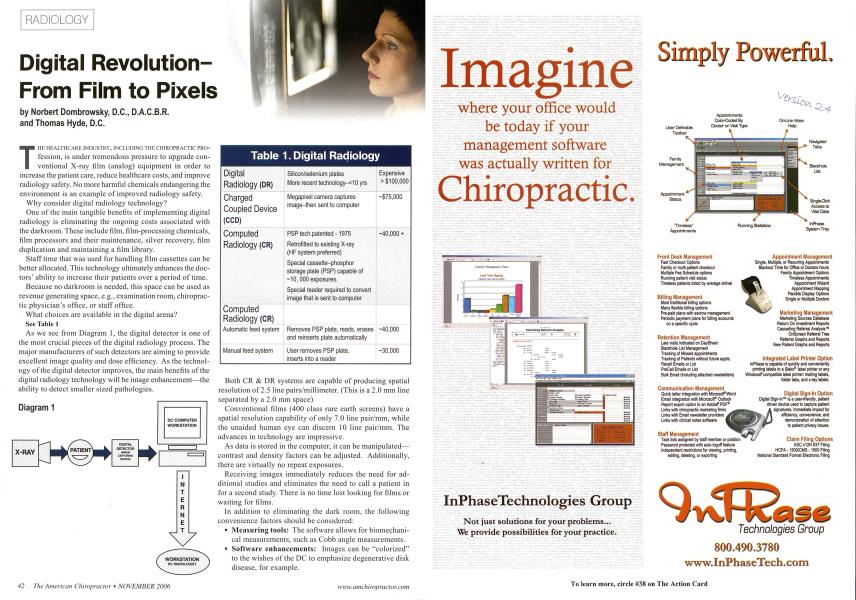
T HE HEALTHCARE INDUSTRY, INCLUDING THE CHIROPRACTIC PRO-fession, is under tremendous pressure to upgrade conventional X-ray film (analog) equipment in order to increase the patient care, reduce healthcare costs, and improve radiology safety. No more harmful chemicals endangering the environment is an example of improved radiology safety. Why consider digital radiology technology? One of the main tangible benefits of implementing digital radiology is eliminating the ongoing costs associated with the darkroom. These include film, film-processing chemicals, film processors and their maintenance, silver recovery, film duplication and maintaining a film library. Staff time that was used for handling film cassettes can be better allocated. This technology ultimately enhances the doctors' ability to increase their patients over a period of time. Because no darkroom is needed, this space can be used as revenue generating space, e.g., examination room, chiropractic physician's office, or staff office. What choices are available in the digital arena? See Table 1 As we see from Diagram 1, the digital detector is one of the most crucial pieces of the digital radiology process. The major manufacturers of such detectors are aiming to provide excellent image quality and dose efficiency. As the technology of the digital detector improves, the main benefits of the digital radiology technology will be image enhancement—the ability to detect smaller sized pathologies. Both CR & DR systems are capable of producing spatial resolution of 2.5 line pairs/millimeter. (This is a 2.0 mm line separated by a 2.0 mm space) Conventional films (400 class rare earth screens) have a spatial resolution capability of only 7.0 line pair/mm, while the unaided human eye can discern 10 line pair/mm. The advances in technology arc impressive. As data is stored in the computer, it can be manipulated— contrast and density factors can be adjusted. Additionally, there are virtually no repeat exposures. Receiving images immediately reduces the need for additional studies and eliminates the need to call a patient in for a second study. There is no time lost looking for films or waiting for films. In addition to eliminating the dark room, the following convenience factors should be considered: Measuring tools: The software allows for biomechani- cal measurements, such as Cobb angle measurements. Software enhancements: Images can be "colorized" to the wishes of the DC to emphasize degenerative disk disease, for example. Table 1. Digital Radiology Digital Silicon/selenium plates Expensive Radiology (DR) More recent technology-<10 yrs > $100,000 Charged Megapixel camera captures -$75,000 Coupled Device image-then sent to computer (CCD) Computed PSP tech.patented -1975 -40,000 + Radiology (CR) Retrofitted to existing X-ray (HF system preferred) Special cassette-phosphor storage plate (PSP) capable of -10,000 exposures. Special reader required to convert image that is sent to computer Computed Radiology (CR) Automatic feed system Removes PSP plate, reads, erases -40,000 and reinserts plate automatically Manual feed system User removes PSP plate, -30,000 inserts into a reader Data storage: The patient's record can be reported into a medical record software program. Transference: Patients can have radiology information burned to CD, which is convenient and transportable. Consultations: Data in the computer can be forwarded via the internet using appropriate DICOMM (digital image and communications in medicine) protocols and HIPPA compliance standards. Your computer profes sional can aid in creating an internet tunnel (VPN—vir tual private network) that moves the images safely across the Internet. The chiropractic physician needs to make sure his system is not only DICOMM compliant but DICOMM enabled (for DICOMM Print, DICOMM Send and DICOMM Modality Worklist); if not, the DC needs to ask that the equipment be made DICOMM enabled. If a chiropractic physician is considering a digital radiology system, a good plan for implementation is a must. The entire process will be less aggravating, less costly, and a more satisfying transition if you have planned for at least the following: Network and network wiring. Adequate connectivity: high speed DSL (digital sub scriber line). Viewing stations: Is one reviewing station sufficient or will each DC in the office require one? These are but a few considerations that require planning with your equipment vendor and computer professional. Today's healthcare delivery system mandates improved efficiency. Digital radiology allows the chiropractic physician to be more productive, actually reduces radiology costs, and provides more time for quality patient care. Dr. Dombrowsky is Chief Radiologist for Pro Imaging, Inc. He can he reached by e-mail at [email protected]. Dr. Hyde is Medical Director for Pro Imaging, Inc. He can be reached via e-mail at [email protected]. For more information about Pro Imaging, Inc., visit www.proimagingDC.com. REFERENCES: Gater, Laura, Getting Digital Radiology on Track. Radiology Today: Vol.7 No. 8 p. April 2006 Orenstein, Beth. W. CR vs. DR-The Digital X-ray Decision - Radiol ogy Today;Vo\.l #12 p. 10. June 2006 Kyes, Kris, The Digital Dilemma: Orthopedic Technology Review; Jul-Aug. 2006 Fischer, Fred, Digital Imaging gives high tech benefits. Chiropractic Economics; Vol.52 Issue 13, Aug. 30, 2006. Yochum, Terry R., Digital Imaging Is Here: Time to do away with you darkroom forever! Dynamic Chiropractic, Vol.24 Issue 08, April 10,2006. Pate, Deborah, Digital X-Rays. Dynamic Chiropractic, Vol. 21 Issue 21, Oct. 6,2003. www.gehealthcarc.com/uscn/xr/radio/product Bushong, Stewart C, Radio/ogic Science for Technologists: 6th. Ed. 1997, p. 194. EH