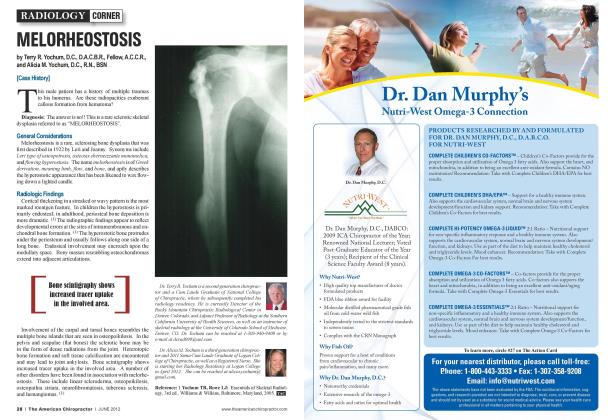
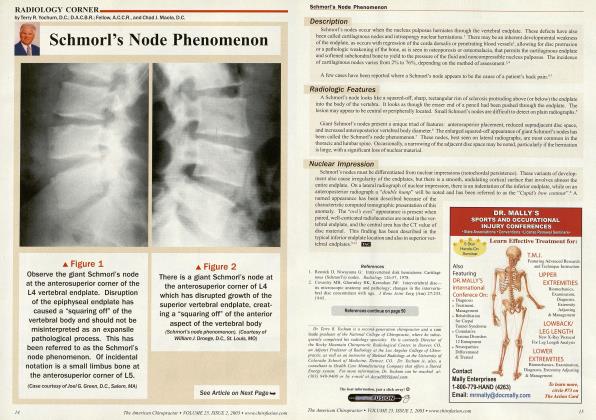
Case History: This 13 year old female presents with suboccipital pain and tenderness. Diagnosis: Ostcoh tic destruction of the C2 lamina and spinous process from an ancurysmal bone cyst (ABC). General Considerations Ancurysmal bone cyst (ABC) is a non-ncoplastic solitary lesion of bone consisting of a cystic cavity filled with blood. ABC is the only bone lesion that derives its name from its rocntgen appearance rather than from its histology. (1) The lesion is neither an ancurysm nor a tnic cyst, but is made of channels containing flowing blood. (1) Incidence: Ancurysmal bone cysts represent approximately one percent of biopsicd primary bone tumors. (1) Clinical Features Age and Sex Distribution ABC occurs in patients between 5 and 20 years of age in 75 percent of the cases. Approximately 60 percent occur in females. (1) Signs And Symptoms The chief complaint of ABC is acute onset of pain at the affected site with a rapid increase in severity over a short period. Spinal ABCs may produce neurological deficits and even complete paraplegia. This occurs because of its marked predilection for the neural arch resulting in spinal stenosis and an "cxtradural" defect. (1) Location In 80 percent of cases, the cysts arc in the long tubular bones and the spine. (1) In the remaining 20 percent of cases. ABCs affect the flat bones and short tubular bones. The femur and tibia arc the most common long tubular bones affected. The thoracic and lumbar spine are the most common spinal areas, with a great predilection for the neural arch (spinous process, transverse process, and lamina). (1) Radiological Features Many lesions may reach 8 to 10 cm in size. The characteristic cortical change is a marked ballooning of a thinned cortex. This cortical bulge has been described as having a "blown out" appearance or as the "fingcr-in-the-balloon sign." (1) Table I Radiological Features of Aneurvsmal Bone Cyst Long Bones: mctaphysis. diaphysis Spine: neural arch, "inflated spine" Geographic Eccentric Expansile Very thin peripheral cortex Light scptations Marginal periostcal buttress A spinal ABC creates a grossly expansile lytic lesion, usually of the neural arch (spinous process, transverse process, or lamina), which usually lacks any scptation. (1) This appearance may be called the "inflated spine." The thoracic and lumbar spine arc prcdilcctcd. The other major entity in the differential diagnosis of neural arch spinal expansile lesions is ostcoblastoma. The age range is similar, but ABC seems to have greater expansile properties. Osteoblastomas may present as a radiopaquc lesion occasionally, facilitating the differential diagnosis. Most osteoblastomas in the spine, however, arc lytic lesions and a biopsy may be the only means of final differentiation. (1) Treatment And Prognosis Surgical curcttagc with bone chip replacement is the usual mode of therapy. Recurrence rates are very high with ABC. approaching 50 percent. (1) Radiation therapy creates sclerosis of the vessels, helping to reduce recurrence rates. Surgical curcttagc remains the treatment of choice. (1) References 1. YochumTR.RoweLJ: The Essentials of Skeletal Radiology. 3rd cd.. Baltimore. Williams & Wilkins. 2005. Dr. Terry R. Yochum is a second generation chiropractor and a Cum Laude Graduate of Sational College of Chiropractic, where he subsequently completed his radiology residency. He is currently Director of the Rocky Mountain Chiropractic Radiological Center in Denver. Colorado, and Adjunct Professor of Radiology at the Southern California University of Health Sciences, as well as an instructor of skeletal radiology at the University of Colorado School of Medicine. Denver. CO. Dr. Yochum can be reached at 1-303-940-9400 or by e-mail at dcrad099djiol.com Dr. Alicia .\ I. Yochum is a third generation chiropractor and 201! Suma Cum Laude Graduate of Logan College of Chiropractic, as well as a Registered Surse. She is in a Radiology residency at Logan College in St. Louis, MO. She can be reached at alicia.yochumfagmail.com.