Effective Phone Communication
Keith Giaquinto
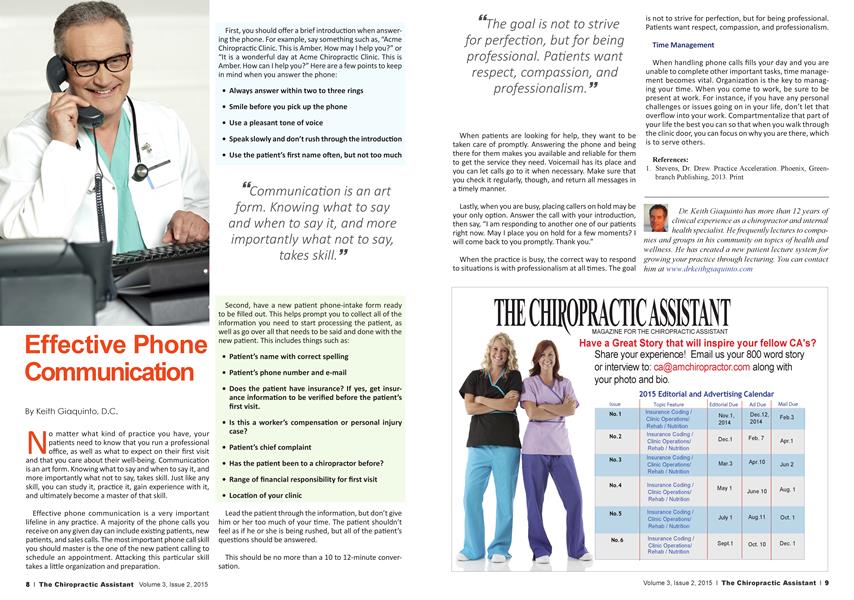
No matter what kind of practice you have, your patients need to know that you run a professional office, as well as what to expect on their first visit and that you care about their well-being. Communication is an art form. Knowing what to say and when to say it, and more importantly what not to say, takes skill. Just like any skill, you can study it, practice it, gain experience with it, and ultimately become a master of that skill.
Effective phone communication is a very important lifeline in any practice. A majority of the phone calls you receive on any given day can include existing patients, new patients, and sales calls. The most important phone call skill you should master is the one of the new patient calling to schedule an appointment. Attacking this particular skill takes a little organization and preparation.
First, you should offer a brief introduction when answering the phone. For example, say something such as, "Acme Chiropractic Clinic. This is Amber. How may I help you?" or "It is a wonderful day at Acme Chiropractic Clinic. This is Amber. How can I help you?" Here are a few points to keep in mind when you answer the phone:
• Always answer within two to three rings
• Smile before you pick up the phone
• Use a pleasant tone of voice
• Speak slowly and don't rush through the introduction
• Use the patient's first name often, but not too much
“Communication is an art form. Knowing what to say and when to say it, and more importantly what not to ; takes skill.
Second, have a new patient phone-intake form ready to be filled out. This helps prompt you to collect all of the information you need to start processing the patient, as well as go over all that needs to be said and done with the new patient. This includes things such as:
• Patient's name with correct spelling
• Patient's phone number and e-mail
• Does the patient have insurance? If yes, get insurance information to be verified before the patient's first visit.
• Is this a worker's compensation or personal injury case?
• Patient's chief complaint
• Has the patient been to a chiropractor before?
• Range of financial responsibility for first visit
• Location of your clinic
Lead the patient through the information, but don't give him or her too much of your time. The patient shouldn't feel as if he or she is being rushed, but all of the patient's questions should be answered.
This should be no more than a 10 to 12-minute conversation.
I he goal is not to strive for perfection, but for being professional. Patients want respect, compassion, and professionalism. ”
When patients are looking for help, they want to be taken care of promptly. Answering the phone and being there for them makes you available and reliable for them to get the service they need. Voicemail has its place and you can let calls go to it when necessary. Make sure that you check it regularly, though, and return all messages in a timely manner.
Lastly, when you are busy, placing callers on hold may be your only option. Answer the call with your introduction, then say, "I am responding to another one of our patients right now. May I place you on hold for a few moments? I will come back to you promptly. Thank you."
When the practice is busy, the correct way to respond to situations is with professionalism at all times. The goal
is not to strive for perfection, but for being professional. Patients want respect, compassion, and professionalism.
Time Management
When handling phone calls fills your day and you are unable to complete other important tasks, time management becomes vital. Organization is the key to managing your time. When you come to work, be sure to be present at work. For instance, if you have any personal challenges or issues going on in your life, don't let that overflow into your work. Compartmentalize that part of your life the best you can so that when you walkthrough the clinic door, you can focus on why you are there, which is to serve others.
References:
1. Stevens, Dr. Drew. Practice Acceleration. Phoenix, Greenbranch Publishing, 2013. Print
Dr. Keith Giaquinto has more than 12 years of clinical experience as a chiropractor and internal health specialist. He frequently lectures to companies and groups in his community on topics of health and wellness. He has created a new patient lecture system for growing your practice through lecturing. You can contact him at www.drkeithgiaquinto.com