A Doctor of Selling Three Keys to Building Relationships
By Eric Kaplan, DC, FIAMA
PRACTICE MANAGEMENT
When I graduated NYCC in 1979,1 had nothing. I then moved to Florida, where I knew no one. I had one great gift that I share with you today—desire.
Desire to succeed and fear of failure. Anthony Robbins would call this neurolinguistic programing, and it worked for me. You went to school to be a doctor not a simple salesperson. You can deliver chiropractic and be successful without being a pure salesperson, but just by being a better doctor.
My consulting philosophy has always been to be the best doctor possible. Stop looking for get rich schemes and the magic ad—the secret lies inside of you.
There is an old Chinese proverb that states, “When the student is ready, the teacher will appear.” Ai e you ready? Ai e you ready to grow your practice and reach your potential?
Top professionals don’t just see themselves as “doctors of selling.” They see themselves as professionals, well educated, acting in their patients’ best interests, and bound by a high code of ethics.
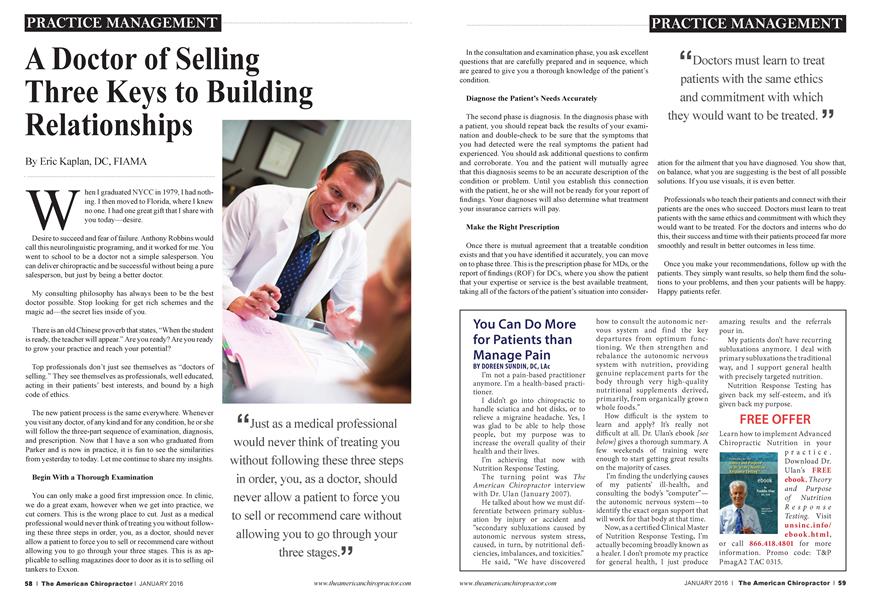
The new patient process is the same everywhere. Whenever you visit any doctor, of any kind and for any condition, he or she will follow the three-part sequence of examination, diagnosis, and prescription. Now that I have a son who graduated from Parker and is now in practice, it is fim to see the similarities from yesterday to today. Let me continue to share my insights.
Begin With a Thorough Examination
You can only make a good first impression once. In clinic, we do a great exam, however when we get into practice, we cut comers. This is the wrong place to cut. Just as a medical professional would never think of treating you without following these three steps in order, you, as a doctor, should never allow a patient to force you to sell or recommend care without allowing you to go through your three stages. This is as applicable to selling magazines door to door as it is to selling oil tankers to Exxon.
■ "Just as a medical professional would never think of treating you without following these three steps in order, you, as a doctor, should never allow a patient to force you to sell or recommend care without allowing you to go through your three stages. 5 5
In the consultation and examination phase, you ask excellent questions that are carefully prepared and in sequence, which ai e geared to give you a thorough knowledge of the patient’s condition.
Diagnose the Patient’s Needs Accurately
The second phase is diagnosis. In the diagnosis phase with a patient, you should repeat back the results of your examination and double-check to be sure that the symptoms that you had detected were the real symptoms the patient had experienced. You should ask additional questions to confirm and corroborate. You and the patient will mutually agree that this diagnosis seems to be an accurate description of the condition or problem. Until you establish this connection with the patient, he or she will not be ready for your report of findings. Your diagnoses will also determine what treatment your insurance carriers will pay.
Make the Right Prescription
Once there is mutual agreement that a treatable condition exists and that you have identified it accurately, you can move on to phase three. This is the prescription phase for MDs, or the report of findings (ROF) for DCs, where you show the patient that your expertise or service is the best available treatment, taking all of the factors of the patient’s situation into consider-
^Doctors must learn to treat patients with the same ethics and commitment with which they would want to be treated. 5 5
ation for the ailment that you have diagnosed. You show that, on balance, what you are suggesting is the best of all possible solutions. If you use visuals, it is even better.
Professionals who teach their patients and connect with their patients are the ones who succeed. Doctors must learn to treat patients with the same ethics and commitment with which they would want to be treated. For the doctors and interns who do this, their success and time with their patients proceed far more smoothly and result in better outcomes in less time.
Once you make your recommendations, follow up with the patients. They simply want results, so help them find the solutions to your problems, and then your patients will be happy. Happy patients refer.
Follow Your Dreams
66
It never ceases to amaze me how much time people waste by searching endlessly for magical shortcuts to entrepreneurial success and fulfillment, when the only real
path is staling them right in the face—real entrepreneurs who start real businesses that employ real people who provide real products and services to real customers.
Yes, I know that’s hard. It’s a lot of work. What can I say? That’s life. Besides, look on the bright side. You get to do what you want, and you get to do it your way. There’s just one catch—you’ve got to start somewhere. Ideas and opportunities don’t just materialize out of thin air.
The only way I know to get started is by learning a marketable skill and getting to work. In my experience, that’s where the ideas, opportunities, partners, and finances always seem to come from. Sure, it also takes an enormous amount of hard work, but that just comes with the territory.
If you want to do entrepreneurship right, here are eight stories that you’ve probably never heard about recognizable, successful companies.
The only way I know to get started is by learning a marketable skill and getting to work.??
The Piene Omidyar way. In 1995, a computer programmer started auctioning off stuff on his personal website. Auction Web, as it was known then, was really just a personal project, but when the amount of web traffic made it necessary to upgrade to a business Internet account, Omidyar had to start charging people fees. He actually hired his first employee to handle all of the payment checks. The site is now known as eBay.
The John Ferolito and Don Vultaggio way. Back in the 1970s, a couple of Brooklyn friends started a beer distributor out of the back of an old Volkswagen bus. Two decades later, after seeing how well Snapple was doing, they decided to try their hand at soft drinks and launched Arizona Green Tea. Today, Arizona teas aie number one in America and distributed worldwide. The friends still own the company.
The Matt Maloney and Mike Evans way. When a couple of Chicago software developers working on lookup searches for Apartments.com got sick of calling restaurants in search of takeout food for dinner, the lightbulb went off: Why isn’t there a one-stop shop for food delivery? That’s when the pair decided to start GrubHub, which went public last April and is now valued at more than $3 billion.
The Joe Coulombe way. After operating a small chain of convenience stores in southern California, Joe Coulombe had that the idea that upwardly mobile college grads might want something better than 7-Eleven. So he opened a tropicalthemed market in Pasadena, stocked it with good wine and booze, hired good people, and paid them well. He added more locations near universities and then healthy foods, and that’s how Trader Joe’s got started.
The Howard Schultz way. A trip to Milan gave a young marketer working for a Seattle coffee bean roaster the idea for upscale espresso cafes like those he saw all over Italy. His employer had no interest in owning coffee shops, but he still agreed to finance Schultz’s endeavor. They even sold him their brand name, Starbucks.
The Phil Robertson way. There was a guy who loved duck hunting so much that he chose to do that instead of playing professional football for the NFL. He invented a duck call and started a company called Duck Commander. He eventually put his son Willy in charge and that spawned a media and merchandising empire for a family of rednecks known as Duck Dynasty.
The Konosuke Matsushita way. In Japan in 1917, a 23-year-old apprentice at the Osaka Electric Light Company who had no formal education came up with an improved light socket. His boss wasn’t interested, so young Matsushita
started making samples in his basement. He later expanded with battery-powered bicycle lamps and other electronic products. Matsushita Electric, as it was known until 2008 when the company officially changed its name to Panasonic, is now worth $66 billion.
The Steve Wozniak and Steve Jobs way. While they had been friends since high school, the two college dropouts gained considerable exposure to the computer world while working on game software together on the night shift at Atari. The third Apple founder, Ron Wayne, was also an Atari alumnus.
As I always say, the world is full of infinite possibilities and countless opportunities, but your life and career are finite, meaning you have limited time to find what you’re searching for and to make your mark on the world. This is your time. It’s limited, so don’t waste it. Find something you like to do and just do it. That’s how real entrepreneurs always start.
Dr Eric S. Kaplan, a former President COO of a NASAQ traded public company, which includedNutrisystem, Currently he is CEO of Concierge Coaches, Inc., www. conciergecoaches. com, a comprehensive coaching firm with a successful, docu mented history of assisting doctors create profitable practices
nationwide, providing over 3ONew Patient marketingPrograms. Dr Kaplan is a member of the adjunct faculty at Parker. Parker University now offers a National Certification course on spinal decompression. For more information on coaching or spinal decompression, call 1-561-626-3004.