Chiropractic as the Solution for Mechanical Spine Failure and Failed Back Surgery
PERSPECTIVE
Mark Studin
DC, FASBE(C), DAAPM,
DAAMLP
William J. Owens
DAAMLP
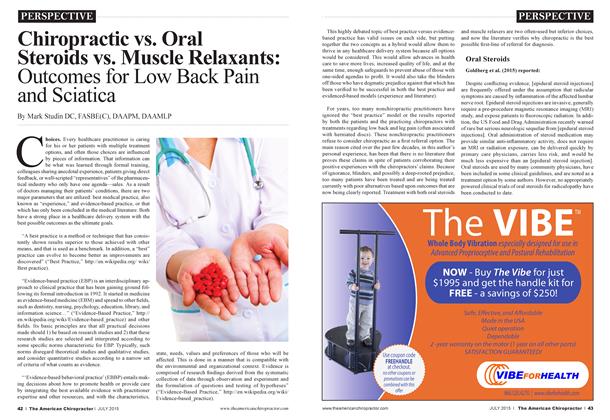
The latest CDC statistics show that, in 2012, 54 out of 100 people had self-reported musculoskeletal conditions. By way of comparison, that is six times more than self-reported cases of cancer, double that of respiratory disease, and one-third more than circulatory disorders. If we extrapolate that to a more current population in the United States of 321 million, that equates to 173 million people reporting musculoskeletal problems in 2012. Many of these are spine patients who suffer long term without any type of biomechanical assessment or functional case management.
In 2013, Itz, Geurts, van Kleef, and Nelemans reported, “Nonspecific low back pahi [LBP] is a relatively common and recurrent condition with major medical and economic implications for which today there is no effective cure” (p. 5). The idea that spinal pain has a “natural history” resulting in a true resolution of symptoms is a myth, and the concept that spine pain should only be treated in the acute phase for a few visits has no support in the literature. We don’t address cardiovascular disease in this manner (i.e., wait until you have a heart attack to treat), we don’t follow this procedure with dentistry (i.e., wait until you need a root canal to treat), and we certainly don’t handle metabolic disorders such as diabetes in this way (i.e., wait until you have diabetic ulcers or advanced vascular disease to treat). Why does health care fall short with spinal conditions despite the compelling literature that states the opposite in treatment outcomes?
The front lines of medical care for spine-related pain is typically the prescription of pain medication, particularly at the emergency care level, and then if that doesn’t work, a referral is made to physical therapy. If physical therapy is unsuccessful, the final referral is to a surgeon. If the surgeon does not intervene with surgery, then the diagnosis becomes “nonspecific back
54 out of 100 DeoDle had self-reported musculoskeletal conditions. By way of comparison, that is six times more than self-reported cases of cancer
pain,” and the patient is given stronger medication since there is nothing the surgeon can do. For surgical interventions that result in persistent pain, a commonly reported problem, there is an ICD-10 diagnosis for failed spine surgery—M96.1
In a recent article, Ordia and Vaisman (2011) described this syndrome a bit further stating, “We propose that these terms [post-laminectomy syndrome or failed back syndrome] should be replaced with post-surgical spine syndrome (PSSS)” (p. 132). They continued by reporting, “The incidence of PSSS may be reduced by a meticulous neurological examination and careful patient selection. The facet and sacroiliac joints should always be examined, particularly when the pain is predominantly in the lower back, or when it radiates only to the thigh or groin and not below the knee” (Ordia & Vaisman, 2011, p. 132). The authors finally stated, “Adherence to these simple guidelines can result in a significant reduction in the pain and suffering, as also the enormous financial cost of PSSS” (Ordia & Vaisman, 2011, p. 132). They are referring to a careful distinction between “anatomical” and “biomechanical” cause of the sphie pain.
According to Mulholland (2008), “[Surgery] Spinal fusion became what has been termed the ‘gold standard’ for the treatment of mechanical low back pain, yet there was no scientific
basis for this” (p. 619). He continued, “However whilst that fusion [surgery] may be very effective in stopping movement, it was deficient in relation to load transfer” (Mulholland, 2008, p. 623). He concluded, “The concept of instability as a cause of back pain is a myth. The clinical results of any procedure that allows abnormal disc loading to continue are unpredictable” (Mulholland, 2008, p. 624). Shnply put, surgery does not correct the underlying biomechanical failure or the cause of the pain.
When a biomechanical assessment is lacking, the patient’s pain persists and allopathic medicine focuses on “managing the pain” versus correcting the underlying biomechanical lesion/ pathology /imbalance, and the medication of choice at this point in care has been opioid analgesics. Back in 2011, the CDC reported, “Sales of OPR quadrupled between 1999 and 2010. Enough OPR were prescribed last year [2010] to medicate every American adult with a standard pain treatment dose of 5 mg of hydrocodone (Vicodin and others) taken every four hours for a month” (p. 1489). That was six year s ago, which was when people began to feel that treating musculoskeletal pain with narcotics was trending in the wrong direction. Now, in 2016, we can see there is a problem of epidemic proportions to the point that MDs are changing how they refer spine patients for diagnosis and treatment.
Dowell, Haegerich, and Chou (2016), along with the CDC, published updated guidelines relating to the prescription of opioid medication:
Oprord parn medrcatron use presents serrous risks, mcluding overdose and opioid use disorder. From 1999 to 2014, more than 165,000 persons died from overdose related to opioid pain medication in the United States. In the past decade, while the death rates for the top leading causes of death such as heart disease and cancer have decreased substantially, the death rate associated with opioid pain medication has increased markedly.
... a recent study of patients aged 15-64 years receiving opioids for chr onic noncancer pain and followed for up to 13 year s revealed that one in 550 patients died from opioidrelated overdose at a median of 2.6 years from their first opioid prescription, and one in 32 patients who escalated to opioid dosages >200 morphine milligram equivalents (MME) died from opioid-related overdose, (p. 2)
Clearly, there needs to be a nationwide standard for the process by which patients with spine pain are handled, including academic and clinical leadership on spinal biomechanics. The only profession that is poised to accomplish such a task is chiropractic.
In a recent study by Houweling et al. (2015), the authors reported, “The purpose of this study was to identify differences in outcomes, patient satisfaction, and related healthcare costs in spinal, hip, and shoulder pain patients who initiated care with medical doctors (MDs) versus those who initiated care with doctors of chiropractic (DCs) in Switzerland” (p.
477). This is an important study that continually demonstrates maintaining access to chiropractic care is critical for both acute and chronic pain.
We can also see from current utilization statistics that chiropractic care is underutilized on a major scale. The authors also state, “Although patients may be comanaged with other medical colleagues or paramedical providers (e.g., physiotherapists), treatment for the same complaint may vary according to the type of first-contact provider. For instance, MDs tend to use medication, including analgesics, muscle relaxants, and anti-inflammatory agents, for the treatment of acute nonspecific spinal pain, whereas DCs favor spinal manipulative therapy as the primary treatment for this condition” (Houweling et al., 2015, p. 478). They continue by stating, “This study showed that spinal, hip, and shoulder pain patients had modestly higher pain relief and satisfaction with care at lower overall cost if they initiated care with DCs, when compared with those who initiated care with MDs” (Houweling et al., 2015, p. 480). Overall, when taking cost into consideration, “Mean total spinal, hip, and shoulder pain-related healthcare costs per patient during the four-month study period were approximately 40% lower in
■ ■ When a biomechanical assessment is lacking, the patient’s pain persists and allopathic medicine focuses on “managing the pain” versus correcting the underlying biomechanical lesion/pathology/ imbalance 5 5
patients initially consulting DCs compared with those initially consulting MDs” (Houweling et al., 2015, p. 481). The authors concluded, “The findings of this study support first-contact care provided by DCs as an alternative to first-contact care provided by MDs for a select number of musculoskeletal conditions” (Houweling et al., 2015, p. 481).
Based on the literature and outcome studies, backed up with 121 years of doctors of chiropractic and their patients’ testimonies, the time has never been better for the chiropractic profession to move into treating the 93% of the population that is not under care. Chiropractic must be moved from the accepted standard of biomechanical processes in the laboratory to the standard of care for spine beyond fracture, tumor, or infection across all professions, inclusive of physical therapy. The outcomes overwhelmingly support that anything less perpetuates the epidemic of failed back treatments.
References
1. Centers for Disease Control and Prevention. (2015). National hospital discharge survey. Retrieved from: http://www.cdc.gov/nchs/nhds.htm
United States Census Bureau, (n.d.). Quick facts, United States. Retrieved from https:// www.census.gov/quickfacts/
Itz, C. J., Geurts, J. W., van Kleef M., & Nelemans, P. (2013). Clinical course of non specific low back pain: A systematic review of prospective cohort studies set in primary care. European Journal of Pain, 17(1), 5-15. Ordia, J., & Vaisman, J. (2011). Postsurgical. spine syndrome. Surgical Neurology International, 2, 132.
Midholland, R. C. (2008). The myth of lumbar instability: The importance of abnormal loading as a cause of low back pain. European Spine Journal, 17(5), 619-625.
Centers for Disease Control and Prevention. (2011). Vital signs: Overdoses of prescription opioid pain relievers - United States, 1999 - 2008. Morbidity and Mortality Weekly Report, 60(43), 1487-1492.
Dowell, I)., Haegerich, T. M., & Chou, R. (2016). CDC guideline for prescribing opioids for chronic pain - United States, 2016. JAMA, 315(15), 1624-1645.
Houweling, T.A., Braga, A. V, Hausheer, Vogelsang, M., Peterson, C., & Humphreys, B. K. (2015). First-contact care with a medical vs. chiropractic provider after consultation with a swiss telemedicine provider: Comparison of outcomes, patient satisfaction, and health care costs in spinal, hip, and shoulder pain patients. Journal of Manipulative and Physiological Therapeutics, 38(7), 477-483.
f Dr. Mark Studin is an adjunct associate professor of chiropractic at the University of Bridgeport College of Chiropractic; an adjunct professor of clinical scij J ences at Texas Chiropractic College; and a clinical " presenter for the State of New York at Buffalo, School of Medicine and Biomedical Sciences for postdoctoral education, teaching MRI spine interpretation, spinal biomechanical engineering, and triaging trauma cases. He also coordinates a clinical rotation in neuroradiology for chiropractic students at the State University of New York at Stony Brook, School of Medicine, Department of Radiology. Dr Studin is the president of the Academy of Chiropractic teaching doctors of chiropractic how to interface with the medical and legal communities (www. DoctorsPIProgram.com); teaches MRI interpretation and triaging trauma cases to doctors of all disciplines nationally; and studies trends in health care on a national scale (www.TeachDoctors. com). He can be reached at IbrMark a AcademyofChiropraciic. com or at 631-786-4253.
Dr Bill Owens is presently in private practice in Buffalo and Rochester, New York and generates the majority of his new patient referrals directly from the primary care medical community. He is an associate adjunct professor at the State University of New York at Buffalo School of Medicine and Biomedical Sciences and the University of Bridgeport, College of Chiropractic, as well as an adjunct professor of clinical sciences at Texas Chiropractic College. He also works directly with doctors of chiropractic to help them build relationships with medical providers in their community. He can be reached at dr. owens(Tf academy of chiropractic.com, via www.mdreferralprogram.com, or at 716-228-3847.