Interactive Healer Jeffrey Tucker, DC.
INTERVIEW
The American Chiropractor
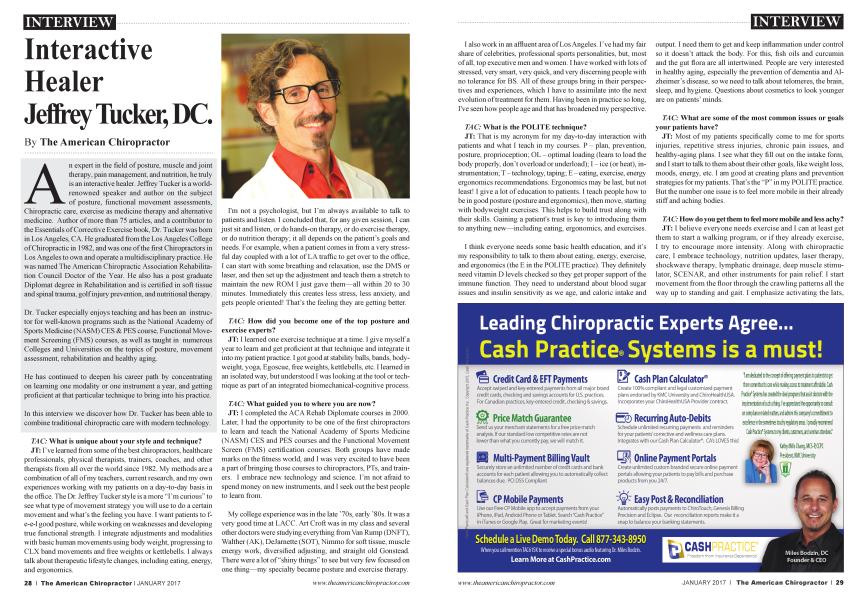
An expert in the field of posture, muscle and joint therapy, pain management, and nutrition, he truly is an interactive healer. Jeffrey Tucker is a worldrenowned speaker and author on the subject of posture, functional movement assessments, Chiropractic care, exercise as medicine therapy and alternative medicine. Author of more than 75 articles, and a contributor to the Essentials of Corrective Exercise book, Dr. Tucker was bom in Los Angeles, CA. He graduated from the Los Angeles College of Chiropractic in 1982, and was one of the first Chiropractors in Los Angeles to own and operate a multidisciplinary practice. He was named The American Chiropractic Association Rehabilitation Council Doctor of the Year. He also has a post graduate Diplomat degree in Rehabilitation and is certified in soft tissue and spinal trauma, golf injury prevention, and nutritional therapy.
Dr. Tucker especially enjoys teaching and has been an instructor for well-known programs such as the National Academy of Sports Medicine (NASM) CES & PES course, Functional Movement Screening (FMS) courses, as well as taught in numerous Colleges and Universities on the topics of posture, movement assessment, rehabilitation and healthy aging.
He has continued to deepen his career path by concentrating on learning one modality or one instrument a year, and getting proficient at that particular technique to bring into his practice.
In this interview we discover how Dr. Tucker has been able to combine traditional chiropractic care with modem technology.
TAC: What is unique about your style and technique?
JT: I’ve learned from some of the best chiropractors, healthcare professionals, physical therapists, trainers, coaches, and other therapists from all over the world since 1982. My methods are a combination of all of my teachers, current research, and my own experiences working with my patients on a day-to-day basis in the office. The Dr. Jeffrey Tucker style is a more “Em curious” to see what type of movement strategy you will use to do a certain movement and what’s the feeling you have. I want patients to fe-e-1 good posture, while working on weaknesses and developing true functional strength. I integrate adjustments and modalities with basic human movements using body weight, progressing to CLX band movements and free weights or kettlebells. I always talk about therapeutic lifestyle changes, including eating, energy, and ergonomics.
I'm not a psychologist, but I’m always available to talk to patients and listen. I concluded that, for any given session, I can just sit and listen, or do hands-on therapy, or do exercise therapy, or do nutrition therapy; it all depends on the patient’s goals and needs. For example, when a patient comes in from a very stressful day coupled with a lot of LA traffic to get over to die office, I can start with some breathing and relaxation, use the DMS or laser, and then set up the adjustment and teach them a stretch to maintain the new ROM I just gave them—all within 20 to 30 minutes. Immediately this creates less stress, less anxiety, and gets people oriented! That’s the feeling they are getting better.
TAC: How did you become one of the top posture and exercise experts?
JT: I learned one exercise technique at a time. I give myself a year to leam and get proficient at that technique and integrate it into my patient practice. I got good at stability balls, bands, bodyweight, yoga, Egoscue, free weights, kettlebells, etc. I learned in an isolated way, but understood I was looking at the tool or technique as part of an integrated biomechanical-cognitive process.
TAC: What guided you to where you are now?
JT: I completed the ACA Rehab Diplomate courses in 2000. Later, I had the opportunity to be one of the first chiropractors to leam and teach the National Academy of Sports Medicine (NASM) CES and PES courses and the Functional Movement Screen (FMS) certification courses. Both groups have made marks on the fitness world, and I was very excited to have been a part of bringing those courses to chiropractors, PTs, and trainers. I embrace new technology and science. I’m not afraid to spend money on new instruments, and I seek out the best people to leam from.
My college experience was in the late ’70s, early ’80s. Itwasa very good time at LACC. Ait Croft was in my class and several other doctors were studying everything from Van Rump (DNFT), Walther (AK), DeJamette (SOT), Nimmo for soft tissue, muscle energy work, diversified adjusting, and straight old Gonstead. There were a lot of “shiny things” to see but very few focused on one thing—my specialty became posture and exercise therapy.
I also work in an affluent area of Los Angeles. I’ve had my fair share of celebrities, professional sports personalities, but, most of all, top executive men and women. I have worked with lots of stressed, very smart, very quick, and very discerning people with no tolerance for BS. All of these groups bring in their perspectives and experiences, which I have to assimilate into the next evolution of treatment for them. Having been in practice so long, I've seen how people age and that has broadened my perspective.
TAC: What is the POLITE technique?
JT: That is my acronym for my day-to-day interaction with patients and what I teach in my courses. P - plan, prevention, posture, proprioception; OL - optimal loading (leam to load the body properly, don’t overload or underload); I - ice (or heat), instrumentation; T - technology, taping; E - eating, exercise, energy ergonomics recommendations. Ergonomics may be last, but not least! I give a lot of education to patients. I teach people how to be in good posture (posture and ergonomics), then move, stalling with bodyweight exercises. This helps to build trust along with their skills. Gaining a patient's trust is key to introducing them to anything new—including eating, ergonomics, and exercises.
I think everyone needs some basic health education, and it’s my responsibility to talk to them about eating, energy, exercise, and ergonomics (the E in the POLITE practice). They debnitely need vitamin D levels checked so they get proper support of the immune function. They need to understand about blood sugar issues and insulin sensitivity as we age, and caloric intake and
output. I need them to get and keep inflammation under control so it doesn’t attack the body. For this, fish oils and curcumin and the gut flora are all intertwined. People are very interested in healthy aging, especially the prevention of dementia and Alzheimer’s disease, so we need to talk about telomeres, the brain, sleep, and hygiene. Questions about cosmetics to look younger are on patients’ minds.
TAC: What are some of the most common issues or goals your patients have?
JT: Most of my patients specifically come to me for sports injuries, repetitive stress injuries, chronic pain issues, and healthy-aging plans. I see what they fill out on the intake form, and I staif to talk to them about their other goals, like weight loss, moods, energy, etc. I am good at creating plans and prevention strategies for my patients. That’s the “P” in my POLITE practice. But the number one issue is to feel more mobile in their already stiff and aching bodies.
TAC: How do you get them to feel more mobile and less achy?
JT: I believe everyone needs exercise and I can at least get them to start a walking program, or if they already exercise, I try to encourage more intensity. Along with chiropractic care, I embrace technology, nutrition updates, laser therapy, shockwave therapy, lymphatic drainage, deep muscle stimulator, SCENAR, and other instruments for pain relief. I start movement from the floor through the crawling patterns all the way up to standing and gait. I emphasize activating the lats,
core, and glutes. I also like to strengthen the scapula stabilizers for good posture. Many people really have dysfunctional motion in the hips and thoracic spine. Restorative flow motions like “groiners” and deep squat sits are amazing—they can really get the body to relax a lot of the tension built up within the spine. I train the three planes of motion—sagittal, frontal, and transverse concepts of motion. Many people are really tight in the ribcage and armpit area when their arms are in an overhead position, so stretching the lateral fascial lines helps a lot.
Many people also have tight ankles and hips. I believe that ankle and hip mobilization is huge for people getting out of movement dysfunctions. Even relatively fit people can have locked up ankles or less rotation in their hips, which will make their gait altered! And of course, we have to talk about eating!
7.1 C: Tell us more about the exercise training.
JT: Patients need to own their own body weight. Each patient is going to go through a series of the dead bug, abdominal bracing, rolling, bird dog, and then to the steps that lead up to standing and gait. I blend in the use of bands for resistance at each step, sometimes around the feet or hands or both. My method brings classic resistance and kettlebell exercises into an upright position while moving in different planes. This also allows patients to get that isolated effect that many people want.
7.1 C: Do you have an example of a key oversight chiropractors make when they’re training an athlete?
JT: That error is forgetting that mobility, stability, proprioception, core strength, overall strength, endurance, and metabolism are qualities we need. Strength is the foundation for all the other physical qualities. People have forgotten that fact. Fashions come and go. Right now, bodyweight and high-intensity interval training are fashionable. A little earlier it was "functional training" and “circuit training”; soon it will be something else. This doesn’t mean that bodyweight training or metabolic training don't have value. They obviously do, but strength is the mother quality. It should never be out of style.
Some people who are very weak do a lot of repetitions with light weight, hying to develop strength endurance. Build some strength to endure.
TAC: What’s a good exercise?
JT: My definition of a “good exercise” is “one a patient will do!” I continue to practice with patients and leam what works and doesn’t work. I like to teach practitioners about the tests and things they are already doing in practice that can become functional and integrate exercise progressions. Pick an assessment, do movement therapy, retest that assessment, and see if it changed for the better. If the patient is better, make that movement something they do at home. Some won't comply, but you’ll see
a higher level of engagement in those who do.
Help patients make a better movement decision. A beginner, intermediate, and advance movement choice needs to be available. We call that progressions. I teach doctors how to design their own programs related to a specific condition.
7.1 C: What’s your favorite exercise?
JT: I really like the Turkish get-up (TGU). It’s one of those fundamental movements because it progresses horn lying to standing, usually with a kettlebell in your hand. It integrates every muscle in your body, and I can use it as an assessment as well as an exercise. If there’s a weak spot somewhere, it helps amplify it. It takes a little time to teach patients the movement pattern, but as you teach it to them, many good changes start happening within their body. The TGU creates flexibility and mobility in the joints, along with the basic strength you need to playfully get up horn the ground with weight.
I do a lot of calf stretching, hip flexor and thoracic spine mobility training. I also like planks—forearms to toes—and side planks. For low back patients, it’s understanding hip action versus
low back movement. I have more experience with die CLX band than any doctor or trainer I know; it really can be used for any back exercise program. My favorite exercises teach patients to feel safer with movement.
7.1 C: What if it’s a weight-loss patient?
JT: For my fat loss program, I use body composition analysis, so I have to get people moving with the right diet. The goal is to increase metabolic demand resulting in fat loss. So I want as much muscle involved as possible to increase metabolism. If we can really get their metabolism driving, we can really get them losing fat. Patients in pain need efficient, duid dow movements, but fat loss patients need to get burning calories. If I need metabolic training, we need to go from the CLX band to the kettlebell. This is a fantastic duo because I can keep the heart rate up while I switch exercises as the body gets fatigued. For example, in a one-minute interval, I might start with 20 seconds of CLX band or kettlebell lunges, and as I get tired, switch to 20 seconds of CLX band swings, then 20 seconds of CLX band or kettlebell overhead presses—all while keeping my heart rate high enough to get an interval training response.
7.1 C: What did you learn from patients who failed or did not progress?
JT: My career depends on the level of my patient’s improvement and their ability to function. I help patients get clarity in an often murky and confused discipline. It’s a good thing to ask for help and refer out. What’s really worked is talking to other practitioners who use similar types of modalities (i.e., DMS, laser, shockwave). I use my sales reps a lot for advice (i.e., Dr. Jake for DMS, Jim Nicastro for body comp and fat loss) and I use exercise as medicine. I believe that exercise is the best tonic, and I make sure they are doing the program we agreed they would do.
7.1 C: What are some of the things chiropractors can start doing to get into the rehab?
JT: I like groundbreaking strategies, insights, scientifically proven methods, and practical programs for enhancing performance across the board. Buy a body composition machine like the one I have in my office. Create a “personal training area” in your office. These areas are usually open spaces or an extra room, and they help give the doctor and patient a bit of privacy and convenience (no more walking around and waiting for a machine to free up). Most of the equipment in this “personal training area” is actually portable equipment: foam rolls, CLX bands, BOSU, stability ball, a step, dumbbells or kettlebells, a suspension trainer, a mat, etc.
7.1 C: What's next for you in your career?
JT: I was granted the first US Patent on a cannabis cream for many conditions we treat. I will be putting more time into that
business venture. I look forward to teaching for the ACA Rehab Council Diplomate classes. I’m also the current secretary-treasurer of the ACA Rehab Council, and I am told I will be the next president ofthat. I’ll be teaching a 36-hour certification course on rehab sponsored by Performance Health. I will be teaching along with Dr. Jake Pivaroff (inventor of the DMS) about the fascial system and pain relief. I have a lot of new movement-based material for classes that I will be teaching at SCHUS in 2017.1 am personally really set on continuing to learn. In my career, I am steadily working on my own method and getting it out there to specifically help people who are stuck in an old mindset. With my POLITE technique, I am hying to teach a new approach to classic chiropractic and exercise training that’s about the whole body.
GraduatedLACC1982. Continuous active practice in Los Angeles. One of the first Chiropractors to be in a multi-disciplinary practice in Los Angeles (13 years), Recipient of the Los Angeles Alternative Medical Praclice Award. Dr. Jeffrey Tucker is the past president of the CA Santa Monica Chiropractic society. Received
Diplomate from the American Chiropractic Rehabilitation Board. Received Certification in Soft Tissue Trauma. Past instructor for the National Academy of Sports Medicine (NASM). Past instructor for the Functional Movement Screen (FMS). Current secretary-treasurer of the ACA Rehabilitation Council. Instructor for the ACA Rehab Diplomate program. Taught Anti-aging, Rehab, and therapy courses in Brazil, China, Canada, Africa, Mexico Education committee member for Performance Health Uses Laser technology, shockwave technology, lymphatic drainage technology, SCENAR technology, Deep Muscle Stimulator (DMS). Owner of an online body composition device and weight loss system. US Patent holder for the first Cannibus cream ever issued by the Government. Dr. Jeffrey Tucker's website iswww.DrJeffreyTucker.com