Chiropractic Management of Children with Post-Crash Injuries
PERSONAL INJURY
Timothy Weir
DC, FPSC & Mark Studin, DC, FPSC, FASBE(C), DAAPM
“The main finding of the present study was that 32.3% of children injured in a road accident had not fully recovered their health status by one year, according to their caregivers.”
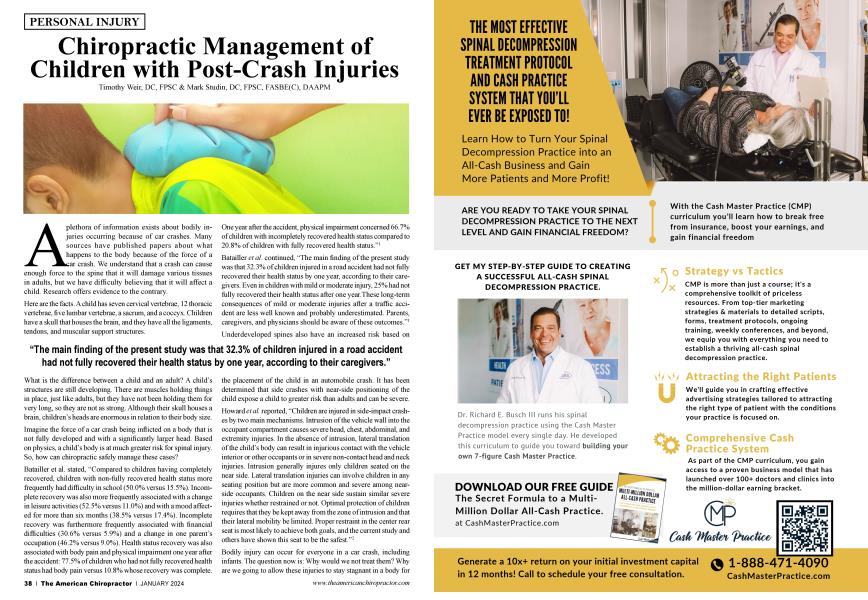
A plethora of information exists about bodily injuries occurring because of car crashes. Many sources have published papers about what happens to the body because of the force of a car crash. We understand that a crash can cause enough force to the spine that it will damage various tissues in adults, but we have difficulty believing that it will affect a child. Research offers evidence to the contrary.
Here are the facts. A child has seven cervical vertebrae, 12 thoracic vertebrae, five lumbar vertebrae, a sacrum, and a coccyx. Children have a skull that houses the brain, and they have all the ligaments, tendons, and muscular support structures.
What is the difference between a child and an adult? A child’s structures are still developing. There are muscles holding things in place, just like adults, but they have not been holding them for very long, so they are not as strong. Although their skull houses a brain, children’s heads are enomious in relation to their body size.
Imagine the force of a car crash being inflicted on a body that is not fully developed and with a significantly larger head. Based on physics, a child’s body is at much greater risk for spinal injury. So, how can chiropractic safely manage these cases?
Batailler et al. stated, “Compared to children having completely recovered, children with non-fully recovered health status more frequently had difficulty in school (50.0% versus 15.5%). Incomplete recovery was also more frequently associated with a change in leisure activities (52.5% versus 11.0%) and with a mood affected for more than six months (38.5% versus 17.4%). Incomplete recovery was furthermore frequently associated with financial difficulties (30.6% versus 5.9%) and a change in one parent’s occupation (46.2% versus 9.0%). Health status recovery was also associated with body pain and physical impairment one year after the accident: 77.5% of children who had not fully recovered health status had body pain versus 10.8% whose recoveiy was complete.
One year after the accident, physical impairment concerned 66.7% of children with incompletely recovered health status compared to 20.8% of children with fully recovered health status.”1
Batailler el al. continued, “The main finding of the present study was that 32.3% of children injured in a road accident had not fully recovered their health status by one year, according to their caregivers. Even in children with mild or moderate injury, 25% had not fully recovered their health status after one year. These long-term consequences of mild or moderate injuries after a traffic accident are less well known and probably underestimated. Parents, caregivers, and physicians should be aware of these outcomes.”1
Underdeveloped spines also have an increased risk based on the placement of the child in an automobile crash. It has been determined that side crashes with near-side positioning of the child expose a child to greater risk than adults and can be severe.
Howard etal. reported, “Children are injured in side-impact crashes by two main mechanisms. Intrusion of the vehicle wall into the occupant compartment causes severe head, chest, abdominal, and extremity injuries. In the absence of intrusion, lateral translation of the child’s body can result in injurious contact with the vehicle interior or other occupants or in severe non-contact head and neck injuries. Intrusion generally injures only children seated on the near side. Lateral translation injuries can involve children in any seating position but are more common and severe among nearside occupants. Children on the near side sustain similar severe injuries whether restrained or not. Optimal protection of children requires that they be kept away from the zone of intrusion and that their lateral mobility be limited. Proper restraint in the center rear seat is most likely to achieve both goals, and the current study and others have shown this seat to be the safest.”2
Bodily injury can occur for everyone in a car crash, including infants. The question now is: Why would we not treat them? Why are we going to allow these injuries to stay stagnant in a body for 20 years only to manifest with worsening symptoms as life progresses? There are those who question the safety of treating a small child who has been injured.
Cox and Mior reported, “Pediatric mechanical neck pain appears to be successfully managed by chiropractic care. Spinal manipulative therapy (chiropractic spinal adjustments) appears to benefit pediatric mechanical neck pain resulting from dayto-day activities with no reported serious adverse events. The most common treatment provided was manual therapy. SMT provided was high-velocity, low-amplitude thrust manipulation, delivered supine with a rotary thrust directed at the painful segments. There were no adverse events recorded in the patient charts. This is a treatment option with minimal risk and reported successful pain management for a commonly experienced MSK condition by many pediatric patients.”3
Due to the lack of musculoskeletal training reported by Humphr eys cl ah,the proficiency of medical doctors, including emergency room physicians, averaged a 20% basic competency score in musculoskeletal medicine.4 Although excellent in other bodily systems, patients from emergency rooms and pediatricians too often misdiagnose bodily injuries caused by trauma. This includes more serious injuries to the child.
Spinal cord injury without radiographic abnormality (SCIWORA) is an acute injuiy to the cord that leaves the younger patient with sensory deficits. Spinal diagnostic X-rays in children have the same negative health risks as adults, with the threshold of 100 msv. Spinal X-rays have 0.2, 1.0, and 1.5 msv for the cervical, thoracic, and lumbar spine exposure. This is well below any threshold for carcinogenic risk.5 6 If X-rays do not give you a conclusive diagnosis of your patient’s clinical findings, advanced imaging (MRI) could be considered.
Launey et al. reported, “The location of injuiy in SCIWORA commonly involves the cervical cord secondary to forced excessive spinal movement, particularly the upper cervical cord in children younger than three years. Upper cervical SCIWORA has been reported to have more severe neurologic consequences than lower cervical SCIWORA. When the neurologic deficit is diagnosed clinically but neither plain radiographs nor CT scans show any abnormality, MRI scans become the only way to show neural and extra neural injuries. Some clinicians recommend dynamic radiographs to assess potential spinal instability, but acute dynamic radiographs may not show the subtle amount of subluxation because the paraspinous musculature often splints the spine, and dynamic radiographs might cause additional injury to the spinal cord in an unresponsive patient. For delineating spinal cord and soft tissue abnormalities, MRI scans are superior to CT in detecting neural injuries such as edema and hemorrhage, and extra neural injuries such as traumatic disc protrusions, compressive extradural hematomas, and ligamentous injuries.”7 This management is no different from determining an accurate diagnosis for adult patients.
Advanced training in trauma care is required for both the young and old. Managing these cases necessitates an in-depth understanding of clinical evaluations for the pediatric patient, advanced imaging, and connective tissue pathology with formal credentials thr ough graduate training. This type of postdoctoral education is available to every doctor of chiropractic. Managing these cases often requires collaboration with medical primary care providers and specialists who need to see you as a peer versus a technician, and advanced credentials will help foster those relationships. Lives depend on it, both young and old.
Timothy Weir, DC, FPSC, is a 1981 graduate of Palmer College of Chiropractic in Davenport, Iowa. He has practiced for 37 years and is an adjunct postdoctoral professor at Cleveland University-Kansas City, College of Chiropractic. He also earned his Fellowship in Primary Spine Care certified in joint providership from The State University of New York at Buffalo. Dr. Weir can be reached at [email protected].
Mark Studin, DC, FPSC, FASBE(C), DAAPM, is an adjunct assistant professor at the University of Bridgeport, School of Chiropractic. He also earned his Fellowship in Primary Spine Care certified in joint providership from The State University of New York at Buffalo. He can be reached at 631-786-4253 or [email protected].
References
1. Batailler P, Hours M, Maza M, Charnay P, Tardy H, Tournier C, Javouhey E. Health status recovery at one year in children injured in a road accident: a cohort study. Accid Anal Prev. 2014 Oct;71:267-72. doi: 10.1016/j.aap.2014.06.001. Epub 2014 Jim 20. PMID: 24956131.
2. Howard A, Rothman L, McKeag AM, Pazmino-Canizares J, Monk B, Comeau JL, Mills D. Blazeski S, Hale I, German A. Children in side-impact motor vehicle crashes: seating positions and injury mechanisms. J Trauma. 2004 Jun;56(6): 1276-85. doi: 10.1097/01.ta.0000078883.74947.eb. PMID: 15211137.
3. Cox J, Davidian C, Mior S. Neck pain in children: a retrospective case series. J Can Chiropr Assoc. 2016 Sep;60(3):212-219. PMID: 27713576; PMCID: PMC5039770.
4. Humphreys BK, Sulkowski A, McIntyre K, Kasiban M, Patrick AN. An examination of musculoskeletal cognitive competency in chiropractic interns. J Manipulative Physiol Ther. 2007 Jan;30(l):44-9. doi: 10.1016/j.jmpt.2006.11.006. Erratum in: J Manipulative Physiol Ther. 2007 Mar;30(3):246. PMID: 17224355.
5. Mettler FA Jr, Huda W, Yoshizumi TT, Mahesh M. Effective doses in radiology and diagnostic nuclear medicine: a catalog. Radiology. 2008 Jul;248(l):254-63. doi: 10.1148/radiol.2481071451. PMID: 18566177.
6. Callahan MJ, MacDougall RD, Bixbv SD, Voss SD, Robertson RL, Cravero JP. Ionizing radiation from computed tomography versus anesthesia for magnetic resonance imaging in infants and children: patient safety considerations. Pediatr Radiol. 2018 Jan;48(l):21-30. doi: 10.1007/ S00247-017-4023-6. Epub 2017 Nov 27. Erratum in: Pediatr Radiol. 2018 Jan 25. PMID: 29181580.
7. Launay F, Leet AI, Sponseller PD. Pediatric spinal cord injury without radiographic abnormality: a meta-analysis. Clin Orthop Relat Res. 2005’Apr;(433): 166-70. doi: 10.1097/01. blo.0000151876.90256.bf. PMID: 15805953.