Trump Exceeding His Mandate, and Will That Affect His Success? How Will it Impact the Profession?
Trump Exceeding His Mandate, and Will That Affect His Success? How Will it Impact the Profession?

Even though the congressional elections are over a year away, the makeup of Congress has already garnered considerable interest from pollsters and voters.
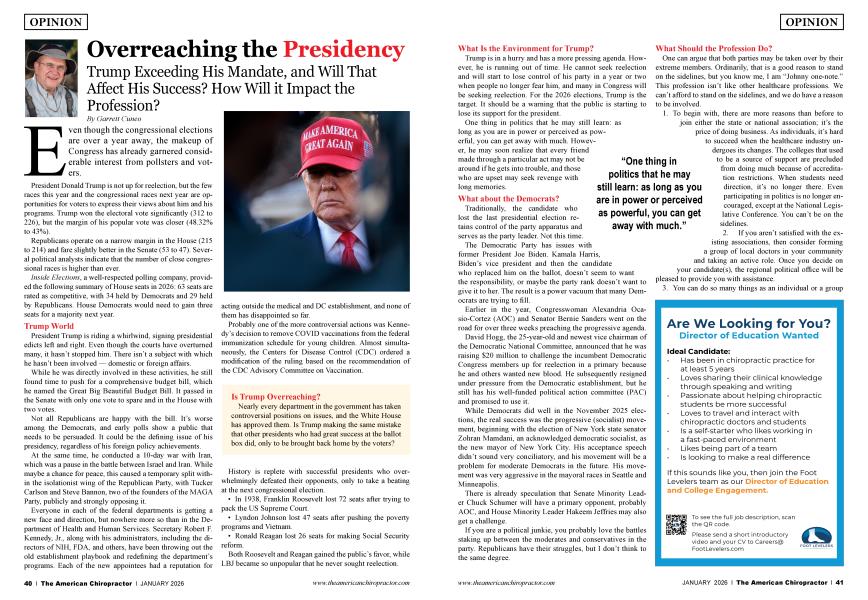
President Donald Trump is not up for reelection, but the few races this year and the congressional races next year are opportunities for voters to express their views about him and his programs. Trump won the electoral vote significantly (312 to 226), but the margin of his popular vote was closer (48.32% to 43%).
Republicans operate on a narrow margin in the House (215 to 214) and fare slightly better in the Senate (53 to 47). Several political analysts indicate that the number of close congressional races is higher than ever.
Inside Elections, a well-respected polling company, provided the following summary of House seats in 2026: 63 seats are rated as competitive, with 34 held by Democrats and 29 held by Republicans. House Democrats would need to gain three seats for a majority next year.
President Trump is riding a whirlwind, signing presidential edicts left and right. Even though the courts have overturned many, it hasn’t stopped him. There isn’t a subject with which he hasn’t been involved — domestic or foreign affairs.
While he was directly involved in these activities, he still found time to push for a comprehensive budget bill, which he named the Great Big Beautiful Budget Bill. It passed in the Senate with only one vote to spare and in the House with two votes.
Not all Republicans are happy with the bill. It’s worse among the Democrats, and early polls show a public that needs to be persuaded. It could be the defining issue of his presidency, regardless of his foreign policy achievements.
At the same time, he conducted a 10-day war with Iran, which was a pause in the battle between Israel and Iran. While maybe a chance for peace, this caused a temporary split within the isolationist wing of the Republican Party, with Tucker Carlson and Steve Bannon, two of the founders of the MAGA Party, publicly and strongly opposing it.
Everyone in each of the federal departments is getting a new face and direction, but nowhere more so than in the Department of Health and Human Services. Secretary Robert F. Kennedy, Jr., along with his administrators, including the directors of NIH, FDA, and others, have been throwing out the old establishment playbook and redefining the department’s programs. Each of the new appointees had a reputation for acting outside the medical and DC establishment, and none of them has disappointed so far.
Probably one of the more controversial actions was Kennedy’s decision to remove COVID vaccinations from the federal immunization schedule for young children. Almost simultaneously, the Centers for Disease Control (CDC) ordered a modification of the ruling based on the recommendation of the CDC Advisory Committee on Vaccination.
Nearly every department in the government has taken controversial positions on issues, and the White House has approved them. Is Trump making the same mistake that other presidents who had great success at the ballot box did, only to be brought back home by the voters?
History is replete with successful presidents who overwhelmingly defeated their opponents, only to take a beating at the next congressional election.
• In 1938, Franklin Roosevelt lost 72 seats after trying to pack the US Supreme Court.
• Lyndon Johnson lost 47 seats after pushing the poverty programs and Vietnam.
• Ronald Reagan lost 26 seats for making Social Security reform.
Both Roosevelt and Reagan gained the public’s favor, while LBJ became so unpopular that he never sought reelection.
“One thing in politics that he may still learn: as long as you are in power or perceived as powerful, you can get away with much.”
Trump is in a hurry and has a more pressing agenda. However, he is running out of time. He cannot seek reelection and will start to lose control of his party in a year or two when people no longer fear him, and many in Congress will be seeking reelection. For the 2026 elections, Trump is the target. It should be a warning that the public is starting to lose its support for the president.
One thing in politics that he may still learn: as long as you are in power or perceived as powerful, you can get away with much. However, he may soon realize that every friend made through a particular act may not be around if he gets into trouble, and those who are upset may seek revenge with long memories.
Traditionally, the candidate who lost the last presidential election retains control of the party apparatus and serves as the party leader. Not this time.
The Democratic Party has issues with former President Joe Biden. Kamala Harris, Biden’s vice president and then the candidate who replaced him on the ballot, doesn’t seem to want the responsibility, or maybe the party rank doesn’t want to give it to her. The result is a power vacuum that many Democrats are trying to fill.
Earlier in the year, Congresswoman Alexandria Ocasio-Cortez (AOC) and Senator Bernie Sanders went on the road for over three weeks preaching the progressive agenda.
David Hogg, the 25-year-old and newest vice chairman of the Democratic National Committee, announced that he was raising $20 million to challenge the incumbent Democratic Congress members up for reelection in a primary because he and others wanted new blood. He subsequently resigned under pressure from the Democratic establishment, but he still has his well-funded political action committee (PAC) and promised to use it.
While Democrats did well in the November 2025 elections, the real success was the progressive (socialist) movement, beginning with the election of New York state senator Zohran Mamdani, an acknowledged democratic socialist, as the new mayor of New York City. His acceptance speech didn’t sound very conciliatory, and his movement will be a problem for moderate Democrats in the future. His movement was very aggressive in the mayoral races in Seattle and Minneapolis.
There is already speculation that Senate Minority Leader Chuck Schumer will have a primary opponent, probably AOC, and House Minority Leader Hakeem Jeffries may also get a challenge.
If you are a political junkie, you probably love the battles staking up between the moderates and conservatives in the party. Republicans have their struggles, but I don’t think to the same degree.
One can argue that both parties may be taken over by their extreme members. Ordinarily, that is a good reason to stand on the sidelines, but you know me, I am “Johnny one-note.” This profession isn’t like other healthcare professions. We can’t afford to stand on the sidelines, and we do have a reason to be involved.
1. To begin with, there are more reasons than before to join either the state or national association; it’s the price of doing business. As individuals, it’s hard to succeed when the healthcare industry undergoes its changes. The colleges that used to be a source of support are precluded from doing much because of accreditation restrictions. When students need direction, it’s no longer there. Even participating in politics is no longer encouraged, except at the National Legislative Conference. You can’t be on the sidelines.
2. If you aren’t satisfied with the existing associations, then consider forming a group of local doctors in your community and taking an active role. Once you decide on your candidate(s), the regional political office will be pleased to provide you with assistance.
3. You can do so many things as an individual or a group of doctors: offer your phones in the evening to volunteers who can contact voters, organize car parades promoting your candidate, volunteer at the campaign headquarters, walk precincts, and raise money.
4. Most political pundits agree that control of the House and Senate is up for grabs, and that every profession will be involved, particularly now that the Senate/House bill has been approved and signed by the president. Everyone has a reason to love and hate it. Party leadership from both sides will cherry-pick what they like best and least, focusing on those aspects.
There is no question that Trump has had success in foreign policy. However, issues that will hit home are how successful the administration will be in persuading voters that they are better off under Trump than they were under Biden.
The American Chiropractic Association (ACA) sponsored a bill that could have a tremendous impact on the profession. Introduced in January 2025, the Chiropractic Coverage Medicare Modernization Bill will ensure that Medicare patients have access to chiropractic care.
• HR 539 www.congress.gov/bill/119th-co... house-bill/539
• S 106 www.congress.gov/bill/119th-co... wate-bill/106
It was introduced at the beginning of the 25th congressional session, but it can take up to two years to secure the necessary cosponsors and approximately 200 signatures to amend an existing Medicare bill. While it’s not guaranteed that the cosponsors will necessarily vote for the provision if it’s amended, the provision must be considered.
Then there is the Senate bill, which has to go through the same process. It’s not easy, but if the profession increased its reimbursement through Medicare, it would be constructive, especially for new doctors.
“Then there is the Senate bill, which has to go through the same process.”
I know many DCs who have a relationship with their federal representatives receive calls whenever there is a measure impacting the profession. We need more doctors to have relationships with their members of Congress, which will help during next year’s election.
For the Ways and Means and other committees, anything controversial is subject to control. Too many changes are being proposed that organized medicine and pharmaceuticals would like to see changed, and this could occur during budget time.
If the congressional bill isn’t interesting enough or the state of the country, the results of the congressional races might have an impact on the work at HHS, particularly on issues of interest to the profession.
I believe Secretary Kennedy is the first HHS secretary since Secretary Tommie Thompson to have policies that are sympathetic to the profession. He has taken strong positions on nutrition, pesticides, pharma, and other concerns.
But why should we care? Secretary Kennedy is appointed and doesn’t have to worry about being reelected. However, if the Republicans lose control of the House, one of the Democrats’ favorite targets will be the HHS budget.
This is a great time to be part of the profession, but it is also the worst time. I have nothing to lose or gain with this article. I am retired, playing with my grandkids, and fly fishing, but I remember when the profession exercised its “DC Power,” and I think we can do it. I encourage you to do so.

Garrett “Gary” Cuneo was involved with the chiropractic profession for nearly fifty years, serving in top administrative roles throughout his career. He began with the California Board of Chiropractic Examiners (1974-1981), later spending more than twenty years with chiropractic associations—first as Executive Director of the California Chiropractic Association (1983-1995), and then as Executive Vice President of the American Chiropractic Association (1995-2005). He went on to serve as Executive Director of the Foundation for Chiropractic Progress from 2006 until his retirement in 2019. Before his work in chiropractic, he taught school for five years in San Francisco. The academic calendar allowed him to work on political campaigns during the summers, an experience that taught him the value of organized campaigns for achieving goals and connected him with future Reagan staff. This ultimately led to roles in the Reagan Administration, first when Reagan was Governor and later as President. He can be reached at [email protected].
1. Gonzales N. 2026 House overview: Republicans vs. history [Internet], Washington, DC: Inside Elections; 2025 June 5. Available from: https://www.insideelections.co...
2. Whyte LE. RFK Jr. names eight vaccine panel replacements, including COVID-shot skeptics [Internet], Wall. Street Journal, 2025 June 12. Available from: https://www.wsj.com/health/hea... rfk-jr-names-eight-vaccine-panel-replacements-including-covidshot-skeptics-9a7d2d54?gaa_at=eafs&gaa_n=ASWzDAjn9JiQw8jxfdW683xhYFNVCg43hcvkRGWC0XYDRXnPyCN_Z8kwDjZT3QkSD3E%3D&gaa_ts=68d063aa&gaa_sig=QZbflj3UB3sSy06XGJ8koYlAe9Co3dAKaUGnTlgZYOMSOY17R_OElAI4ZTYq4VrS_ NOVNTWpr20_zXybLI7TTw%3D%3D
3. Stack L. A new political star emerges out of a fractured Democratic party [Internet], Wall Street Journal. 2025 June 25. Available from: https://www.nytimes.com/2025/06/25/nyregion/democratic-party-zohran-mamdani. html
4. Garafolio J. What the shocking NYC mayoral race means for two of California's biggest politicians [Internet], San Francisco Chronicle, 2025 June 25. Available from: https://www.sfchronicle.com/po... joegarofoli/article/mamdani-pelosi-harris-20393522.php
5. Rove K. A look ahead at the 2026 midterm elections [Internet], Wall Street Journal, 2025 June 4. Available from: https://www.rove. com/article/6-4-25-wsj
6. Gillum J, West J, Champelli P. Where the GOP lost support this past week [Internet], Wall Street Journal, 2025 November 8. Available from: https://wallstreetjournal-ny.n... medium=referral&utm_campaign=blue-wave
7. Noonan P. Take Mamdani seriously and literally [Internet], Wall Street Journal, 2025 November 6. Available from: https://www.wsj. com/opinion/take-mamdani-seriously-and-literally-192fl285?gaa_ at=eafs&gaa_n=AWEtsqfpWgokW7w0wQiEnjZftY GWALmWtcBd3Aa5tgsvkbpm4RUlz_bfl4y3b7Pppls%3D&gaa_ts=691a8413&gaa_ sig=7X_LsFIVleatZ8CiOXIXjdSclULhedt5adbVz82rBeSl_hAx4wdbKKbTfcnoKNrgkcD9O061Tsd8iyTMLvXMGA%3D%3D