..."This stress/stretch has become increasingly recognized as one of the primary and essential factors controlling biological functions”...
The neuroskeleton is a unique chiropractic model developed by D.D. Palmer. Palmer was one of chiropractic’s greatest theorists, but the profession has never made use of his concept of the neuroskeleton as a regulator of tension and of the subluxation as “a mishap that interferes with such regulation and requires an adjustment.”
Neuroskeleton offers a functional understanding of chiropractic that embodies Palmer’s central ideas. He described it as the internal skeletal structure and the protector of the nervous system, which could easily be interpreted as the cytoskeletal neuronal cell ultrastructures. Palmer wrote that the neuroskeleton was a “regulator of tension.” By tension, he meant tone, which is described as the renitency, elasticity, and firmness of healthy tissues. He considered disease “a disordered state” (cytoskeletal microtubules can be easily disordered) because the tension was above or below normal tone. The strain or laxity from above or below normal is due to the position of the neuroskeleton. This pressure or tension affects the brain, spinal cord, and nerves. Transmission of impulses is disturbed, which also disturbs vibrations, heat, and ultimately functions. According to Palmer, stretching or slacking of nerves causes too much or not enough functioning.
D.D. Palmer’s final theory of chiropractic (1908 - 1913 ) preserved the vitalism-through-the-nerves idea. However, by this time, he had abandoned his earlier belief that nerves were pinched by joint misalignment. Instead, he proposed that skeletal misalignment caused nerves to be stretched or slackened, thereby altering vibrationally mediated nerve impulses sent to end organs. This final theory has been referred to as the tension-regulation theory of chiropractic. Until recently, the study of basic problems in cell biology has been performed almost exclusively within the context of biochemistry and through the use of molecular and genetic approaches. Pathological processes may be considered disruptions in biochemical signaling events.
The regulation of cell function by extracellular signals may be understood from the point of view of binding of a molecule to a receptor on the cell surface.
Recently, there has been a shift in paradigm in the understanding of cell function and disease, primarily within the analytical context of biochemistry. In particular, it has become well established that critical insights into diverse cellular processes and pathologies can be gained by understanding the role of mechanical force.
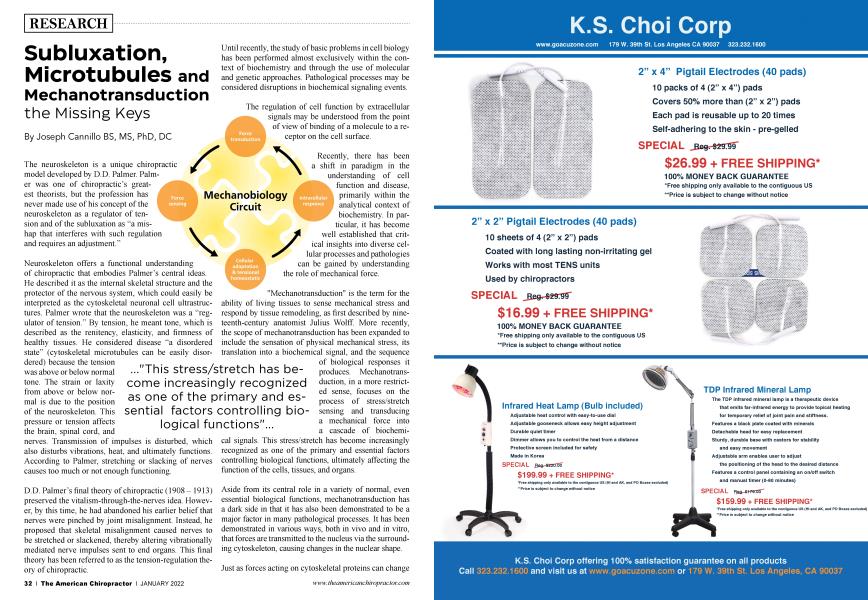
"Mechanotransduction" is the term for the ability of living tissues to sense mechanical stress and respond by tissue remodeling, as first described by nineteenth-century anatomist Julius Wolff. More recently, the scope of mechanotransduction has been expanded to include the sensation of physical mechanical stress, its translation into a biochemical signal, and the sequence of biological responses it produces. Mechanotransduction, in a more restricted sense, focuses on the process of stress/stretch sensing and transducing a mechanical force into cascade of biochemical signals. This stress/stretch has become increasingly recognized as one of the primary and essential factors controlling biological functions, ultimately affecting the function of the cells, tissues, and organs.
Aside from its central role in a variety of normal, even essential biological functions, mechanotransduction has a dark side in that it has also been demonstrated to be a major factor in many pathological processes. It has been demonstrated in various ways, both in vivo and in vitro, that forces are transmitted to the nucleus via the surrounding cytoskeleton, causing changes in the nuclear shape.
Just as forces acting on cytoskeletal proteins can change their conformation, DNA can be unwound under applied force to expose a transcription sequence. Pulling/stretching on a single strand of DNA can cause histone release and nucleosomal disruption, so it is not unreasonable to hypothesize that force could also influence gene expression and replication. It has been demonstrated that forces are indeed transmitted to the nucleus, providing evidence for direct control of gene expression.
What we now understand is that there are mechanical correlates to cellular function, which when altered from ideal (“dysregulatioin of mechanical responses contributes to major human diseases.”), play a part in disease processes. Alter length-tension relationships to alter mechanical stress/strain to the cells that comprise a tissue in order to alter the functions of those cells.
The nucleus has been shown to be intimately linked to the cytoskeleton by both microfilaments and intermediate filaments and to undergo predictable deformation when extracellular forces are applied to focal adhesions in cultured cells. Within the nucleus, nucleoli have been shown to undergo molecular rearrangement when external forces were applied to the focal adhesions, indicating further hierarchical organization of the cell. Further, ex vivo tissue stretch studies demonstrated a loss of fibroblast nuclear membrane invaginations during tissue stretch, which is important because these invaginations are thought to play a pivotal role in many key functions of the nucleus-impacting gene expression. Given these findings, it has been proposed that mechanical forces could directly affect genetic expression by regulating the opening and closing of nuclear pore complexes, inducing chromatin remodeling, or lead to epigenetic melting (opening up or closing) of select regions of DNA.
The role of mechanotransduction in cell physiology leads one to consider the possibility of pathologic states due to altered mechanotransduction. Changes in the extracellular environment or within the cell could lead to altered mechanotransduction and ultimately result in disease. Numerous pathological states, such as cardiomyopathy, osteoporosis, muscular dystrophy, asthma, tumors, and atherosclerosis, are now attributed in part to alterations in mechanotransduction.
One disease that has received a great deal of attention in relation to mechanotransduction is cancer. Cancer can be viewed as a problem of growth and differentiation. Prestressed cells are able to receive mechanical signals, and this mechanotransduction is known to regulate both growth and differentiation in normally functioning cells.
It could be suggested that alterations in mechanotransduction may lead to tumor formation by altering cell growth and differentiation, thus contributing to the metastatic potential of the resulting tumor by changing the way the tumor cells “sense” or “see” their extracellular environment. It has long been recognized that the majority of tumors are surrounded by a stiffened or rigid ECM (extracellular matrix). The increase in ECM stiffness could be due to an extracellular event, such as increased fibrosis, or to an intracellular event, such as an increase in cytoskeletal prestress gelation within the cell that is exerting tension on the ECM. Regardless of the initiating mechanism, the resulting change in the mechanical environment will lead to altered mechanotransduction, which could cause further changes in growth and differentiation and potentially lead to metastasis.
Cells need to sense their extracellular environment to survive. When a cell is in contact with its ECM, the physiologic motion of its surrounding tissue will be sensed through mechanotransduction and integrated with other biochemical signals to orchestrate processes such as growth, differentiation, and apoptosis. Restrictions to normal physstrech/stram ^ iologic motion in nerve cells are sensed through mechanotransduction and lead to altered functioning of the nerve cell. This altered mechanical functioning at the vertebral/ neurological level could be viewed as a subluxation. If the physiologic motion is restored, either through the use of chiropractic adjustment or by other means, the tissue returns to its prior state and functions normally. If, however, physiologic motion is not restored, prolonged changes in mechanical forces (stretch) at the nerve root level can lead to chronic tissue alteration and fibrosis, leading to a chronically altered somatic, visceral reflex state, thus becoming more difficult to manage.
The cytoskeleton is a dynamic scaffold inside all eukaryotic cells that is responsible for cell shape and motility as well as the transport and organization of intracellular components. The cytoskeleton is composed of three classes of protein polymers called microtubules, microfilaments, and intermediate filaments, each formed by the self-association of protein subunits. The cytoskeleton is critical for the shape and physiology of nerve cells. These cells also have the highest density of microtubules that contribute to specialized structures, such as growth cones, which are responsible for axon elongation and guidance during development, synaptic boutons, and dendritic spines.These form the structural basis for nerve cell communication and higher-order processes, such as learning and memory, and membrane specializations, such as axon initial segments and nodes of Ranvier, which are critical for the initiation and propagation of nerve impulses.
In the complexity of the brain’s neural network, there are quantum vibrational computations in microtubules' major components of the cytoskeleton. These protein polymers inside brain neurons help govern neuronal and synaptic function. These are the proto-conscious quantum structure of our reality (fine scale.) Microtubules are the neural substrate for consciousness. ORCH or quantum bits or qubits are helic pathways in microtubule lattices in our brain, called brain microtubule vibrations.
Consciousness depends on harmonic vibrations of microtubules inside neurons, which is a theory proposed by Penrose and Hameroff. Microtubules vibrate to harmonic structure. Microtubules are the cell’s nervous system. They are cylindrical polymers of protein “tubulin,” which is the major component of the cytoskeleton inside cells and the brain’s most prevalent protein and holographic storage device. Consciousness is the fine structure of the universe. Our body is a biochemical system, or a macroscopic system. Our brain is a bioelectric and biochemical computer, as well as a quantum computer. The cell bodies, neurons, and neuron networks of our brains are entangled with each other. Our brains through our spinal cord are in a quantum symphony that is tuned to our universe.
The ORCH (orchestrated objective reduction) consciousness arises from quantum vibrations, which interfere, “collapse,” and control neuronal firings to generate consciousness and connect to our “deeper innate.” When a patient is considered through the lens of mechanotransduction and the relation of altered vertebral mechanical stimuli to disease processes through altered cytoskeletal/ microtubular tension, it is suggestive that chiropractic has a positive effect on health states through normalizing mechanical neurological stretch stimuli and flow of innate universal consciousness through the microtubule and the extracellular matrix environment.
Innovative basic research in chiropractic is needed. Mechanobiology could be the path; the mechanical forces acting on neural cell membranes or through cytoskeletal filaments can also be transformed into consequences on membrane-bound and cytoskeletal-tethered protein activity. Membrane-bound protein activity is also influenced by the properties of the cellular phospholipid bilayer. How the properties and changes in density of phospholipid bilayers influence the propagation of mechanical waves and neuronal processes, such as action potential initiation and propagation, is not precisely known.
It has recently been proposed that propagating density pulses in the membrane may also serve as the signal that modulates the function of membrane-bound enzymes, operating as an alternative mechanism for cellular signaling and nerve pulse propagation. The development of devices utilizing mechanical energy to interact with the nervous system has received considerable attention recently and includes ultrasound for noninvasive neural stimulation and magnetic resonance elastography for noninvasive palpitation of the brain, spinal cord, and nerve roots.
The extent to which cellular-mechanical dynamics influences neuronal activity, and effectually the interfacing to the nervous system using mechanical forces, remains largely unexplored. To advance neuroscience and our understanding of the complex nervous system, the compartmentalization of analyses and processes due to electrical, chemical, or mechanical energies in system characterization and manipulation needs to be stepped away from. While numerous mechanical events have been observed and associated with neuronal activity, it has not been until very recently that technology has started to be adapted to capitalize on these mechanical events to allow the observation, and even modulation, of nervous tissue.
Joseph Cannillo BS, MS, PhD, DC is a graduate of the Long Island University CW Post, BS in Biology, MS in Molecular Genetics, Cornell University PhD in Biochemistry, New York Chiropractic College in 1988. In private Chiropractic & Functional Nutrition practice in Italy for over 30 years, teaches Nutrition and Herbology at the University level, started a Herbal & Supplement R&D Lab with a Manufacturing facility 30 yrs ago called Forza Vitale. Scientific Director of CITIVA a Medical Cannabis manufacturing and Research laboratory at the University of the West Indies, Jamaica. Research interests, Cell Microtubule Physiology, Endocannabinoids & Phytocannabinoids, Epigenetics and Plant active principles isolation and bioavailability through Nanoparticles.
For references please see page 46.
Subluxation, Microtubules and Mechanotransduction the Missing Keys
References
1. Introduction to Cell Mechanics and Mechanobiology Christopher R. Jacobs, Hayden Huang, Ronald Y Kwon 2013. Garland Science: New York
2. Consciousness in the universe A review of the ‘Orch OR ’ theory, Stuart Hameroff a, Roger Penrose b a Anesthesiology, Psychology and Center for Consciousness Studies, The University of Arizona, Tucson, AZ, USA, b Mathematical Institute and Wadham College, University of Oxford, Oxford, UK Physics of Life Reviews 11 (2014) 39-78 3. Mechanobiology and diseases of Mechanotransduction Donald E. higher Ann Med. 2003;35(8):564-77. doi: 10.1080/07853890310016333