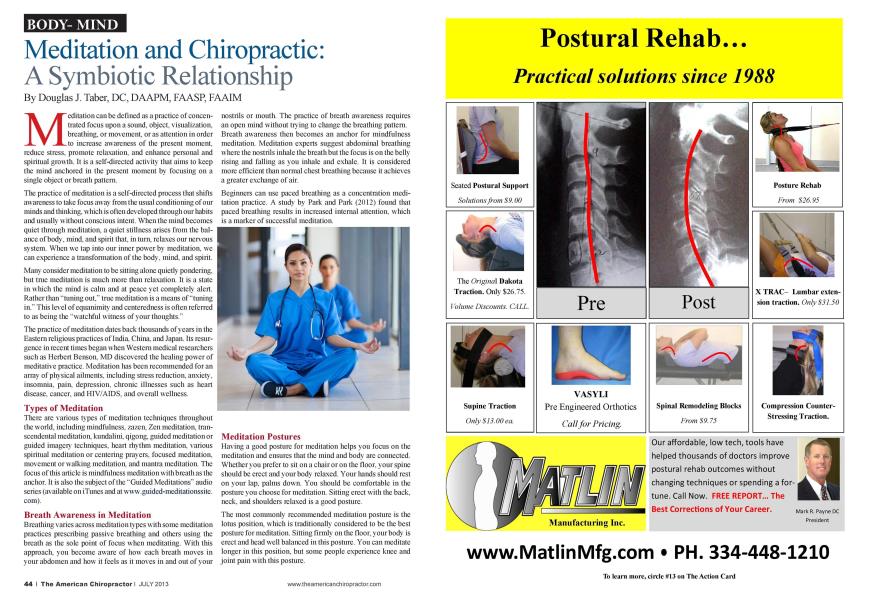
M editation can be defined as a practice of concentrated focus upon a sound, object, visualization, breathing, or movement, or as attention in order to increase awareness of the present moment, reduce stress, promote relaxation, and enhance personal and spiritual growth. It is a self-directed activity that aims to keep the mind anchored in the present moment by focusing on a single object or breath pattern. The practice of meditation is a self-directed process that shifts awareness to take focus away from the usual conditioning of our minds and thinking, which is often developed through our liabits and usually without conscious intent. When the mind becomes quiet through meditation, a quiet stillness arises from the balance of body. mind, and spirit that, in turn, relaxes our nervous system. When we tap into our inner power by meditation, we can experience a transformation of the body. mind, and spirit Many consider meditation to be sitting alone quietly pondering, but tnie meditation is much more than relaxation. It is a state in which the mind is calm and at peace yet completely alert. Rather than "tuning out." tnic meditation is a means of "tuning in." This level of equanimity and ccntcrcdncss is often referred to as being the "watchful witness of your thoughts." The practice of meditation dates back thousands of years in the Eastern religious practices of India. China, and Japan. Its resurgence in recent times began when Western medical researchers such as Herbert Benson. MD discovered the healing power of meditative practice. Meditation has been recommended for an array of physical ailments, including stress reduction, anxiety, insomnia, pain, depression, chronic illnesses such as heart disease, cancer, and HIV/AIDS, and overall wcllncss. Types of Meditation There arc various types of meditation techniques throughout the world, including mindfulncss. zazen. Zen meditation, transcendental meditation, kundalini. qigong, guided meditation or guided imagery techniques, heart rhythm meditation, various spiritual meditation or centering prayers, focused meditation, movement or walking meditation, and mantra meditation. The focus of this article is mindfulncss meditation with breath as the anchor. It is also the subject of the "Guided Meditations" audio scries (available on iTuncs and at www.guidcd-mcditationssitc. com). Breath Awareness in Meditation Breathing varies across meditation types with some meditation practices prescribing passive breathing and others using the breath as the sole point of focus when meditating. With this approach, you become aware of how each breath moves in vour abdomen and how it feels as it moves in and out of vour nostrils or mouth. The practice of breath awareness requires an open mind without trying to change the breathing pattern. Breath awareness then becomes an anchor for mindfulncss meditation. Meditation experts suggest abdominal breathing where the nostrils inhale the breath but the focus is on the belly rising and falling as you inhale and exhale. It is considered more efficient than normal chest breathing because it achieves a greater exchange of air. Beginners can use paced breathing as a concentration meditation practice. A study by Park and Park (2012) found that paced breathing results in increased internal attention, which is a marker of successful meditation. Meditation Postures Having a good posture for meditation helps you focus on the meditation and ensures that the mind and body are connected. Whether you prefer to sit on a chair or on the floor, your spine should be erect and your body relaxed. Your hands should rest on your lap. palms down. You should be comfortable in the posture you choose for meditation. Sitting erect with the back, neck, and shoulders relaxed is a good posture. The most commonly recommended meditation posture is the lotus position, which is traditionally considered to be the best posture for meditation. Sitting firmly on the floor, your body is erect and head well balanced in this posture. You can meditate longer in this position, but some people experience knee and joint pain with this posture. Science behind Meditation and Its Effects on the Body As a doctor of chiropractic, the "above-down-inside-out" viewpoint of the benefits of meditation is often easy for us to understand. As science continues to substantiate the effectiveness of chiropractic manipulation for a variety of ailments, we should also be aware that there is a growing body of evidence for the practice of meditation. The interplay of perception and focus in the area of pain management suggests that meditative practice can be beneficial for a variety of physical ailments. For example, researchers at Stanford University's Ncuroscicncc and Pain Lab found that as patients watched their own brains react to pain in real-time, they could learn to control their responses. There was strikingly more activity in the brain when patients focused on something distracting instead of the pain. Autonomic Nervous System and Meditation The autonomic nen ous system consists of the sympathetic and parasympathctic nen ous systems. It is proposed that meditation can reduce the activity of the sympathetic nen ous system while increasing activity in the parasympathctic nen ous system. Most meditative activity targets the autonomic nen ous system, which in turn regulates organs and muscles in the body and controls the digestive system, breathing, etc. Meditation may affect both sympathetic and parasympathctic nen ous systems. The "fight or flight" response is the body's innate ability to "fight" or "flee" from perceived danger or harm to survival. When under stress due to internal or external situations, the body triggers the "fight or flight" response. This response is built into the brain to guard us from danger. The hypothalamus region of the brain is stimulated during stress and in turn it triggers a nerve cell action that stimulates the release of catccholamincs (hormones) into the bloodstream to prepare us to run away or fight. When this occurs, the body undergoes changes causing a significant increase in breathing rate. The pupils dilate and amis and legs arc pumped with blood to flee or fight, as required. The perception of pain reduces and we become more aware. Our bodies prepare us physically and physiologically for the situation. The "fight or flight" response creates tremendous movement and exertion and the stress lionnones released are metabolized. Once the threat is over, body and mind return to a state of calm. Meditation helps the body release catccholamincs and other stress lionnones as parasympathctic activity increases in the body. In response to stress, the hypothala-mus in the brain is activated and triggers the adrenal gland to produce and release the stress hormone cortisol. Catecholamines arc certain chemical messengers that include dopamine. norcpincphrinc. and cpincphrinc. The response also affects the heart, lungs, and blood circulation in the body. In a study (Jung YH ct al. 2010). catecholamines were measured in meditation and control groups, and it was found that the levels arc related to stress levels. The meditation group showed higher scores on positive effect and lower scores on stress compared with the control group. Health Benefits of Meditation For years researchers have studied the effects of meditation and reported that it calms stress, depression, and anxiety. However, what else might we be gaining from meditation? Data analysis from multiple studies has shown that the effect of meditation is not only a mental process, but surprisingly, a physiological process as well. Meditation has the potential to aid in treating heart disease, depression, and insomnia. Research also suggests tliat regular meditative practices can reduce pain and enhance the body's immune system. A 1995 report to the National Institutes of Health on alternative medicine concluded that "more than 30 years of research, as well as the experience of a large and growing number of individuals and health care providers, suggests that meditation and similar forms of relaxation can lead to better health, higher quality of life, and lowered health care costs..." Mind-body therapy is the most common form of complementary and alternative medicine used in the United States. Meditation, relaxation, breathing techniques, yoga. etc. arc used to treat pain, stroke, headaches, fibromyalgia. epilepsy, and many other neurological diseases. Mind-body therapies focus on the interactions between the brain, mind. body, and our behavior, and how those interactions affect our health and diseases. Most of these therapies arc linked to relaxation and. therefore, arc beneficial to patients suffering from psychological stress. Mind-body therapies like meditation arc easy to utilize due to low associated risk and low cost. The self-directed nature of meditations allows patients to actively manage their treatments. Different meditation types include self-observation of mental activity and mindfulncss. which means focusing on internally generated events such as breathing, emotions, and thoughts. Application of Meditation to Neurologic Processes The most common neurological conditions that mind-body therapies arc applied to arc pain syndromes. Patients suffering from chronic pain have been treated successfully with meditation. Meditation and other forms of mind-body therapies are used frequently among adults suffering from common neurological conditions such as headaches and general pain. Headaches Mindful meditation helps control severe headaches and discomfort, and is a cost-effective alternative to pain medications. As chiropractors know, headaches arc not attributed to a single pathogencsis. and often involve various dysfunctional mechanisms such as joint dysfunction, myofascial restriction, vascular changes, neurological dysafferentation. and postural sequelae. Meditation alone or in combination with other mind-body therapies has been shown to significanth reduce symptoms of migraine, tension, and mixed-type headaches. Wachholtz and Pargamcnt (2008) studied patients suffering from migraine headaches and investigated if spiritual medicine was effective in enhancing pain tolerance to reduce migraine-related symptoms. They found that people who practiced spiritual meditation had a greater decrease in migraine headache frequency as well as anxiety. The subjects also showed a greater increase in pain tolerance. Back and Neck Pain Different chronic pain conditions are often relieved with mind-body therapies. Back and neck pain arc the most common chronic pain syndromes seen in chiropractic offices, and several studies have focused on the benefits of mind-body therapies to manage spinal pain symptoms. An 8-wcck mindfulncss-bascd stress reduction program showed significant change in pain intensity among patients suffering from arthritis and back and neck pain (Roscnzw cig ct al. 2010). A 10-wcck mindfulncss meditation program targeted to train chronic pain patients in self-regulation with pain in the lower back, neck and shoulder, and headache. At the end of 10 weeks. 65% of the patients showed reduction greater than or equal to 50% (Kabat-Zinn J. 1982). Older patients with chronic lower back painbenefitted tremendously from a mindfulncss meditation program such as the one featured at www .guidcd-meditationssite.com. Based on their diary entries, participants described improved attention skills and quality of sleep. Common themes were identified that related to pain reduction, improved attention, and overall well-being, suggesting that mindfulncss meditation has potential as a nonphannacologic agent in the treatment of chronic pain for older adults (Moronc et al. 2008). Mam- study participants noted pain reduction and indicated the methods and processes that were used to reduce the pain. i.e.. distraction from pain, pain reduction using meditation, heightened awareness of pain that led them to make behavioral changes, and to develop better coping mechanism to pain. Some of the mechanisms the older adults used to distract themselves arc simple and we can all do this to cope with pain. Some focused on other parts of the body while others focused on routine activities. One of the mechanisms the older adults used was to develop a heightened awareness of body sensations that led to behavior change eventually resulting in reducing pain. They were able to recognize pain earlier than was typical by awakened realization of the body's subtle sensations. This allowed them to intervene before the pain became severe. When the adults are able to cope better, diary entries such as this were common: "The pain is still with me: however, it just doesn't feel as intense as it was." Distraction from pain with music, relaxation, prayer, and exercise helped the participants with pain relief. Mindfulncss meditation was shown to be effective in relieving pain when the focus is on breathing or concentration was somewhere other than the pain. The equanimity that meditation affords the practitioner with freedom from pain is described by Kabat-Zinn (1982) as "an attitude of detached observation toward a sensation when it becomes prominent in the field of awareness, and to observe with similar detachment the accompanying but independent cognitive processes, which lead to evaluation and labeling of the sensation as painful, as hurt." It is this focus on relaxation and breath work that I used when designing the audio meditation that I've recently made available for download. By sharing this system with your patients, you can make a positive impact on their overall health. Our body naturally wishes to avoid pain and tliat is translated as anxiety. To be present with pain when it arises is difficult, but with mindfulncss we can learn to come to peace with pain. Pain can be debilitating and anxiety resides with the pain to magnify suffering. Learning to differentiate the pain and how the body reacts to the pain is useful in that our reactions do not need to be added to the physical pain. Final Thoughts Meditation has a long history with a recent resurgence in the healthcare arena. Its philosophies (abovc-down-insidc-out. focus on balance and homeostasis). physical practice (proper posture, diaphragmatic breathing), and growing body of scientific studies (consistent with the evidence-based care paradigm) make it an excellent adjunct to chiropractic patient care. Both disciplines share an art-philosophy-science paradigm that can produce positive changes in the body-mind. ► To view references go to pages 55 & 61 Dr. Douglas J. Taberhas been referred to as the scholar-sage of integrated chiropractic care. He is the author of multiple books and articles, and his 2011 release. The Seek Pain Solution: A Guided Healing Approach, was winner of the 2011 International Rook Awards. This article ;.v an excerpt from his upcoming hook, Here, scheduled for release in late 2013. His recent audio release. Guided Meditations, is available on i'l'unes and Amazon. For more information, go to www.guided-medilalionssite.com. He can he reached for speaking engagements and book signings at spinalgurudocdijaol.com. ► Continued from page 50 References: Kox M ct ill. The influence of concentration/meditation on autonomic nervous system activity and the innate immune response: a case study. Psychosom Med. 2012 Jun;74(5):489-94. Pcrcssulti C el al. Docs mindfulncss meditation shift the cardiac autonomic nervous system to a highly orderly operational state? Int J Cardiol. 2012 Jan 26:154(2):210-2. " Peng CK ct al. Exaggerated heart rate oscillations during two meditation techniques. Int J Cardiol. 1999 Jul 3 1:70(2): 101-7. Jung YH ct al. The effects of mind-body training on stress reductioa positive affect, and plasma catccholamines. Ncurosci Lett. 2010 Jul 26:479(2): 138-42. Jung YH ct al. Influence of brain-dcrived ncurotrophic factor and catcchol O-mcthyl transfcrasc polymorphisms on effects of meditation on plasma catccholamines and stress. Stress. 2012 Jan:15(l):97-104. Lang R ct al. Sympathetic activity and transcendental meditation. J Neural Transm." 1979:44(1-2): 117-35. Michaels RR. Huber MJ. McCann DS. Evaluation of transcendental meditation as a method of reducing stress. Science. 1976 Jun 18:192(4245):1242-4. Infante JR ct al. Catccholaminc levels in practitioners of the transcendental meditation technique. Physiology & Behavior. 2001: 72:141-6. WahbchHetal. Mind-body interventions. Neurology. 2008:70:2321-28. Astin JA. Mind-body therapies for the management of paia Clin J Pain. 2004 Jan-Feb:io(l):27-32. Sun TF. Kuo CC. Chiu NM. Mindfulncss meditation in the control of severe headache. Chang Gung Mcd J. 2002 Aug:25(8):538-41. Sicrpina V. Astin J. Giordano J. Mind-body therapies for headache. Am Fam Physician. 2007 Nov 15:76(10): 1518-22. Roscnzwcig S ct al. Mindfulncss-bascd stress reduction for chronic pain conditions: variation in treatment outcomes and role of home meditation practice. J Psychosom Res. 2010 Jan:68(l):29-36. Wachholtz AB. Pargamcnl KI. Migraines and meditation: does spirituality matter? J Behav Med. 2008 Aug;31(4):351-66. Kabat-Zinn J. An outpatient program in behavioral medicine for chronic pain patients based on the practice of mindfulncss meditation: theoretical considerations and preliminary results. Gen Hosp Psychiatry. 1982 Apr:4(l):33-47. Morone NE. Lynch CS. Greco CM. Tindle HA. Weiner DK. "I felt like a new person." The effects of niindfulness meditation on older adults with chronic pain: qualitative narrative analysis of diary entries. JPaia 2008 Sep:9(9):841-8. Kabat-Zinn J. Lipworth L. Burncy R. The clinical use of niindfulness meditation for the self-regulation of chronic pain. J Bchav Mcd. 1985 Jun;8(2): 163-90. Kabat-Zinn J. An outpatient program in behavioral medicine for chronic pain patients based on the practice of mindfulncss meditation: theoretical considerations and preliminary results. Gen Hosp Psychiatry. 1982 Apr:4(l):33-47. ► Continue on page 61 ► Continuation from page 55 Moronc NE. Greco CM. Mind-body interventions for chronic pain in older adults: a structured review. Pain Med. 2007 May-Jun:8(4):359-75. Bonadonna R. Meditation's impact on chronic illness. Holist Nurs Pract. 2003 Nov-Dcc:17(6):309-19. Balaji PA. Varnc SR. Ali SS. Physiological effects of yogic practices and transcendental meditation in health and disease. N Am J Mcd Sci. 2012Oct:4(10):442-8. Park YJ. Park YB. Clinical utility of paced breathing as a concentration meditation practice. Complement Thcr Med. 2012 Dcc:20(6):393-9. Kiran el al. Impact of meditation on autonomic nervous system—a research study. 201 lScpt-Dec:l(l):144-8. Takahashi T et al. Changes in EEG and autonomic nervous activity during meditation and their association with personality trails, hit J Psychophysiol. 2005 Fcb:55(2): 199-207. Rosenkranz MA et al. A comparison of mindfulness-bascd stress reduction and an active control in modulation of neurogenic inflammation. Brain. Behavior, and Immunity. 2013 Jan (27): 174-84. http://www.umm.edii/palientcd/articles/what_biological_effecls_of_ acute_stress_00003 l_2.htm htlp://www. cmcrgingrnleadcr.com/tag/mcditation/ http://www.aafp.Org/afp/2007/l 115/p 1523. html http://www.holisticlhcrapyllc.com/iipIoads/RccincMeditalionBio-chemicaI_Rcscarch.pdf http://nccam.nih. gov/heallh/mcditalion/overvievv.htm http://phys.org/ncws/2011-04-demystifying-meditation-brain-iniaging.htinl http://www.huffingtonpost.com/2013/04/30/meditation-health-bcncfits_n_3178731 html#slidc=309243 http://online.wsj.com/arliclc/SB10001424127887324345804578424 863782143682.html http://www.ps> chologytoday.com/basics/mcdilation http://www.artofliYing.org/iiieditatioii hllp://www. browndailyhcrald.com/2013/02/22/study-reYeals-bcnefils-of-mcditation/ http://\\ ww.c\ cr\ da> licalth.com/rliciunatoid-amirilis/mindfiilncss-medita-tion-nwy-scK)thc-iiiflaniniation-4035.aspx?niXFw&mQZw?xid=iir_cc_ra http://www.> ogajoiinial.com/praclice/2246 http://online.wsj.com/arlicle/SB10001424052970204323904577038 041207168300. html hHp://wwv.scicnccdircct.comyscicncc/arliclc/pii/S0889159112004758 h 11 p : / / w w w . > o g a j o u r n a 1. c o m / p r a c I i c e /1 4 1 ? u I in _ sou rce = Daily I nsight& ut m_ medium = new sic ttcr& ut m_ campaign=Daily Insight http://ww\v.thebodysoulconiiection.com/EducationCcnlcr/fight.html