The New Congress and its Impact on Health Care Policy
POLITICS
Keith Overland
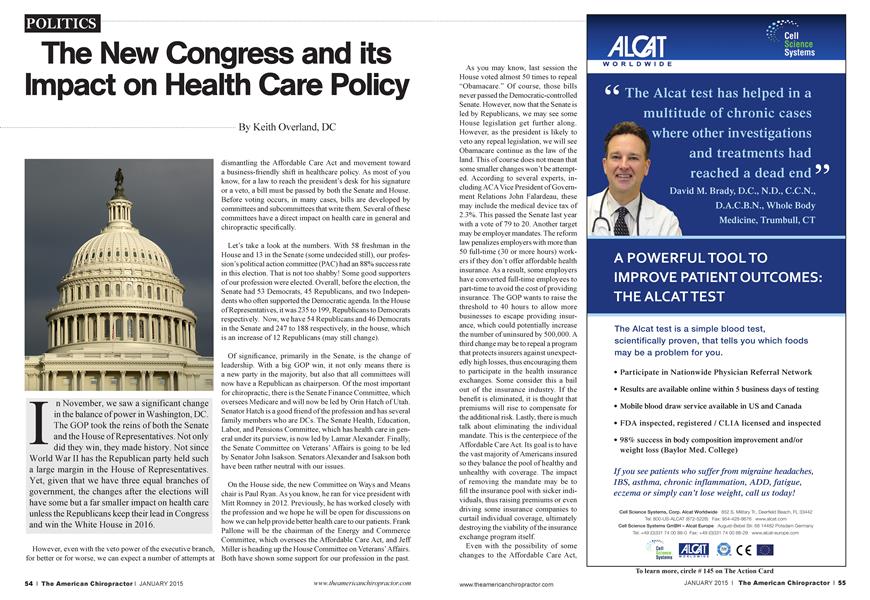
In November, we saw a significant change in the balance of power in Washington, DC. The GOP took the reins of both the Senate and the House of Representatives. Not only did they win, they made history. Not since World War II has the Republican party held such a large margin in the House of Representatives. Yet, given that we have three equal branches of government, the changes after the elections will have some but a far smaller impact on health care unless the Republicans keep their lead in Congress and win the White House in 2016.
However, even with the veto power of the executive branch, for better or for worse, we can expect a number of attempts at dismantling the Affordable Care Act and movement toward a business-friendly shift in healthcare policy. As most of you know, for a law to reach the president’s desk for his signature or a veto, a bill must be passed by both the Senate and House. Before voting occurs, in many cases, bills are developed by committees and subcommittees that write them. Several of these committees have a direct impact on health care in general and chiropractic specifically.
Let’s take a look at the numbers. With 58 freshman in the House and 13 in the Senate (some undecided still), our profession’s political action committee (PAC) had an 88% success rate in this election. That is not too shabby! Some good supporters of our profession were elected. Overall, before the election, the Senate had 53 Democrats, 45 Republicans, and two Independents who often supported the Democratic agenda. In the House of Representatives, it was 235 to 199, Republicans to Democrats respectively. Now, we have 54 Republicans and 46 Democrats in the Senate and 247 to 188 respectively, in the house, which is an increase of 12 Republicans (may still change).
Of significance, primarily in the Senate, is the change of leadership. With a big GOP win, it not only means there is a new party in the majority, but also that all committees will now have a Republican as chairperson. Of the most important for chiropractic, there is the Senate Finance Coimnittee, which oversees Medicare and will now be led by Orin Hatch of Utah. Senator Hatch is a good friend of the profession and has several family members who aie DCs. The Senate Health, Education, Labor, and Pensions Committee, which has health care in general under its purview, is now led by Lamar Alexander. Finally, the Senate Coimnittee on Veterans’ Affairs is going to be led by Senator John Isakson. Senators Alexander and Isakson both have been rather neutral with our issues.
On the House side, the new Coimnittee on Ways and Means chair is Paul Ryan. As you know, he ran for vice president with Mitt Romney in 2012. Previously, he has worked closely with the profession and we hope he will be open for discussions on how we can help provide better health care to our patients. Frank Pallone will be the chairman of the Energy and Commerce Coimnittee, which oversees the Affordable Care Act, and Jeff Miller is heading up the House Coimnittee on Veterans’ Affairs. Both have shown some support for our profession in the past.
As you may know, last session the House voted almost 50 times to repeal “Obamacare.” Of course, those bills never passed the Democratic-controlled Senate. However, now that the Senate is led by Republicans, we may see some House legislation get further along. However, as the president is likely to veto any repeal legislation, we will see Obamacare continue as the law of the land. This of course does not mean that some smaller changes won’t be attempted. According to several experts, including ACA Vice President of Government Relations John Falardeau, these may include the medical device tax of 2.3%. This passed the Senate last year with a vote of 79 to 20. Another target may be employer mandates. The reform law penalizes employers with more than 50 full-time (30 or more hours) workers if they don’t offer affordable health insurance. As a result, some employers have converted full-time employees to part-time to avoid the cost of providing insurance. The GOP wants to raise the threshold to 40 hours to allow more businesses to escape providing insurance, which could potentially increase the number of uninsured by 500,000. A third change may be to repeal a program that protects insurers against unexpectedly high losses, thus encouraging them to participate in the health insurance exchanges. Some consider this a bail out of the insurance industry. If the benefit is eliminated, it is thought that premiums will rise to compensate for the additional risk. Lastly, there is much talk about eliminating the individual mandate. This is the centerpiece of the Affordable Care Act. Its goal is to have the vast majority of Americans insured so they balance the pool of healthy and unhealthy with coverage. The impact of removing the mandate may be to fill the insurance pool with sicker individuals, thus raising premiums or even driving some insurance companies to curtail individual coverage, ultimately destroying the viability of the insurance exchange program itself.
Even with the possibility of some changes to the Affordable Care Act, there remains the lawsuit filed by House Republicans against the Obama administration that focused on two major areas. The first area concerns the administration’s decision to postpone the employer mandate to 2015. Second, the lawsuit alleges that President Obama gave $175 billion to insurance companies in violation of the law. This money was approved to be spent on subsides for lowerand middle-income people to help pay for insurance premiums. However, according to Speaker of the House John Boehner, those funds have not been appropriated by Congress, suggesting the president unlawfully transferred the funds.
Of course the issue of veteran’s health care has been all over the news.
Given the new GOP majority, we also need to look outside of the Affordable Care Act. In particular, we need to pay attention to the concept of the ability to purchase health insurance across state lines. Some of you may recall that several years ago, there was an effort to pass a bill called S. 1955, which we fought aggressively. It would have allowed folks to buy the least expensive insurance from anywhere across the country. This in essence could eliminate any state insurance requirements for coverage of doctors of chiropractic as well as other important mandated healthcare benefits. We must remember that a mandate is a need as detennined by a state’s legislature that the insurance industry did not voluntarily add to its policies. A majority of states required a mandate before our services were ever covered, while others had coverage but required a mandate to give patients a fair and appropriate benefit.
In Medicare, SGR “fix” bills are debated every year. They aie needed to postpone the reduction of medical fees to providers buy some 30%. To date, only temporary stopgap measures have been implemented. There is a lot of discussion about a permanent fix, but given its cost, it has never made it very far.
Of course, the issue of veterans’ health care has been all over the news. With poor care, long waiting times, and simply unacceptable operational conditions, we can expect to see this issue become front and center when all of the studies and task forces complete their reviews and recommendations. We hope those will include greater access to the conservative first approach to health care offered by doctors of chiropractic.
The bottom line is that health care, being 19% of our GDP, will be a hot topic for this Congress and for those to come. Our profession has many of the answers that regulators and legislators aie seeking. Given that there are many new freshmen, there has never been a better time for you to take a proactive step and meet with your congressional representatives at their home offices or at NCLC this February in Washington, DC. In most cases, they simply do not know about the role we can play in building a healthier America. You can and should become their hometown expert by sharing the facts about the chiropractic profession’s role in a new and better healthcare system. Take the time to get involved in your future. Your patients are counting on you!
Dr. Keith Overland is the immediate past president of the American Chiropractic Association and now is the chairman of the legislative committee and interim chairman of the chiropractic summit government relations committee. He can be contacted at [email protected]