WHY VITAMINS WON’T STOP ACID/ALKALINE IMBALANCE
NUTRITION
Donald L. Hayes
I spend a great deal of my time lecturing around the country and answering doctor’s questions on acid/ alkaline imbalance and its relationship to eating fruits and vegetables.
As healthcare providers we have a basic understanding of the physiology involved, but most of us lack knowledge and certainty on how the imbalance affects our treatment programs and clinical outcomes.
As far as our patients are concerned and the “lay” public at large, they know they should eat more plant based foods but beyond that, they don’t really have a clue why and they never seem to connect the lack of eating them to their current health problem or a future one.
Let me give you an example of what we in healthcare aie all dealing with. I was recently interviewed by an award-winning watchdog reporter with the Chicago Tribune who focuses on food and consumer issues. In this role this reporter examines how well the food industry and government agencies are serving the public and how consumers can make the best choices. I was being interviewed because of the recent release of my book, The E-Myth Nutritionist, I co-authored with NY Times Best Selling author Michael E. Gerber. The reporter quickly got to her passion which was nutrition and asked me the following question on the air: “Dr. Hayes, I don’t eat any fruit and vegetables and feel great, why then do I need to change my diet to include them”? Wow, did that blow me away! I didn’t expect that type of a question from such a savvy, well-educated professional, but it goes to show you we have a lot of work to do if we healthcare providers ai e going to make a difference and improve the wellness of the world.
Flashing back to my days of giving health care talks in my clinic and being asked similar direct questions in front of others, I simply went on automatic pilot. I stalled explaining about the medical condition known as oxidative stress, it’ relationship to acid/alkaline balance and the role fruits and vegetables play. I explained that oxidative stress is a condition that is created in the body when there aie more free radical molecules than antioxidants to neutralize them, and how that process contributes to inflammation and consequent tissue damage. I told her of Dr. Denham Harman, the father of the free radical theory of aging and how even though he proposed it in 1954, it was completely ignored by medical science until the late 1960’s when several scientific studies proved him right. Since then I told her that 80 known, non-germ, degenerative diseases have been linked to the consequences of oxidative stress and today scientists now believe that these diseases are not really separate things at all, but just different ways the body is expressing the results of a poor diet, lifestyle and environment.
To get to specifically answering her question of why eat fruits and vegetables today even if she now feels great, I explained to her of two published research studies done by Anthony Sebastian, MD, a professor at UCSF School of Medicine in Berkley California. Sebastian and his colleagues stated in a study that due to eating the Standard American Diet, which is devoid of sufficient fruits and vegetables, as we get older our alkaline bicarbonate reserves go down with a complete loss by the age of 40. (1) In other words, the body does have a “bank account” of alkalinity to draw from, but at some point all of us will be overdrawn and will suffer the consequences. To prove my point on acid/alkaline imbalance and oxidative stress I told her of another published study where Sebastian showed how metabolic acidosis and oxidative stress alone and interacting increase the risk of fracture in diabetic subjects. (2) Needless to say she was intrigued and went on to agree that eating more fruits and vegetables is a very good idea.
Whatever the free radical touches first and steals the electron from, is wrecked.
Oxidative Stress Acid/Alkaline Imbalance Review
As a refresher for my colleagues let me discuss a few key terms and then I will show you a typical timeline of progression that leads up to one or more of the known 80 plus lifestyle diseases attributed to oxidative stress.
Free Radical
A free radical is an atom or group of atoms with at least one unpaired electron. In the body, it's usually an oxygen molecule that has lost an electi on and needs to stabilize itself by stealing an electron from a nearby molecule. That process is called oxidation. Whatever the free radical touches first and steals the election from, is wrecked. If if s the cell wall, the cell dies. If if s the DNA, it causes a mutation that can lead to many diseases.
Free radicals only last for a tiny fraction of a second, but during their fleeting existence, they cause some serious structural damage to the cell. They often leave a huge path of destruction in their wake. Once a molecule is oxidized by a free radical, it often starts a chain reaction of oxidation until an antioxidant can stop it.
Antioxidants
Antioxidants ai e molecules that can donate an electron to another molecule that has an unpaired electron, like a free radical. Antioxidants basically change the free radical into a harmless molecule. They neutralize it before it touches something in the cell, which would damage it.
Without antioxidants, free radicals would cause so much damage that the cell's repair systems couldn't keep up. After years of constant free radical destin ction, wherever most of the damage happened is what health problem is developed. If it's in the blood vessels, it will be cardiovascular disease. If it's in the brain, it will be Alzheimer's. If it's in the eyes, it will be cataracts or maculai’ degeneration, etc.
Not all antioxidants are created equal. Each one "lives" in a different part of the cell, so a person needs lots of different ones to get full protection. Antioxidants also need other antioxidants to work properly, so a person doesn’t get the full benefit if they only have a few.
Antioxidants Work in Synergy
Antioxidants work in synergy, in other words they work best when consumed in their natural state as phytonutrients from fruits and vegetables. Studies giving people large doses of just one antioxidant have provided disappointing results and have even showed that the condition being studied got worse, i.e., Vitamin E and heart disease or Beta-carotene and smokers. Only recently have studies been done with multiple antioxidants and what is being discovered is that the more antioxidants being used in the studies, the more dramatic the results.
Balancing Free Radicals and Antioxidants
A person can't possibly avoid free radicals. All you can do is make sure you have enough antioxidants to minimize the damage. Free radicals and antioxidants ai e in a constant power struggle. Free radicals ai e not entirely bad. They play a key role in breathing and are important to the immune system by being partly responsible for killing bacteria and other invaders of the body. They also help start the inflammatory process that helps repair injury. Free radicals and antioxidants are both important to your health. The key is to balance the two.
Acid/Alkaline Balance and Health
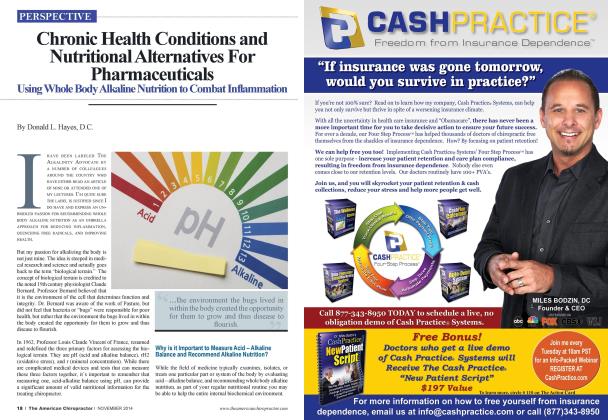
A good case can be made that health depends on a balance between free radicals, oxidative stress and the body’s antioxidant defenses (reserves). There is also a direct link between oxidative stress, antioxidants and acid/alkaline balance.
Aging and chr onic diseases reflect the inability of our antioxidant defenses (alkaline reserves) to cope with oxidative stress (acidic overload) overtime. The good news is that with strong antioxidant reserves and defenses, long life without disease should be possible.
Oxidative Stress and Acid/Alkaline Imbalance Timeline
I want to connect the dots and provide a simple step-by-step oxidative stress acid/alkaline imbalance timeline. In addition, let’s assume the typical patient besides eating poorly has presented themselves with an acute/chronic structural sprain/ strain injury. The injury alone creates a tremendous amount of additional free radicals that the body must deal with, but when the injury is coupled with the typical lifestyle listed below, you begin to see why an aggressive therapeutic phytonutrient rich supplement program is warranted from the very first visit.
1. Patient presents with an acute/chronic structural sprain/ strain injury.
2. Patient consumes too few foods that burn to alkaline ash (Fruits & Vegetables).
3. Patient consumes too many foods that bum to acid ash (Animal, Dairy, Sugar, Processed etc.).
4. Poor food choices + oxygen, injured tissues and poor lifestyle produce Free Radicals.
5. Free Radical production signals body into an emergency status.
6. The body is knocked out of Homeostasis (Walter C annon & Arthur Guyton).
7. The body is put into a state of Oxidative Stress. Acid/ Alkaline Imbalance & Inflammation
This State Contributes To:
8. Increasing inflammatory markers like (C-Reactive Pro tein - CRP).
9. Decreasing the inflammatory marker Adiponectin. (Only inflammatory marker inversely related)
10. Decreasing Saliva pH (becomes more acidic) due to decrease in Adiponectin.
11. Depleting Alkaline & Antioxidant Reserves (Anthony Sebastian / Berkeley).
12. Creating an imbalance between Oxidative Stress & Antioxidant Defenses
13. Causing a shift from Anti-inflammatorv to Pro-inflammatory status.
14. Further exacerbating fatigue, inflammation and tissue breakdown.
15. Possible cause of one of the 80 known “non germ” flee radical damage diseases.
Conclusion
Inflammation is always created in the presence of oxidative stress, flee radical damage and acid/alkaline imbalance. Leading pathology textbooks suggest that almost all known diseases are caused by inflammation. Scientists no longer think of inflammation strictly as a local phenomenon, they say it’s global. This means that we can no longer accept that inflammation in one part of the body is somehow isolated from every other part of the body. If inflammation starts out affecting one part of the body, say the neck or low back, the associated physiologic chemicals will be present in other parts of the body as well.
Oxidative stress, free radical damage and acid/alkaline imbalance are not due to a vitamin deficiency, therefore recommending isolated antioxidants or a combination of vitamins and minerals is not the answer.
Instead, recommend patients employ one of three options: 1) follow the USDA guidelines of having their plate half full of a variety of fruits and vegetables at every meal, www.choosemyplate.gov, 2) use a blender to make a drink that contains a large assortment of dark green and brightly colored fruits and vegetables two to three times a day, or 3) consume a whole food phytonutrient rich supplement containing 40-50 different fruits, vegetables and super foods first thing in the morning and a phytonutrient rich supplement designed for late afternoon use to provide 24 hour around the clock oxidative stress protection. If using the supplemental approach be sure to offer both products on the first visit, and continue them for 30 to 90 days or until the patient’s objective measurements of health have been achieved. For most patients it would be an excellent idea to keep them on the daytime phytonutrient supplement for maintenance.
Any of the three strategies listed above should be sufficient to help increase and maintain antioxidant reserves, combat free radical damage, support acid/alkaline balance while also helping to reduce inflammation, repair injuries and restore vitality.
Reference:
(1) Journal of Gerontology A Biological Science, 1996 Jan; 51 (1) :B91-9
(2) Med Hypotheses. 2012 Aug; 79(2): 189-92.
Dr. Donald L. Hayes, DC is a clinician educator and author in the field of alkalizing nutrition and has delivered post graduate nutritional seminars to thousands of doctors and staff. Dr. Hayes is owner and President of Greensfirst, the chiropractic profession's number one alkalizing whole-food fruit and vegetable nutritional supplement. He can be reached at 866-410-1818 or at www.greensfirst.com