Seven-Year Idiopathic Foot Drop: A Valleix Phenomenon
EVALUATION
Mitch Mally
Whether your patients complain of knee, hip, low back pain, sciatica, headaches, etc., always evaluate the foundation of the structure—the feet, which represent 25% of the human skeleton (26 bones in each foot = 52 of 206 bones in the skeleton).
The biomechanics of any shift in an architectural structure has profound and potentially deleterious effects on the suprastructure above it. The following is a typical case study of hundreds of comparable cases of misdiagnoses that yielded poor clinical outcomes and resulted in a lack of hope, chronic unnecessary pain and suffering, and questioning of one’s own profession—a colleague. There is absolutely no reason for this nonsense! Confucius said, “Do not do efficiently what need not have to be done.”
Stop hitting the dashboard to get the gas light to go off!
Case Study: A 62-year-old male patient presented with seven years of idiopathic foot drop (right), exquisite low back pain, confirmed bulging discs at L-4-5 and L5-S1, right S-I pain, and right sciatica. History disclosed an acute sudden onset of symptomatology with no prior pertinent additional medical history provided.
Prior treatment consisted of numerous chiropractic treatments to the lumbar spine, pelvis, and sacrum, physiotherapy, traction, and laser, all to no avail. The condition(s) remained recalcitrant to all conservative measures and patient frustration resulted in portal of entry for care into traditional medical model for the same or similar sequelae.
Having exhausted all conservative and allopathic means for correction and/or relief, which afforded neither, this patient lived a life of disdain and disgust and experienced the same maladies of complaints seven years later.
At one of my speaking venues on lower extremities, a doctor of chiropractic presented this case, his own story, and immediately the audience and I listened intently to his heartfelt disgust, anguish, and frustration. Asking him to come to the front of the lecture hall, I addressed this colleague with a novel concept. Facetious as I was, I asked if he had any prior history
ofincident(s) related to the foot and/or ankle of the ipsilateral symptomatic side.
He paused, looked at me bewildered, and replied, “That’s amazing. I never thought that an ankle sprain two years prior to the onset of the aforementioned refractory conditions could or would be contributory.”
Let’s review the facts as they presented. A right ankle sprain (inversion) allegedly responded without any mediated care two years prior to developing right low back pain, S-I pain, right sciatica, and ultimately right foot drop.
A review of the anatomy and biomechanics of the inversion sprain evinces possible entrapment neuropathy of the common peroneal nerve as it courses beneath the lateral malleolus. Damage of the lateral compartment of the ankle often results in the “goose egg” appearance, not only resulting in pain and edema, but moreover the potential for compression of the common peroneal nerve traversing the outer ankle. Long-term sequelae results in connective tissue hyperplasia, and said fibrosis of repair promulgates scar tissue, often resulting in entrapment. In this case, the patient’s ankle sprain resulted in the classic antalgic gait and traditional treatment, including icing, elevation, and rest.
Failure to receive proper specialized manual manipulation of the subluxated calcaneus, talus, etc. resulted in aberrant weight distribution, faulty biomechanics of the foot/ankle, overpronation, and an abnormal gait cycle. The ensuing compensatory changes to the knee, hip, pelvis, and spine, termed “valleix phenomenon,” resulted in more proximal neuromusculoskeletal adaptive changes that culminated in various arbitrary yet predictable pain-distribution patterns. This sequence of events after an ankle sprain is so common that I consider it pathognomonic. As a result, and more often than not, this proves to be a battleground for the practitioner and a field of agony for the patient.
This “authentic” biomechanical rationale is the result of more than 34 years of evaluating and treating hundreds of comparable cases that have otherwise failed all other approaches. Failure to recognize this phenomenon complicates the diagnosis, often confusing the practitioner, and commonly yields erroneous results due to misdiagnosis.
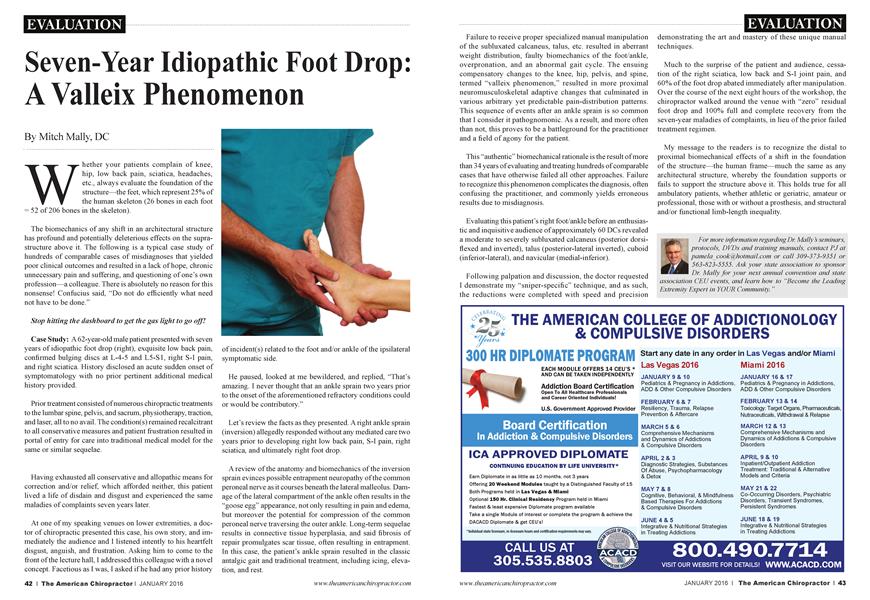
Evaluating this patient’s right foot/ankle before an enthusiastic and inquisitive audience of approximately 60 DCs revealed a moderate to severely subluxated calcaneus (posterior dorsifiexed and inverted), talus (posterior-lateral inverted), cuboid (inferior-lateral), and navicular (medial-inferior).
Following palpation and discussion, the doctor requested I demonstrate my “sniper-specific” technique, and as such, the reductions were completed with speed and precision
demonstrating the art and mastery of these unique manual techniques.
Much to the surprise of the patient and audience, cessation of the right sciatica, low back and S-I joint pain, and 60% of the foot drop abated immediately after manipulation. Over the course of the next eight hours of the workshop, the chiropractor walked around the venue with “zero” residual foot drop and 100% full and complete recovery from the seven-year maladies of complaints, in lieu of the prior failed treatment regimen.
My message to the readers is to recognize the distal to proximal biomechanical effects of a shift in the foundation of the structure—the human frame—much the same as any architectural structure, whereby the foundation supports or fails to support the structure above it. This holds true for all ambulatory patients, whether athletic or geriatric, amateur or professional, those with or without a prosthesis, and structural and/or functional limb-length inequality.
For more information regarding Dr. Mally ’s seminars,
] protocols, DVDs and training manuals, contact PJ at . pamela cooMfhotmail.com or call 309-373-9351 or 563-823-5555. Ask your state association to sponsor Dr. Mally for your next annual convention and state association CEU events, and learn how to “Become the Leading Extremity Expert in YOUR Community. ”