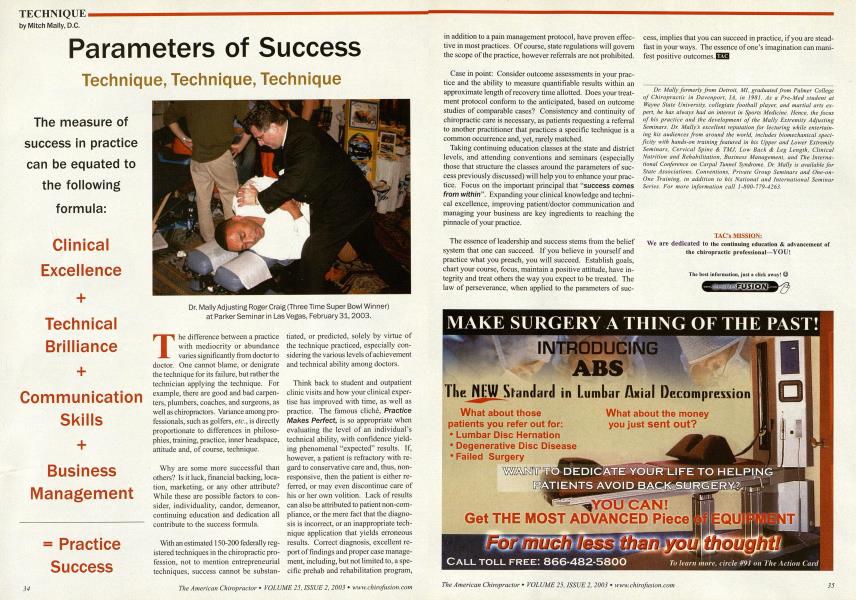
The measure of success in practice can be equated to the following formula: Clinical Excellence Technical Brilliance + Communication Skills + Business Management = Practice Success u T he difference between a practice with mediocrity or abundance varies significantly from doctor to doctor. One cannot blame, or denigrate the technique for its failure, but rather the technician applying the technique. For example, there are good and bad carpenters, plumbers, coaches, and surgeons, as well as chiropractors. Variance among professionals, such as golfers, etc., is directly proportionate to differences in philosophies, training, practice, inner headspace, attitude and, of course, technique. Why are some more successful than others? Is it luck, financial backing, location, marketing, or any other attribute? While these are possible factors to consider, individuality, candor, demeanor, continuing education and dedication all contribute to the success formula. With an estimated 150-200 federally registered techniques in the chiropractic profession, not to mention entrepreneurial techniques, success cannot be substan- tiated, or predicted, solely by virtue of the technique practiced, especially considering the various levels of achievement and technical ability among doctors. Think back to student and outpatient clinic visits and how your clinical expertise has improved with time, as well as practice. The famous cliche, Practice Makes Perfect, is so appropriate when evaluating the level of an individual's technical ability, with confidence yielding phenomenal "expected" results. If, however, a patient is refractory with regard to conservative care and, thus, non-responsive, then the patient is either referred, or may even discontinue care of his or her own volition. Lack of results can also be attributed to patient non-compliance, or the mere fact that the diagnosis is incorrect, or an inappropriate technique application that yields erroneous results. Correct diagnosis, excellent report of findings and proper case management, including, but not limited to, a specific prehab and rehabilitation program, in addition to a pain management protocol, have proven effective in most practices. Of course, state regulations will govern the scope of the practice, however referrals are not prohibited. Case in point: Consider outcome assessments in your practice and the ability to measure quantifiable results within an approximate length of recovery time allotted. Does your treatment protocol conform to the anticipated, based on outcome studies of comparable cases? Consistency and continuity of chiropractic care is necessary, as patients requesting a referral to another practitioner that practices a specific technique is a common occurrence and, yet, rarely matched. Taking continuing education classes at the state and district levels, and attending conventions and seminars (especially those that structure the classes around the parameters of success previously discussed) will help you to enhance your practice. Focus on the important principal that "success comes from within". Expanding your clinical knowledge and technical excellence, improving patient/doctor communication and managing your business are key ingredients to reaching the pinnacle of your practice. The essence of leadership and success stems from the belief system that one can succeed. If you believe in yourself and practice what you preach, you will succeed. Establish goals, chart your course, focus, maintain a positive attitude, have integrity and treat others the way you expect to be treated. The law of perseverance, when applied to the parameters of sue- cess, implies that you can succeed in practice, if you are steadfast in your ways. The essence of one's imagination can manifest positive outcomes. I Dr. Mally formerly from Detroit, Ml, graduated from Palmer College of Chiropractic in Davenport, IA, in 1981. As a Pre-Med student at Wayne State University, collegiate football player, and martial arts expert, he has always had an interest in Sports Medicine. Hence, the focus of his practice and the development of the Mally Extremity Adjusting Seminars. Dr. Mally's excellent reputation for lecturing while entertaining his audiences from around the world, includes biomechanical specificity with hands-on training featured in his Upper and Lower Extremity Seminars, Cervical Spine & TMJ, Low Back & Leg Length, Clinical Nutrition and Rehabilitation, Business Management, and The International Conference on Carpal Tunnel Syndrome. Dr. Mally is available for State Associations, Conventions, Private Group Seminars and One-on-One Training, in addition to his National and International Seminar Series. For more information call 1-800-779-4263. TAC's MISSION: We are dedicated to the continuing education & advancement of the chiropractic professional—YOU! Dr. Mally Adjusting Roger Craig (Three Time Super Bowl Winner) at Parker Seminar in Las Vegas, February 31,2003.