The Secret in the Sauce
ANALGESICS
The Lotions You are Using aren't so Complicated
Bob Bray
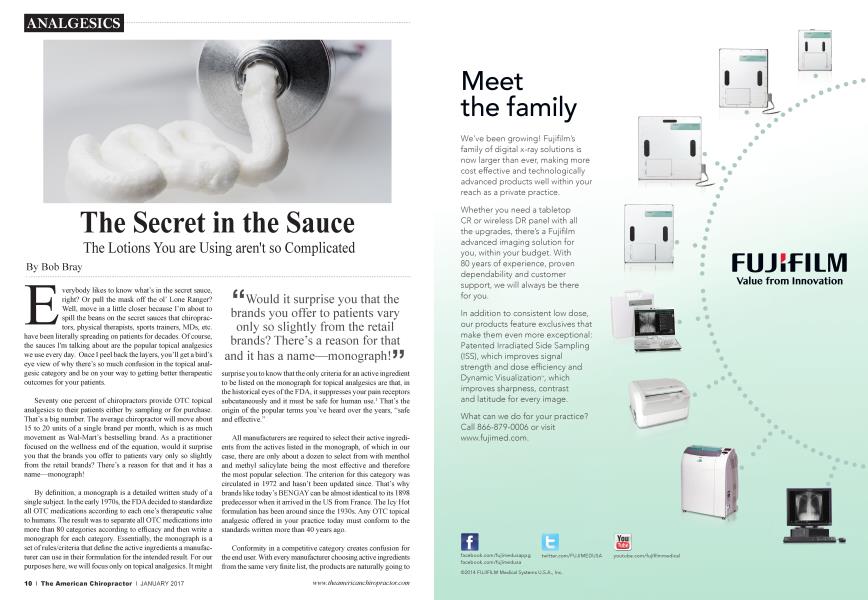
Everybody likes to know what’s in the secret sauce, right? Or pull the mask off the ol’ Lone Ranger? Well, move in a little closer because I’m about to spill the beans on the secret sauces that chiropractors, physical therapists, sports trainers, MDs, etc. have been literally spreading on patients for decades. Of course, the sauces I'm talking about are the popular topical analgesics we use every day. Once I peel back the layers, you’ll get a bird’s eye view of why there’s so much confusion in the topical analgesic category and be on your way to getting better therapeutic outcomes for your patients.
Seventy one percent of chiropractors provide OTC topical analgesics to their patients either by sampling or for purchase. That’s a big number. The average chiropractor will move about 15 to 20 units of a single brand per month, which is as much movement as Wal-Mart’s bestselling brand. As a practitioner focused on the wellness end of the equation, would it surprise you that the brands you offer to patients vary only so slightly from the retail brands? There’s a reason for that and it has a name—monograph!
By definition, a monograph is a detailed written study of a single subject. In the early 1970s, the FDA decided to standardize all OTC medications according to each one’s therapeutic value to humans. The result was to separate all OTC medications into more than 80 categories according to efficacy and then write a monograph for each category. Essentially, the monograph is a set of rules/criteria that define the active ingredients a manufacturer can use in their formulation for the intended result. For our purposes here, we will focus only on topical analgesics. It might
Would it surprise you that the brands you offer to patients vary only so slightly from the retail brands? There’s a reason for that and it has a name—monograph! J J
surprise you to know that the only criteria for an active ingredient to be listed on the monograph for topical analgesics are that, in the historical eyes of the FDA, it suppresses your pain receptors subcutaneously and it must be safe for human use.1 That’s the origin of the popular terms you’ve heard over the years, “safe and effective.”
All manufacturers are required to select their active ingredients from the actives listed in the monograph, of which in our case, there are only about a dozen to select from with menthol and methyl salicylate being the most effective and therefore the most popular selection. The criterion for this category was circulated in 1972 and hasn’t been updated since. That’s why brands like today’s BENGAY can be almost identical to its 1898 predecessor when it arrived in the US from France. The Icy Hot formulation has been around since the 1930s. Any OTC topical analgesic offered in your practice today must conform to the standards written more than 40 years ago.
Conformity in a competitive category creates confusion for the end user. With every manufacturer choosing active ingredients fr om the same very finite list, the products are naturally going to
be very similar in analgesic properties, albeit with varying combinations and concentrations. So what really makes one product different ffom the other? The short answer is not much—one is a cream, one is a gel, one is odorless, one is greaseless, one is a roll-on, one is a spray, one has a cooling effect, one is hot, and one is both. Of course, there are varying concentrations of the actives, but the reality is that for the most part these are simply different ways to apply the product or to provide a certain sensation, like cool or heat, without much real change in efficacy.
Practitioners today are learning to dig into the list of inactives where you find the real treasures that produce better outcomes. In the early 1990s, the Bioffeeze people added an extract called ilex to a pretty basic menthol formulation and built an empire providing a cooling effect. Ingredients like arnica have been regularly used to bump up analgesic values for a more natural analgesic end product. Arnica is not a part of the monograph and, as such, is not listed as an active ingredient, so you have to look for it on the back panel of the label.
Maybe you want to add a strong anti-inflammatory dimension to your program. Look, for example, to find turmeric (curcumin), boswellia serrata, calendula, MSM, and broccoli seed extract hi the formulation. However, the focus of the monograph for topicals is only on analgesic properties. Anti-inflammatory properties are deemed outside of the scope of the monograph. As such, they are not considered an active ingredient, even though, as a holistic-leaning practitioner, you know the value of a good,
all-natural anti-inflammatory.
If you want better outcomes ffom your topical analgesic, you can’t depend on conventional methods and sales hype. You have to go to the bottom of the drag facts panel and do some digging. Know what you want to improve, like anti-inflammatory properties. Usually the inactives are listed alphabetically making the above constituents easy to locate. Behig alphabetical could allow for water to be listed last too because you can bury the fact that most of these formulations are about 60% water—purified, of course.
References
1. Federal Register/Vol. 48 No. 27/ Tuesday, February 8, 1983/Proposed Rules/pg. 27
2. Siddiqui MZ Boswellia serrata, a potential anti-inflammatory agent: an overview . Indian JPharm Sci. (2011)
3. Ukiya, M., et al. (2006). Anti-inflammatory, anti-tumor-promoting, and cytotoxic activities of constituents ofpot marigold (Calendula officinalis) flowers. JNat Prod. 69 1692-96.
a Robert Bray, EX VP & General Manager, Longeva Labs. Inc., Oklahoma City. Has been involved at the executive level in the IMS (vitamin, mineral, supplements) sector since 1991. For the past 15 years has headed all aspects of product development, manufacturing and marketing of homeopathic and OTC medications, most recently steering the proprietary analgesic anti-inflammatory miraFlex-R3 formulation. You may contact him at his office, 405-848-5990.