Topical Analgesics Are about to Make a Radical Change
ANALGESICS
Bob Bray
Thirty years ago, you’d take an aspirin if you had a headache, right? If you take an aspirin today, it’s because you think you’re having a heart attack! What happened? The short story is that ibuprofen hit the market in 1984, followed by naproxen, and just like that, aspirin had to reinvent itself.
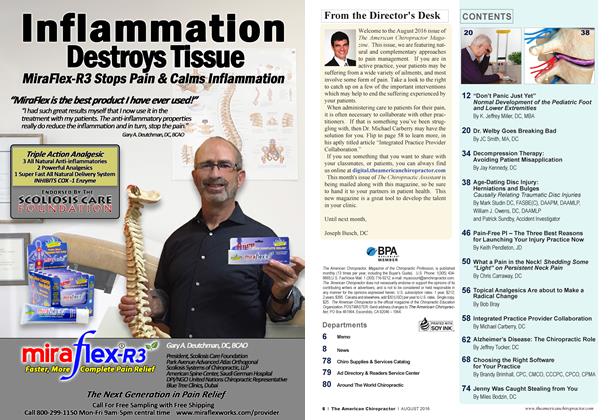
The same thing is beginning to happen in the topical analgesic category. Brands that have been around for decades are losing market share for the first time ever to new players with fresh approaches to musculoskeletal pain relief. As you know, pain relief is only part of the equation. It’s just as important to calm inflammation when relieving a patient’s pain. The new guys are not only aggressively addressing inflammation in their formulations, but they also are employing methods of delivering the medication faster and more efficiently than the older conventional brands. They are coming up with some surprisingly simple but highly effective and even all-natural solutions. There has been such a tremendous market response that consumers and practitioners alike are beginning to shift their loyalties. It happened in the internal (ingestible) analgesic category 30 years ago, and now it’s happening in the external (topical) category.
For example, according to IRI data (Information Resources, Inc.)1, brands such as BENGAY (which entered the US market in 1898) are rapidly losing to new brands that focus as much on contributing factors like inflammation as they do on the analgesic end of the pain-management equation. Some brands, while remaining OTC compliant and featuring folk favorites like arnica, are experiencing more than 40% annual growth. Of the top 10 selling topical analgesics, four of them were unheard of just 36 months ago. These new guys are now averaging more than 60% growth annually even at much higher retail prices.
■ *The new guys are not only aggressively addressing inflammation in their formulations, but they also are employing methods of delivering the medication faster and more efficiently than the older conventional brands. J J
Icy Hot is outspending everyone, spending a fortune in advertising dollars, just to tread water with market share and hang onto their number one position. On the flip side, Salonpas slipped quietly into the number two spot last year while everyone was asking, “Whoever heard of Salonpas?” Incidentally, the growth in what I’ll call “complimentary” analgesic sales is not coming from market expansion, but rather from consumers switching brands for better efficacy. There’s the paradigm shift. Ibuprofen was better at providing overall relief than aspirin, and today’s new generation of topicals provide better overall outcomes than conventional formulations.
The switch in loyalty is clearly due to “improved efficacy.” Today, consumers aie looking to more natural and less conventional products.2’3 The new breed of manufacturers ai e on a converging path with consumers. They have looked beyond the outdated monograph for a competitive advantage by offering formulas that reflect more therapeutic values based on contemporary science. This would include, in particular, the addition of natural anti-inflammatories, which can easily be added to a good formulation and provide expediential value
■ "However, aloe vera also works like a magnet by attracting both water-soluble and fat-soluble
compounds equally and carrying them through the skin barrier with speed and efficiency. J J
to the patient outcome.
Kick that up a notch by wrapping the formulation in a proven delivery vehicle for better and faster absorption, and your patient has a home run. One example is the widespread use of aloe vera as the delivery vehicle. Aloe vera has a long-established reputation for its ability to easily and quickly penetrate the human skin. However, aloe vera also works like a magnet by attracting both water-soluble and fat-soluble compounds equally and carrying them through the skin barrier with speed and efficiency. The analgesics get to the affected area faster and more efficiently and the introduction of anti-inflammatories provides a whole other therapeutic dimension.4-5
The result is faster, more complete relief as we say goodbye to old, single-dimension formulations and say hello to a new generation of analgesics that make a difference in how patients (consumers) view pain management. I wonder how conventional brands will be able to reinvent themselves!
References:
1. IRI for the 52 weeks ended Aug. 10, Total U.S. Multi-Outlet (supermarkets, dmg stores, mass market retailers, military commissaries and select club and dollar retail chains)
2. Chain Dmg Review - Growth Drivers, Barriers in Self Care Market, April 27, 2015
3. Chain Drug Review - Clamor is for More Natural in OTC's, September 14,2015
4. International Journal of Dmg Development and Research, Aloe Vera as Penetration Enhancer
5. International Journal of Pharmaceutics, Skin permeation Enhancement Potential of Aloe Vera, Louise Cole, Charles Heard, Welsh School of Pharmacy, Cardiff University, Cardiff, United Kingdom, September 25,2006
6. Davis, Robert H., Univera Pharmaceuticals, Inc., Method of Using Aloe Vera as a Biological Vehicle (United States Patent 5708038), 01/13/1998.
Robert Bray, EX VP & General Manager, Longeva Labs. Inc., Oklahoma City. Has been involved at the executive level in the VMS (vitamin, mineral, supplements) sector since 1991. Lor the past 15 years has headed all aspects of product development, manufacturing and marketing
of homeopathic and OTC medications, most recently steering the proprietary analgesic/anti-inflammatory miraLlex-R3 formulation. You may contact him at his office, 405-848-5990.