What to Look for in a Supplement
NUTRITION
Todd Singleton
DC
We know that our patients do best when we take a holistic approach to their health. D. D. Palmer, the father of the chiropractic profession, taught that focusing on all three areas of health (physical, emotional, and chemical) will achieve the best possible results.1 In the 1910 text, The Chiropractor’s Adjuster, he emphasized the importance of this “triad of health.”
There are some easy ways to accomplish this. You can address your patients’ emotional health by having warm, caring staff members who take care of them when they come into the office. Their physical wellness is the area where we feel most comfortable. As chiropractors, it is all about the hands-on treatment they receive during their appointments. Their chemical health—the third part of the triad—includes dietary guidelines and great supplementation.
The National Health and Nutrition Examination Survey (NHANES) conducted a cross-sectional survey about the use of supplementation in American adults.2 According to their findings, 49% of adults reported use of supplements to maintain their general health. Awareness of the importance of nutritional supplementation is growing, but not all supplements are safe and effective.
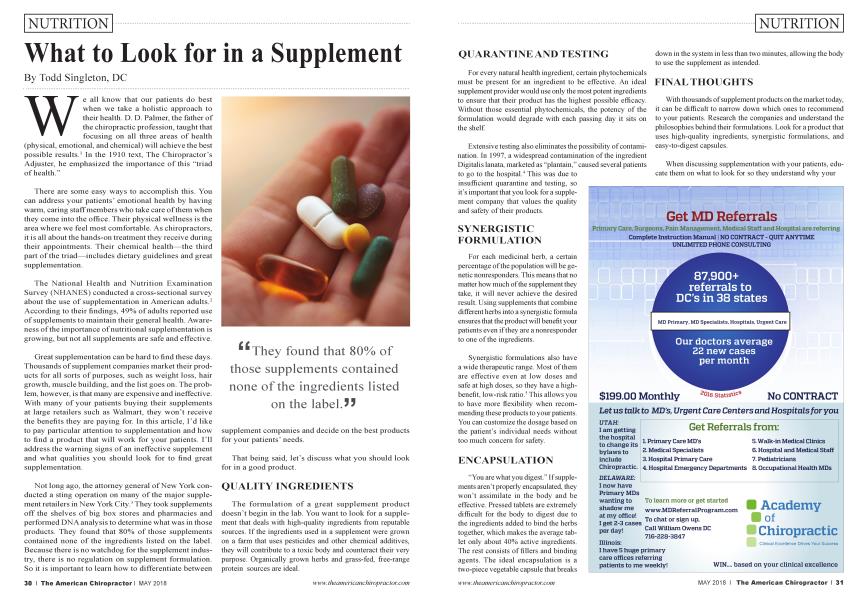
Great supplementation can be hard to find these days. Thousands of supplement companies market their products for all sorts of purposes, such as weight loss, hair growth, muscle building, and the list goes on. The problem, however, is that many are expensive and ineffective. With many of your patients buying their supplements at large retailers such as Walmart, they won’t receive the benefits they are paying for. In this article, I’d like to pay particular attention to supplementation and how to find a product that will work for your patients. I’ll address the warning signs of an ineffective supplement and what qualities you should look for to find great supplementation.
Not long ago, the attorney general of New York conducted a sting operation on many of the major supplement retailers in New York City.3 They took supplements off the shelves of big box stores and pharmacies and performed DNA analysis to determine what was in those products. They found that 80% of those supplements contained none of the ingredients listed on the label. Because there is no watchdog for the supplement industry, there is no regulation on supplement formulation. So it is important to learn how to differentiate between
"They found that 80% of those supplements contained none of the ingredients listed on the label."
supplement companies and decide on the best products for your patients’ needs.
That being said, let’s discuss what you should look for in a good product.
QUALITY INGREDIENTS
The formulation of a great supplement product doesn’t begin in the lab. You want to look for a supplement that deals with high-quality ingredients from reputable sources. If the ingredients used in a supplement were grown on a farm that uses pesticides and other chemical additives, they will contribute to a toxic body and counteract their very purpose. Organically grown herbs and grass-fed, free-range protein sources are ideal.
QUARANTINE AND TESTING
For every natural health ingredient, certain phytochemicals must be present for an ingredient to be effective. An ideal supplement provider would use only the most potent ingredients to ensure that their product has the highest possible efficacy. Without those essential phytochemicals, the potency of the formulation would degrade with each passing day it sits on the shelf.
Extensive testing also eliminates the possibility of contamination. In 1997, a widespread contamination of the ingredient Digitalis lanata, marketed as “plantain,” caused several patients to go to the hospital.4 This was due to insufficient quarantine and testing, so it’s important that you look for a supplement company that values the quality and safety of their products.
SYNERGISTIC FORMULATION
For each medicinal herb, a certain percentage of the population will be genetic nonresponders. This means that no matter how much of the supplement they take, it will never achieve the desired result. Using supplements that combine different herbs into a synergistic formula ensures that the product will benefit your patients even if they are a nonresponder to one of the ingredients.
Synergistic formulations also have a wide therapeutic range. Most of them are effective even at low doses and safe at high doses, so they have a highbenefit, low-risk ratio.5 This allows you to have more flexibility when recommending these products to your patients.
You can customize the dosage based on the patient’s individual needs without too much concern for safety.
ENCAPSULATION
“You are what you digest.” If supplements aren’t properly encapsulated, they won’t assimilate in the body and be effective. Pressed tablets are extremely difficult for the body to digest due to the ingredients added to bind the herbs together, which makes the average tablet only about 40% active ingredients.
The rest consists of fillers and binding agents. The ideal encapsulation is a two-piece vegetable capsule that breaks
down in the system in less than two minutes, allowing the body to use the supplement as intended.
FINAL THOUGHTS
With thousands of supplement products on the market today, it can be difficult to narrow down which ones to recommend to your patients. Research the companies and understand the philosophies behind their formulations. Look for a product that uses high-quality ingredients, synergistic formulations, and easy-to-digest capsules.
When discussing supplementation with your patients, educate them on what to look for so they understand why your
recommendation is important. Not only will they appreciate your advice, but they’ll also see the results they’re looking for. With proper focus on all three areas of your patients’ health— emotional, physical, and chemical—your patients will have the optimum environment for health both inside and out.
References:
Palmer, David D. The chiropractor’s adjuster. Atlaxis, 2014. Bailey, Regan L., el al. “Why US adults use dietary supplements. ” JAMA internal medicine 173.5 (2013): 355-361.
O ’Connor, Anahad. “New York attorney general targets supplements at major retailers. ” New York Times 3 (2015).
Slifman, Nancy R, et al. “Contamination of botanical dietary supplements by Digitalis lanata. ” New England Journal of Medicine 339.12 (1998): 806-811.
Parasuraman, Subramani, Gan Siaw Thing, and Sokkalingam Arumugam Dhanaraj. “Polyherbal formulation: Concept of Ay urveda. ” Pharmacognosy Reviews 8.16 (2014): 73-80. PMC. Web. 14 Feb. 2018.
Todd Singleton, DC, is an author, speaker, and consultant who has been a practicing doctor for more than 28 years. He ran the largest MD DC PT clinics in Utah before switching to an all-cash nuTition model in 2006. He created a very successful cash practice in Salt Lake City and now spends his time speaking, teaching, consulting, and visiting other offices all over the United States. For more information on implementing nutritional protocols in your clinic, call 801917-0900 or visit www.ArticlesByDrSingleton.com