Effective Communication
Kristi Hudson
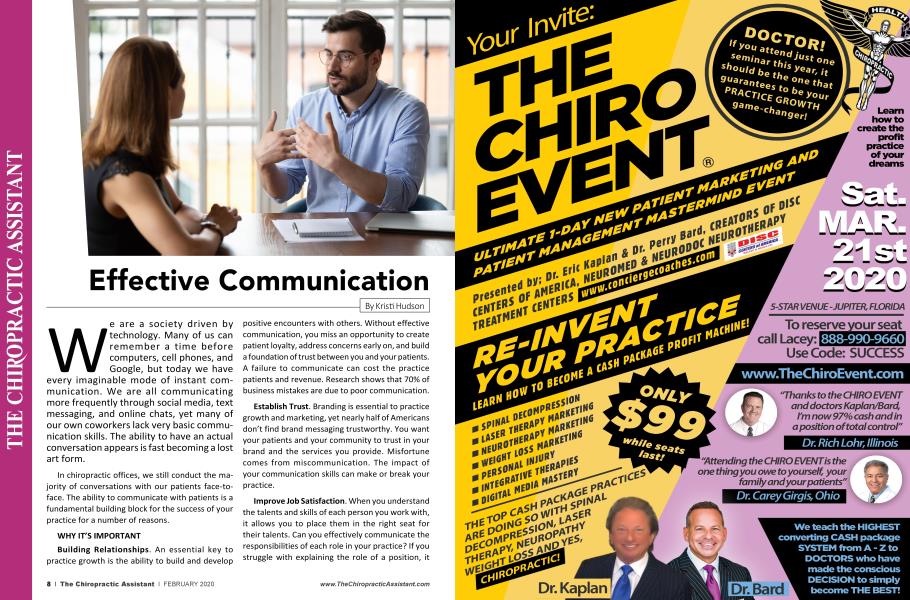
We are a society driven by technology. Many of us can remember a time before computers, cell phones, and Google, but today we have every imaginable mode of instant communication. We are all communicating more frequently through social media, text messaging, and online chats, yet many of our own coworkers lack very basic communication skills. The ability to have an actual conversation appears is fast becoming a lost art form.
In chiropractic offices, we still conduct the majority of conversations with our patients face-toface. The ability to communicate with patients is a fundamental building block for the success of your practice for a number of reasons.
WHY IT'S IMPORTANT
Building Relationships. An essential key to practice growth is the ability to build and develop positive encounters with others. Without effective communication, you miss an opportunity to create patient loyalty, address concerns early on, and build a foundation of trust between you and your patients. A failure to communicate can cost the practice patients and revenue. Research shows that 70% of business mistakes are due to poor communication.
Establish Trust. Branding is essential to practice growth and marketing, yet nearly half of Americans don't find brand messaging trustworthy. You want your patients and your community to trust in your brand and the services you provide. Misfortune comes from miscommunication. The impact of your communication skills can make or break your practice.
Improve Job Satisfaction. When you understand the talents and skills of each person you work with, it allows you to place them in the right seat for their talents. Can you effectively communicate the responsibilities of each role in your practice? If you struggle with explaining the role of a position, it should not come as a surprise when the person in that role struggles with the responsibilities. Effective communication can add clarity, improve productivity, and improve job satisfaction. Everyone wants to do a good job. You just have to let them know what that is.
HOW TO IMPROVE
We spend 50—80% of our time at work communicating with others. Communication is not an exact science, but here are a few things that you can do to help you improve your communication skills.
Make eye contact. Eye contact shows the other person that you are engaged in the conversation.
Posture. Most communication is nonverbal, so be sure that your posture and body language indicate that you are interested in what the other person is saying.
Eliminate distractions. Focus your attention on the person speaking by silencing and putting away your cell phone and other electronic devices.
Listen. Be an active listener and show others that they have your full engagement. Paraphrase what others are saying back to them to confirm clarity and show them you understand their meaning.
Communication affects every aspect of our lives, personally and professionally. In Steven Covey's book, 7 Habits of Highly Effective People, he says, "Seek first to understand, then to be understood." Before we can impact and change the people around us, we first have to take the time to understand where they are coming from. Without effective communication, we miss an opportunity to become effective leaders, inspire others, and share chiropractic with our communities.
Kristi Hudson is a certified professional compliance officer (CPCO). She serves as the Director of Business Relationships for ChiroHealthUSA where she has helped to educate DCs and CAs on establishing simple and compliant financial policies. You can contact Kristi at 888-719-9990 or Kristi@chirohealthusa. com, or you can visit the ChiroHealthUSA website at www. chirohealthusa. com.