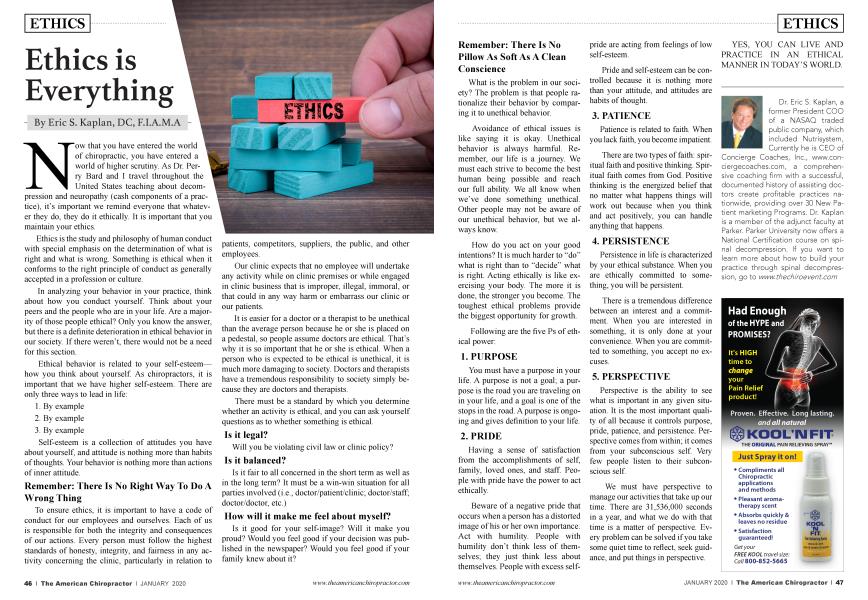
Ethics is Everything
ETHICS
Eric S. Kaplan
DC, F.I.A.M.A
Now that you have entered the world of chiropractic, you have entered a world of higher scrutiny. As Dr. Perry Bard and I travel throughout the United States teaching about decompression and neuropathy (cash components of a practice), it’s important we remind everyone that whatever they do, they do it ethically. It is important that you maintain your ethics.
Ethics is the study and philosophy of human conduct with special emphasis on the determination of what is right and what is wrong. Something is ethical when it conforms to the right principle of conduct as generally accepted in a profession or culture.
In analyzing your behavior in your practice, think about how you conduct yourself. Think about your peers and the people who are in your life. Are a majority of those people ethical? Only you know the answer, but there is a definite deterioration in ethical behavior in our society. If there weren’t, there would not be a need for this section.
Ethical behavior is related to your self-esteem— how you think about yourself. As chiropractors, it is important that we have higher self-esteem. There are only three ways to lead in life:
1. By example
2. By example
3. By example
Self-esteem is a collection of attitudes you have about yourself, and attitude is nothing more than habits of thoughts. Your behavior is nothing more than actions of inner attitude.
Remember: There Is No Right Way To Do A Wrong Thing
To ensure ethics, it is important to have a code of conduct for our employees and ourselves. Each of us is responsible for both the integrity and consequences of our actions. Every person must follow the highest standards of honesty, integrity, and fairness in any activity concerning the clinic, particularly in relation to patients, competitors, suppliers, the public, and other employees.
Our clinic expects that no employee will undertake any activity while on clinic premises or while engaged in clinic business that is improper, illegal, immoral, or that could in any way harm or embarrass our clinic or our patients.
It is easier for a doctor or a therapist to be unethical than the average person because he or she is placed on a pedestal, so people assume doctors are ethical. That’s why it is so important that he or she is ethical. When a person who is expected to be ethical is unethical, it is much more damaging to society. Doctors and therapists have a tremendous responsibility to society simply because they are doctors and therapists.
There must be a standard by which you determine whether an activity is ethical, and you can ask yourself questions as to whether something is ethical.
Is it legal?
Will you be violating civil law or clinic policy?
Is it balanced?
Is it fair to all concerned in the short term as well as in the long term? It must be a win-win situation for all parties involved (i.e., doctor/patient/clinic; doctor/staff; doctor/doctor, etc.)
How will it make me feel about myself?
Is it good for your self-image? Will it make you proud? Would you feel good if your decision was published in the newspaper? Would you feel good if your family knew about it?
Remember: There Is No Pillow As Soft As A Clean Conscience
What is the problem in our society? The problem is that people rationalize their behavior by comparing it to unethical behavior.
Avoidance of ethical issues is like saying it is okay. Unethical behavior is always harmful. Remember, our life is a journey. We must each strive to become the best human being possible and reach our full ability. We all know when we’ve done something unethical. Other people may not be aware of our unethical behavior, but we always know.
How do you act on your good intentions? It is much harder to “do” what is right than to “decide” what is right. Acting ethically is like exercising your body. The more it is done, the stronger you become. The toughest ethical problems provide the biggest opportunity for growth.
Following are the five Ps of ethical power:
1. PURPOSE
You must have a purpose in your life. A purpose is not a goal; a purpose is the road you are traveling on in your life, and a goal is one of the stops in the road. A purpose is ongoing and gives definition to your life.
2. PRIDE
Having a sense of satisfaction from the accomplishments of self, family, loved ones, and staff. People with pride have the power to act ethically.
Beware of a negative pride that occurs when a person has a distorted image of his or her own importance. Act with humility. People with humility don’t think less of themselves; they just think less about themselves. People with excess selfpride are acting from feelings of low self-esteem.
Pride and self-esteem can be controlled because it is nothing more than your attitude, and attitudes are habits of thought.
3. PATIENCE
Patience is related to faith. When you lack faith, you become impatient.
There are two types of faith: spiritual faith and positive thinking. Spiritual faith comes from God. Positive thinking is the energized belief that no matter what happens things will work out because when you think and act positively, you can handle anything that happens.
4. PERSISTENCE
Persistence in life is characterized by your ethical substance. When you are ethically committed to something, you will be persistent.
There is a tremendous difference between an interest and a commitment. When you are interested in something, it is only done at your convenience. When you are committed to something, you accept no excuses.
5. PERSPECTIVE
Perspective is the ability to see what is important in any given situation. It is the most important quality of all because it controls purpose, pride, patience, and persistence. Perspective comes from within; it comes from your subconscious self. Very few people listen to their subconscious self.
We must have perspective to manage our activities that take up our time. There are 31,536,000 seconds in a year, and what we do with that time is a matter of perspective. Every problem can be solved if you take some quiet time to reflect, seek guidance, and put things in perspective.
YES, YOU CAN LIVE AND PRACTICE IN AN ETHICAL MANNER IN TODAY’S WORLD.
Dr. Eric S. Kaplan, a former President COO of a NASAQ traded public company, which included Nutrisystem, Currently he is CEO of Concierge Coaches, Inc., www.conciergecoaches.com, a comprehensive coaching firm with a successful, documented history of assisting doctors create profitable practices nationwide, providing over 30 New Patient marketing Programs. Dr. Kaplan is a member of the adjunct faculty at Parker. Parker University now offers a National Certification course on spinal decompression. If you want to learn more about how to build your practice through spinal decompression, goto www.thechiroevent.com