The Stomach
LOOMIS
STRESS
Howard F. Loomis
Jr., DC
Last month, we wrote about the visceral-so-matic connections between the central nervous system, the mucosal lining of the stomach, upper duodenum, and musculoskeletal system. This month, we look at the other functions that occur in the stomach and the influence of stress upon them. I am going to review a small part of that article because the effect of continued sympathetic stimulation applies equally.
Are there direct connections to the structural symptoms that patients present to us? The answer is a resounding “yes,” and your recognition of the connections can add substantially to your clinical success. Most notably, involuntary muscle contractions involved in shoulder problems and loss of the normal midthoracic kyphosis suggest palpating the abdomen for associated similar muscle contractions in the upper abdomen.
Symptoms of Stress in the Stomach and Duodenum
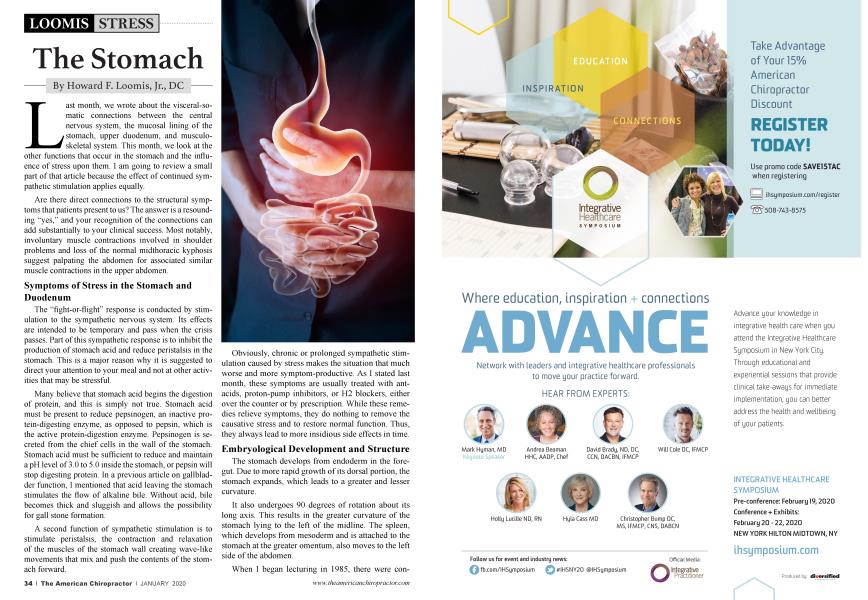
The “fight-or-flight” response is conducted by stimulation to the sympathetic nervous system. Its effects are intended to be temporary and pass when the crisis passes. Part of this sympathetic response is to inhibit the production of stomach acid and reduce peristalsis in the stomach. This is a major reason why it is suggested to direct your attention to your meal and not at other activities that may be stressful.
Many believe that stomach acid begins the digestion of protein, and this is simply not true. Stomach acid must be present to reduce pepsinogen, an inactive protein-digesting enzyme, as opposed to pepsin, which is the active protein-digestion enzyme. Pepsinogen is secreted from the chief cells in the wall of the stomach. Stomach acid must be sufficient to reduce and maintain a pH level of 3.0 to 5.0 inside the stomach, or pepsin will stop digesting protein. In a previous article on gallbladder function, I mentioned that acid leaving the stomach stimulates the flow of alkaline bile. Without acid, bile becomes thick and sluggish and allows the possibility for gall stone formation.
A second function of sympathetic stimulation is to stimulate peristalsis, the contraction and relaxation of the muscles of the stomach wall creating wave-like movements that mix and push the contents of the stomach forward.
Obviously, chronic or prolonged sympathetic stimulation caused by stress makes the situation that much worse and more symptom-productive. As I stated last month, these symptoms are usually treated with antacids, proton-pump inhibitors, or H2 blockers, either over the counter or by prescription. While these remedies relieve symptoms, they do nothing to remove the causative stress and to restore normal function. Thus, they always lead to more insidious side effects in time.
Embryological Development and Structure
The stomach develops from endoderm in the foregut. Due to more rapid growth of its dorsal portion, the stomach expands, which leads to a greater and lesser curvature.
It also undergoes 90 degrees of rotation about its long axis. This results in the greater curvature of the stomach lying to the left of the midline. The spleen, which develops from mesoderm and is attached to the stomach at the greater omentum, also moves to the left side of the abdomen.
When I began lecturing in 1985, there were conflicting statements in the academic anatomy community over whether the cardia or upper portion is part of the stomach, part of the esophagus, or a distinct entity. However, modern surgical and medical textbooks now agree that the gastric cardia is now clearly part of the stomach. There, predigestion occurs by salivary enzymes and enzymes in the food that’s been eaten. This takes advantage of the 45 to 60 minutes it may require to concentrate adequate stomach acid secretion. Very frequently, symptoms arise affecting this area when patients do not chew their food adequately, and digestion of fiber and roughage becomes a problem.
Barrett KE (2006) “Chapter 7. Esophageal Motility” Archived 2013-06-02 at the Wayback Machine in Gastrointestinal Physiology. Lange Medical Books/McGraw-Hill.
Structural Relationships
Pain on palpation below the xiphoid process is indicative of a compromised mucosal lining in the stomach or upper duodenum. However, involuntary muscle contraction related to compromised stomach acid digestion is more commonly found just below that area in the midline.
Palpation in this area is on the linea alba, which is formed of fibers from the aponeuroses of the two rectus abdominis muscles. These muscles are involved with movement of the trunk and work in harmony with other muscles that control the abdominal wall.
Involuntary muscle contraction (IMC) in this area often occurs with involuntary muscle contractions occurring in the midthoracic spine and causing a loss of the normal thoracic kyphosis. This is often involved with shoulder complaints and quite commonly with headaches.
Nutrition
Fortunately, there are “magic bullet” nutrients that will relieve the symptoms of indigestion and restore normal digestion by using the upper portion of the stomach for predigestion, and those are hydrolytic (digestive enzyme) enzymes from plant sources. They will function in the normal resting pH of this area, which lies between 5.0 to 6.0, provided the patient doesn’t regularly consume antacids and alkalizing water. These enzymes and salivary enzymes provide significant digestion in the time before stomach acid activates pepsin and starts protein digestion.
Therein lies the key to treatment—determine the cause of digestive stress and remember that stress comes from three sources in your patients. Is it coming primarily from a structural, visceral, or emotional source? Who else bothers to even consider that possibility?
Conclusion
Next month, we’ll look at other visceral and structural connections of the lower abdomen and large intestine.
Howard F. Loomis, Jr., DC, has an extensive background in enzymes and enzyme supplements. He is the founder and president of the Food Enzyme Institute™. His extensive knowledge of physiology, biochemistry, and enzymology has made him a sought-after speaker and a prolific writer. Dr. Loomis published ENZYMES: The Key to Health in 1999, as well as The Enzyme Advantage: For Healthcare Providers and People Who Care About Their Health, in 2015. Contact Dr. Loomis at [email protected] or 800-662-2630.