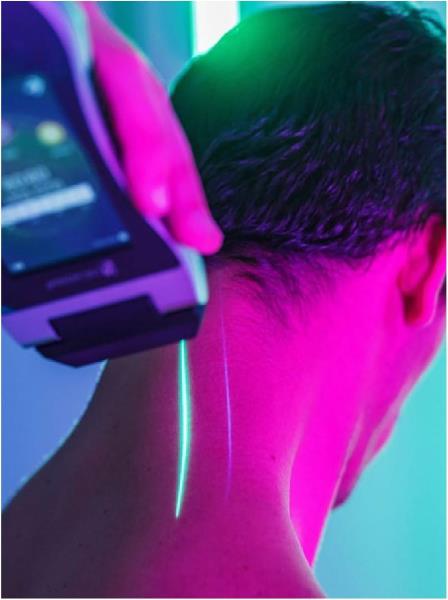
“Using violet lasers before and after surgery can also provide support versus opportunistic microbes to prevent infection.”
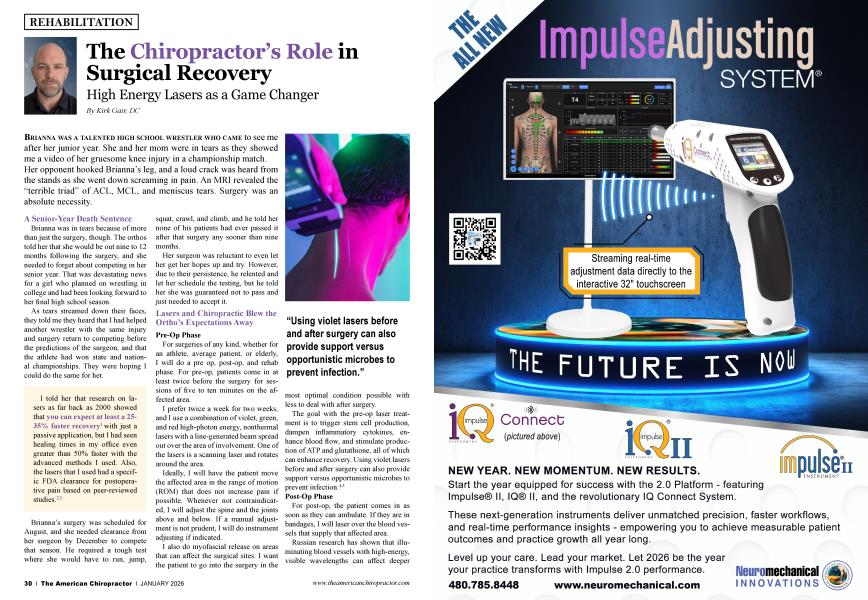
BRIANNA WAS A TALENTED HIGH SCHOOL WRESTLER WHO CAME to see me after her junior year. She and her mom were in tears as they showed me a video of her gruesome knee injury in a championship match. Her opponent hooked Brianna’s leg, and a loud crack was heard from the stands as she went down screaming in pain. An MRI revealed the “terrible triad” of ACL, MCL, and meniscus tears. Surgery was an absolute necessity.
Brianna was in tears because of more than just the surgery, though. The orthos told her that she would be out nine to 12 months following the surgery, and she needed to forget about competing in her senior year. That was devastating news for a girl who planned on wrestling in college and had been looking forward to her final high school season.
As tears streamed down their faces, they told me they heard that I had helped another wrestler with the same injury and surgery return to competing before the predictions of the surgeon, and that the athlete had won state and national championships. They were hoping I could do the same for her.
I told her that research on lasers as far back as 2000 showed that you can expect at least a 2535% faster recovery1 with just a passive application, but I had seen healing times in my office even greater than 50% faster with the advanced methods I used. Also, the lasers that I used had a specific FDA clearance for postoperative pain based on peer-reviewed studies.23
Brianna’s surgery was scheduled for August, and she needed clearance from her surgeon by December to compete that season. He required a tough test where she would have to run, jump, squat, crawl, and climb, and he told her none of his patients had ever passed it after that surgery any sooner than nine months.
Her surgeon was reluctant to even let her get her hopes up and try. However, due to their persistence, he relented and let her schedule the testing, but he told her she was guaranteed not to pass and just needed to accept it.
For surgeries of any kind, whether for an athlete, average patient, or elderly, I will do a pre op, post-op, and rehab phase. For pre-op, patients come in at least twice before the surgery for sessions of five to ten minutes on the affected area.
I prefer twice a week for two weeks, and I use a combination of violet, green, and red high-photon energy, nonthermal lasers with a line-generated beam spread out over the area of involvement. One of the lasers is a scanning laser and rotates around the area.
Ideally, I will have the patient move the affected area in the range of motion (ROM) that does not increase pain if possible. Whenever not contraindicated, I will adjust the spine and the joints above and below. If a manual adjustment is not prudent, I will do instrument adjusting if indicated.
I also do myofascial release on areas that can affect the surgical sites. I want the patient to go into the surgery in the most optimal condition possible with less to deal with after surgery.
The goal with the pre-op laser treatment is to trigger stem cell production, dampen inflammatory cytokines, enhance blood flow, and stimulate production of ATP and glutathione, all of which can enhance recovery. Using violet lasers before and after surgery can also provide support versus opportunistic microbes to prevent infection.4 5
For post-op, the patient comes in as soon as they can ambulate. If they are in bandages, I will laser over the blood vessels that supply that affected area.
Russian research has shown that illuminating blood vessels with high-energy, visible wavelengths can affect deeper structures even without direct penetration to them.6 Additionally, there is an abscopal effect with lasers, which means that while the primary reaction will be at the site of application, there will be global effects throughout the body.
For this phase, I like the patient to come in two or three times per week for four to six weeks for a 1 O-minute, passive laser session. This will dampen inflammation and swelling, enhance repair of the incision, and lessen the need for pain medications. This phase may vary in length depending on the surgery and condition of the patient.
In fact, I coauthored a study that showed that high-energy, nonthermal 635 nm red lasers were more effective for pain than NSAIDS, opioids, red-light LEDs, especially for long-term healing.7
Alternatively, I have the patient rent a laser device from our office and do treatments twice a day at home. The lasers I use are class 2, have an FDA clearance for post-op, and can be used unattended, so I can safely have the patient use them at home after training them to use the device.
I usually have them do a one-month rental for the best results. This may not be something you can do with all lasers and in all states, so you need to check with your manufacturer and board.
For the third phase, I do what I call “neurorecalibration,” which is using the lasers to activate inhibited muscles and reset sensory pathways near the surgical site. This is one of the amazing things that is different with a high-photon energy, collimated, coherent laser versus a noncoherent LED or low-electron volt IR laser.
They can impact communication pathways that relay coherent biophotons through the microtubule networks through electron excitation, delayed luminescence, and super radiance.8 This sends qubits of data to the brain for it to process and make adjustments.
Neurorecalibration involves testing the myotomes for weakness, shakiness, or pain and lasering the muscle belly or nerve roots until the myotome strengthens. It looks like “voodoo,” but patients can feel the change in muscle function quickly. This can also be done with sensory pathways such as light touch, vibration, and pressure.
I love to do this if the patient did not see me for pre-op and is coming in because they feel that their surgery was not as effective as they expected. I can usually get a significant change in ROM and strength on the first session.
Patients will perform coordinated movement or balance exercises while laser is applied transcranially, and of course, they will receive adjustments when not contraindicated. When this sequence is followed, results blow away the minds of the surgeon and physical therapists. When muscle strength is activated and enhanced with the lasers, the results of physical therapy (PT) exercises are far more effective.
Laser done pre-op has also been shown to help elderly patients recommended for knee replacement avoid surgery better than PT or meds. A study on 100 elderly patients who were given traditional PT for knee osteoarthritis versus PT plus laser were followed for six years. Subjects in the laser group were nine times less likely to undergo knee replacement after that timeframe.9
I have used this type of protocol for surgeries on the shoulder, back, neck, CTS, hip, knees, and even preand post-op for dental procedures, all with great success.
“Laser done pre-op has also been shown to help elderly patients recommended for knee replacement avoid surgery better than PT or meds”
Biranna followed my recommendations to the letter, and by November, she told me she was already sparring on the mat and feeling no pain, just three months post-op. I told her she needed to slow down so she did not reinjure herself before her big test with the ortho, and she complied.
On the date of her test, they again reminded her that no one they had worked with had ever passed it before nine months, and she was barely at four months. She blew them away when she nailed it and was pain-free.
Brianna and her mom tried to tell the surgeon and the PTs that she had been doing laser therapy with her chiropractor, and they scoffed, despite seeing results they had never witnessed before. They told her, “Well, if you think that is what did it, then okay. But there just isn’t much research on lasers, so we think you are just genetically gifted.”
So much for evidence-based care! They never contacted me to see what I had done, but that didn’t matter to me.
What mattered was that I got Brianna back 70% faster than expected. She did not miss a single match of senior-year wrestling, and she made it into the championship rounds to go on to wrestle in college.
The bottom line is that if you are not providing laser therapy as an adjunct to your chiropractic treatments, you are missing out on an amazing combo that can change your patients’ lives. Imagine how different Brianna’s high school memories would have been if she had missed that whole senior year? You have the power to alter your patients’ futures in a positive way.
Dr. Kirk Gair has been in private practice since 1999 and using Er-chonia cold lasers since 2004. He has treated elite athletes, including Super Bowl and MLB champions, as well as national record holders. His expertise in cold laser therapy and training in functional medicine and neurology attract patients from across the U.S. Dr. Gair has been featured in the documentary The Thyroid Secret and the bestselling book Hashimoto’s Protocol by Dr. Izabella Wentz, as well as on major health platforms and podcasts. To contact Dr. Gair, call (626) 922-1414, email [email protected], or visit LaserChiropractic.net.
1. Simunovic Z, Ivankovich AD, Depolo A. Wound healing of animal and human body sport and traffic accident injuries using low-level laser therapy treatment: a randomized clinical study of seventy-four patients with control group. J Clin Laser Med Surg. 2000 Apr;18(2):67-73. doi: 10.1089/clm.2000.18.67. PMID: 11800105.
2. Sammons T, Shanks S. Efficacy of red low-level laser for postoperative pain management: a review of literature. J Perioper Pract. 2023 Nov;33(ll):350-357. doi: 10.1177/17504589221124757. Epub 2022 Nov 17. PMID: 36394302.
3. Erchonia. FDA clears low-level laser device for ‘whole body" pain [Internet], Fountain Inn, SC: Erchonia. 2019 July 18. Available from: https://www.erchonia.com/news/...
4. Huang S, Lin S, Qin H, Jiang H, Liu M. The parameters affecting antimicrobial efficiency of antimicrobial blue light therapy: a review and prospect. Biomedicines. 2023;ll(4):1197. doi: 10.3390/biomedicines!1041197.
5. Biener G, Masson-Meyers DS, Bumah VV, Hussey G, Stoneman MR, Enwemeka CS, Raicu V. Blue/violet laser inactivates methicillin-resistant Staphylococcus aureus by altering its transmembrane potential. J Photochem Photobiol' B. 2017 May;170:118-124. doi: 10.1016/j.jphotobiol.2017.04.002. Epub 2017 Apr 6. PMID: 28426977.
6. Moskvin SV, Khadartsev AA. Methods of effective low-level laser therapy in the treatment of patients with bronchial asthma (literature review). Biomedicine (Taipei). 2020 Mar 28;10(l):l-20. doi: 10.37796/2211-8039.1000. PMID: 33854908; PMCID: PMC7608842.
7. Jacob J, Chris B, Cesar AL, Kirk G, Brandon B, Polishuk L, Sammons T. Efficacy of 635nm red low-level laser on nociceptive musculoskeletal pain compared to NSAIDS, opioids, and other light sources. Ortho & Rheum Open Access J. 2020;17(2):555960. doi: 10.19080/OROAJ.2020.17.555960.
8. Jibu M, Hagan S, Hameroff SR, Pribram KH, Yasue K. Quantum optical coherence in cytoskeletal microtubules: implications for brain function. Biosystems. 1994;32(3): 195-209. doi: 10.1016/03032647(94)90043-4. PMID: 7919117.
9. Ip D. Does addition of low-level laser therapy (LLLT) in conservative care of knee arthritis successfully postpone the need for joint replacement? Lasers Med Sci. 2015 Dec;30(9):2335-9. doi: 10.1007/sl0103015-1814-6. Epub 2015 Sep 29. PMID: 26420240.