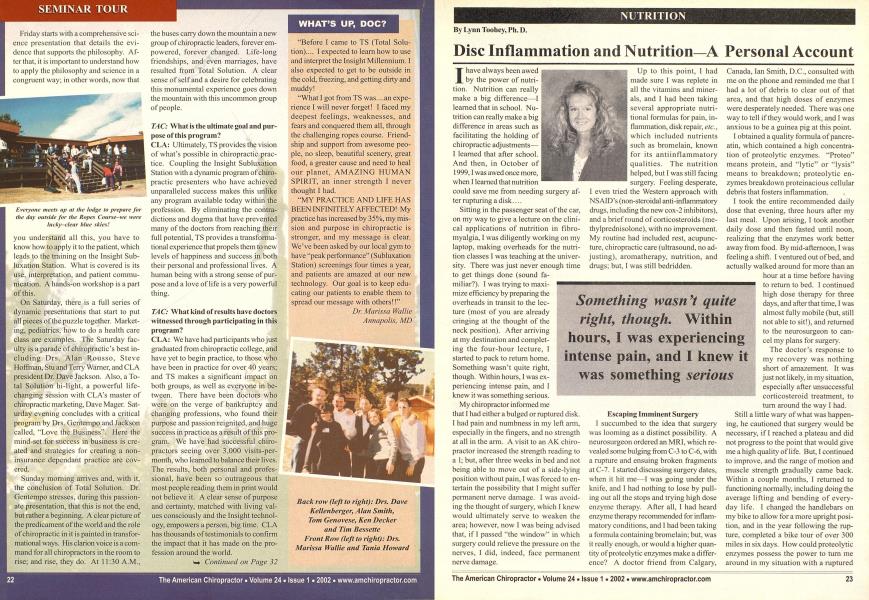
I have always been awed by the power of nutrition. Nutrition can really make a big difference—I learned that in school. Nutrition can really make a big difference in areas such as facilitating the holding of | chiropractic adjustments— I learned that after school. And then, in October of | 1999,1 was awed once more, when I learned that nutrition could save me from needing surgery after rupturing a disk.... Sitting in the passenger seat of the car, on my way to give a lecture on the clinical applications of nutrition in fibro-myalgia, I was diligently working on my laptop, making overheads for the nutrition classes I was teaching at the university. There was just never enough time to get things done (sound familiar?). I was trying to maximize efficiency by preparing the overheads in transit to the lecture (most of you are already cringing at the thought of the neck position). After arriving at my destination and completing the four-hour lecture, I started to pack to return home. Something wasn't quite right, though. Within hours, I was experiencing intense pain, and I knew it was something serious. My chiropractor informed me that I had either a bulged or ruptured disk. I had pain and numbness in my left arm, especially in the fingers, and no strength at all in the arm. A visit to an AK chiropractor increased the strength reading to a 1; but, after three weeks in bed and not being able to move out of a side-lying position without pain, I was forced to entertain the possibility that I might suffer permanent nerve damage. I was avoiding the thought of surgery, which I knew would ultimately serve to weaken the area; however, now I was being advised that, if I passed "the window" in which surgery could relieve the pressure on the nerves, I did, indeed, face permanent nerve damage. Up to this point, I had made sure I was replete in all the vitamins and minerals, and I had been taking several appropriate nutritional formulas for pain, inflammation, disk repair, etc., which included nutrients such as bromelain, known for its antiinflammatory qualities. The nutrition helped, but I was still facing surgery. Feeling desperate, I even tried the Western approach with NSAID's (non-steroidal anti-inflammatory drugs, including the new cox-2 inhibitors), and a brief round of corticosteroids (me-thylprednisolone), with no improvement. My routine had included rest, acupuncture, chiropractic care (ultrasound, no adjusting), aromatherapy, nutrition, and drugs; but, 1 was still bedridden. Escaping Imminent Surgery I succumbed to the idea that surgery was looming as a distinct possibility. A neurosurgeon ordered an MRI, which revealed some bulging from C-3 to C-6, with a rupture and ensuing broken fragments at C-7. I started discussing surgery dates, when it hit me—I was going under the knife, and I had nothing to lose by pulling out all the stops and trying high dose enzyme therapy. After all, I had heard enzyme therapy recommended for inflammatory conditions, and 1 had been taking a formula containing bromelain; but, was it really enough, or would a higher quantity of proteolytic enzymes make a difference? A doctor friend from Calgary, Canada. Ian Smith, D.C., consulted with me on the phone and reminded me that I had a lot of debris to clear out of that area, and that high doses of enzymes were desperately needed. There was one way to tell if they would work, and I was anxious to be a guinea pig at this point. I obtained a quality formula of pancre-atin, which contained a high concentration of proteolytic enzymes. "Proteo" means protein, and "lytic" or "lysis" means to breakdown; proteolytic enzymes breakdown proteinacious cellular debris that fosters inflammation. I took the entire recommended daily dose that evening, three hours after my last meal. Upon arising, I took another daily dose and then fasted until noon, realizing that the enzymes work better away from food. By mid-afternoon, I was feeling a shift. I ventured out of bed, and actually walked around for more than an hour at a time before having to return to bed. I continued high dose therapy for three days, and after that time, I was almost fully mobile (but, still not able to sit!), and returned to the neurosurgeon to cancel my plans for surgery. The doctor's response to my recovery was nothing short of amazement. It was just not likely, in my situation, especially after unsuccessful corticosteroid treatment, to turn around the way I had. Still a little wary of what was happening, he cautioned that surgery would be necessary, if I reached a plateau and did not progress to the point that would give me a high quality of life. But, I continued to improve, and the range of motion and muscle strength gradually came back. Within a couple months, I returned to functioning normally, including doing the average lifting and bending of everyday life. I changed the handlebars on my bike to allow for a more upright position, and in the year following the rupture, completed a bike tour of over 300 miles in six days. How could proteolytic enzymes possess the power to turn me around in my situation with a ruptured disk? What is it about them that addresses inflammation? The Inflammatory Process In order to answer that question, it is helpful to understand the inflammatory process, and how enzymes are able to address that inflammation. Inflammation is a response to tissue injury, or damage. Whether the cells are damaged by microbes, chemicals, or physical trauma, the injury sets off a response. The response can be characterized by redness, pain, heat, swelling and, possibly, loss of function, depending on the extent of the injury. Blood vessels dilate, or increase in size, and become more permeable, which means that substances normally contained in the blood can now travel out of the blood and into tissues. The vessel dilation brings more blood to the site of injury, to remove toxins and dead cells. The increased permeability allows white blood cells to enter the damaged area. The white blood cells (WBC's) contain high amounts of vitamin C, and the vitamin C, in turn, helps the motility and efficiency of the WBC's. This attraction of WBC's is instigated by the release of chemicals from damaged cells. These chemicals include histaminc, kinins, and prostaglandins (pg's). The increased circulation and leakiness, or permeability of capillaries (small blood vessels), produce the heat, redness, and swelling within minutes of injury. Pain results from damage to nerve fibers, toxin irritation, and/ or pressure from the swelling. Prostaglandins magnify and prolong the pain associated with inflammation. Kinins can also affect nerve endings and create pain. After the inflammatory process has been started, phagocytes (bacteria-eating white blood cells) come to the rescue to prevent infection. The various white blood cells squeeze through the capillaries to reach injured tissue, and the neu-trophils, sometimes called, "the warehouses of proteolytic enzymes," clear toxic debris. Enter PE's This is why proteolytic enzymes are utilized in inflammatory conditions—they clear the debris, just like the enzymes released by the neutrophils of our natural immune system. Enzymes are believed to help support the shrinking of fragments, also. When fragments are involved in a rupture, they aren't really going away, unless they're surgically removed; so, it makes sense to want them to shrink to as small as possible, and not impede the nerves. Enzymes have demonstrated an increased ability to foster tissue regeneration, and have been noted in literature to be associated with "healing acceleration" (Tsitologiia. 1992; 34:70-3). It is worth mentioning that there are many people who suffer gastric upset by taking high dose pancreatin. This probability is increased when the patients are on pain meds, because drugs will increase gut permeability (leaky gut syndrome) and increase the likelihood that enzymes will come in contact with exposed tissue. It's similar to the concept of hydrochloric acid: both HC1 and enzymes are naturally present in our bodies; however, if we have damaged, exposed tissue, then burning or GI side effects can occur. To address this issue, the plant proteases are better tolerated, and they can be combined with synergistic herbal ingredients to tame inflammation without the GI side effects. An excellent resource book which explains the concept of utilizing enzyme therapy is Enzyme Therapy: Bringing the body back from injury and disease, by Dr. Evan Mladenoff, D.C., Ac, Diplo-mate AK. The healing process occurring after inflammation places a great demand on the body's store of nutrients. There had been a variety of nutrients that I had incorporated into my nutritional protocol to accelerate healing and recovery, so that I was able to return to normal function, which included returning to the gym and starting to lift weights again—less than two months after my "turnaround". Nutrition can help with pain, inflammation, chiropractic adjustment maintenance, muscle and ligament health, disk rupture...but, more on that later. Since I'm out of space this time, in the next article I will address the accessory nutrients I used to "get back on my feet". Dr. Toohey would like to express a special thank you to Vern Miller, D. C, whose chiropractic knowledge and care helped speed her recovery. Dr. Lynn Toohey received her Ph.D. in nutrition from Colorado State University in Ft. Collins, CO. She has lectured to chiropractors and other health professionals across the country and also in Canada and Europe on nutrition-related topics and complementary medicine. Her various lecture engagements have included speaking for the International College of Applied Kinesiology (ICAK), the United Chiropractors of New Mexico (UCNM), and the Florida Chiropractic Association (FCA). You may contact Dr. Toohey by e-mail at drtoohevCwnutri-west.net.