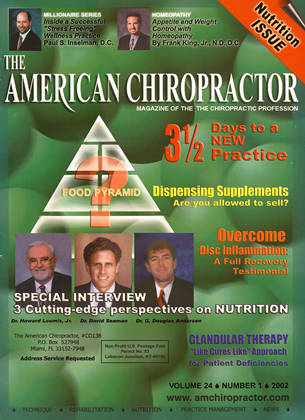
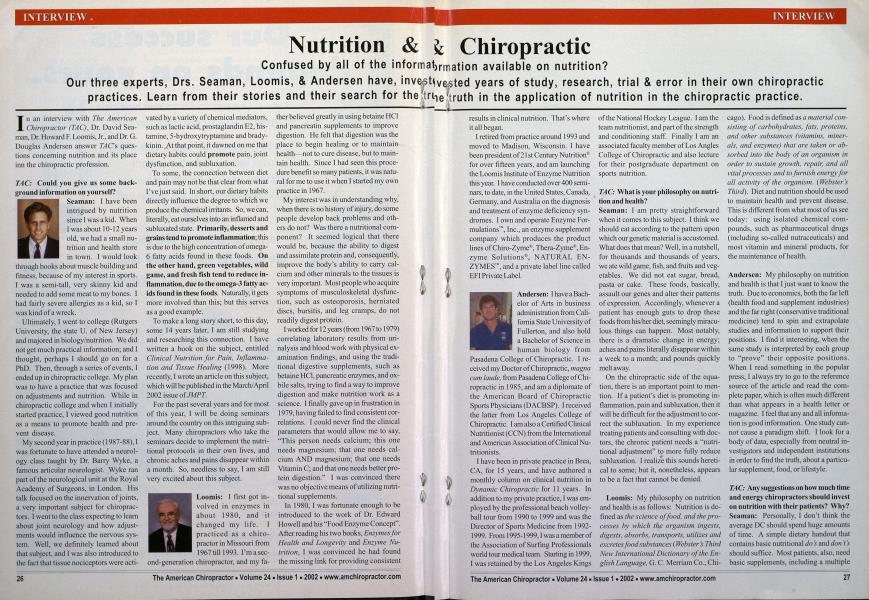
Chiropractic Confused by all of the informa Our three experts, Drs. Seaman, Loomis, & Andersen have, inve&i practices. Learn from their stories and their search for the tr nation available on nutrition? :6ted years of study, research, trial & error in their own chiropractic truth in the application of nutrition in the chiropractic practice. I n an interview with The American Chiropractor (TAC), Dr. David Seaman, Dr. Howard F. Loomis, Jr., and Dr. G. Douglas Andersen answer TAC's questions concerning nutrition and its place inn the chiropractic profession. TAC: Could you give us some background information on yourself? Seaman: 1 have been intrigued by nutrition since I was a kid. When I was about 10-12 years old, we had a small nutrition and health store in town. I would look through books about muscle building and fitness, because of my interest in sports. I was a semi-tall, very skinny kid and needed to add some meat to my bones. I had fairly severe allergies as a kid, so I was kind of a wreck. Ultimately, I went to college (Rutgers University, the state U. of New Jersey) and majored in biology/nutrition. We did not get much practical information; and I thought, perhaps I should go on for a PhD. Then, through a series of events, I ■ ended up in chiropractic college. My plan was to have a practice that was focused on adjustments and nutrition. While in chiropractic college and when I initially started practice, I viewed good nutrition as a means to promote health and prevent disease. My second year in practice (1987-88), I was fortunate to have attended a neurology class taught by Dr. Barry Wyke, a famous articular neurologist. Wyke ran part of the neurological unit at the Royal Academy of Surgeons, in London. His talk focused on the innervation of joints, a very important subject for chiropractors. I went to the class expecting to learn about joint neurology and how adjustments would influence the nervous system. Well, we definitely learned about that subject, and I was also introduced to the fact that tissue nociceptors were acti- vated by a variety of chemical mediators, such as lactic acid, prostaglandin E2, his-tamine, 5-hydroxytryptamine and brady-kinin. _At that point, it dawned on me that dietary habits could promote pain, joint dysfunction, and subluxation. To some, the connection between diet and pain may not be that clear from what I've just said. In short, our dietary habits directly influence the degree to which we produce the chemical irritants. So, we can, literally, eat ourselves into an inflamed and subluxated state. Primarily, desserts and grains tend to promote inflammation; this is due to the high concentration of omega-6 fatty acids found in these foods. On the other hand, green vegetables, wild game, and fresh fish tend to reduce inflammation, due to the omega-3 fatty acids found in these foods. Naturally, it gets more involved than this; but this serves as a good example. To make a long story short, to this day, some 14 years later, 1 am still studying and researching this connection. I have written a book on the subject, entitled Clinical Nutrition for Pain, Inflammation and Tissue Healing (1998). More recently, I wrote an article on this subject, which will be published in the March/April 2002 issue of JMPT. For the past several years and for most of this year, I will be doing seminars around the country on this intriguing subject. Many chiropractors who take the seminars decide to implement the nutritional protocols in their own lives, and chronic aches and pains disappear within a month. So, needless to say, I am still very excited about this subject. Loomis: I first got involved in enzymes in about 1980, and it changed my life. 1 practiced as a chiropractor in Missouri from 1967 till 1993. I'm a sec- ond-generation chiropractor, and my fa- ther believed greatly in using betaine HC1 and pancreatin supplements to improve digestion. He felt that digestion was the place to begin healing or to maintain health—not to cure disease, but to maintain health. Since I had seen this procedure benefit so many patients, it was natural for me to use it when I started my own practice in 1967. My interest was in understanding why, when there is no history of injury, do some people develop back problems and others do not? Was there a nutritional component? It seemed logical that there would be, because the ability to digest and assimilate protein and, consequently, improve the body's ability to carry calcium and other minerals to the tissues is very important. Most people who acquire symptoms of musculoskeletal dysfunction, such as osteoporosis, herniated discs, bursitis, and leg cramps, do not readily digest protein. I worked for 12years(from 1967 to 1979) correlating laboratory results from uri-nalysis and blood work with physical examination findings, and using the traditional digestive supplements, such as betaine HC1, pancreatic enzymes, and ox-bile salts, trying to find a way to improve digestion and make nutrition work as a science. I finally gave up in frustration in 1979, having failed to find consistent correlations. I could never find the clinical parameters that would allow me to say, "This person needs calcium; this one needs magnesium; that one needs calcium AND magnesium; that one needs Vitamin C; and that one needs better protein digestion." I was convinced there was no objective means of utilizing nutritional supplements. In 1980,1 was fortunate enough to be introduced to the work of Dr. Edward Howell and his "Food Enzyme Concept". After reading his two books, Enzymes for Health and Longevity and Enzyme Nutrition, I was convinced he had found the missing link for providing consistent results in clinical nutrition. That's where it all began. 1 retired from practice around 1993 and moved to Madison, Wisconsin. I have been president of 21 st Century Nutrition* for over fifteen years, and am launching the Loomis Institute of Enzyme Nutrition this year. 1 have conducted over 400 seminars, to date, in the United States, Canada, Germany, and Australia on the diagnosis and treatment of enzyme deficiency syndromes. I own and operate Enzyme Formulations™, Inc., an enzyme supplement company which produces the product lines of Chiro-Zyme\ Thera-Zyme", Enzyme Solutions*, NATURAL ENZYMES™, and a private label line called EFI Private Label. Andersen: I have a Bachelor of Arts in business administration from California State University of Fullerton, and also hold a Bachelor of Science in human biology from Pasadena College of Chiropractic. 1 received my Doctor of Chiropractic, magna cum laude, from Pasadena College of Chiropractic in 1985, and am a diplomate of the American Board of Chiropractic Sports Physicians (DACBSP). I received the latter from Los Angeles College of Chiropractic. I am also a Certified Clinical Nutritionist (CCN) from the International and American Association of Clinical Nutritionists. I have been in private practice in Brea, CA, for 15 years, and have authored a monthly column on clinical nutrition in Dynamic Chiropractic for 11 years. In addition to my private practice, I was employed by the professional beach volleyball tour from 1990 to 1999 and was the Director of Sports Medicine from 1992-1999. From 1995-1999,1 was a member of the Association of Surfing Professionals world tour medical team. Starting in 1999, I was retained by the Los Angeles Kings of the National Hockey League. I am the team nutritionist, and part of the strength and conditioning staff. Finally I am an associated faculty member of Los Angles College of Chiropractic and also lecture for their postgraduate department on sports nutrition. TAC: What is your philosophy on nutrition and health? Seaman: I am pretty straightforward when it comes to this subject. I think we should eat according to the pattern upon which our genetic material is accustomed. What does that mean? Well, in a nutshell, for thousands and thousands of years, we ate wild game, fish, and fruits and vegetables. We did not eat sugar, bread, pasta or cake. These foods, basically, assault our genes and alter their patterns of expression. Accordingly, whenever a patient has enough guts to drop these foods from his/her diet, seemingly miraculous things can happen. Most notably, there is a dramatic change in energy; aches and pains literally disappear within a week to a month; and pounds quickly melt away. On the chiropractic side of the equation, there is an important point to mention. If a patient's diet is promoting inflammation, pain and subluxation, then it will be difficult for the adjustment to correct the subluxation. In my experience treating patients and consulting with doctors, the chronic patient needs a "nutritional adjustment" to more fully reduce subluxation. I realize this sounds heretical to some; but it, nonetheless, appears to be a fact that cannot be denied. Loomis: My philosophy on nutrition and health is as follows: Nutrition is defined as the science of food, and the processes by which the organism ingests, digests, absorbs, transports, utilizes and excretes foodsubstances (Webster's Third New International Dictionary of the English Language, G. C. Merriam Co., Chi- cago). Food is defined as a material consisting of carbohydrates, fats, proteins, and other substances (vitamins, minerals, and enzymes) that are taken or absorbed into the body of an organism in order to sustain growth, repair, and all vital processes and to furnish energy for all activity of the organism. (Webster's Third). Diet and nutrition should be used to maintain health and prevent disease. This is different from what most of us see today: using isolated chemical compounds, such as pharmaceutical drugs (including so-called nutraccuticals) and most vitamin and mineral products, for the maintenance of health. Andersen: My philosophy on nutrition and health is that I just want to know the truth. Due to economics, both the far left (health food and supplement industries) and the far right (conservative traditional medicine) tend to spin and extrapolate studies and information to support their positions. I find it interesting, when the same study is interpreted by each group to "prove" their opposite positions. When I read something in the popular press, I always try to go to the reference source of the article and read the complete paper, which is often much different than what appears in a health letter or magazine. I feel that any and all information is good information. One study cannot cause a paradigm shift. I look for a body of data, especially from neutral investigators and independent institutions in order to find the truth, about a particular supplement, food, or lifestyle. TAC: Any suggestions on how much time and energy chiropractors should invest on nutrition with their patients? Why? Seaman: Personally, I don't think the average DC should spend huge amounts of time. A simple dietary handout that contains basic nutritional do s and don 't's should suffice. Most patients, also, need basic supplements, including a multiple vitamin/mineral, EPA/DHA (omega-3 fatty acids), and magnesium. Some patients need more, such as glucosamine, MSM, proteolytic enzymes, and anti-inflammatory herbs, such as ginger and turmeric. These arc really the only supplements I recommend (maybe a couple more) and, really, the only ones a DC needs to carry, unless he/she functions simultaneously as a nutritionist. In this situation, dietary recommendations and supplementation can get much more involved. In short, it does not take more than a second to hand a patient a sheet of dietary and nutritional recommendations. Have the patient pick up the supplements at the front desk, and off they go. Loomis: Chiropractic comes first. Chiropractors are trained to find and eliminate stress in their patients. Stress may come from a mechanical, nutritional or emotional source. Any nutritional stress will also result in muscle contraction, eventually leading to postural deviations or mechanical misalignments. When there is a nutritional cause, it is going to be very hard to correct it with just chiropractic adjustments. Nutrition is an extremely important component to chiropractic care and should be a part of every good chiropractic examination. Andersen: This depends on the individual chiropractor's interest and knowledge in nutrition. There is a minimum one can do in the standard chiropractic practice, which you can see in the side bar entitled "Help Your Recovery with Nutrition". I give this both to patients and doctors I lecture to, who want to utilize nutrition, but do not feel comfortable with deep nutritional therapeutics. TAC: With all the choices available, such as multi-vitamins, whole food vitamins, enzymes, amino acids, glandulars, homeopathics, herbs, etc., can you tie all of these together in an understandable format for chiropractors to understand (and to explain to their patients)? Also, how do you know when to use what? Seaman: 1 don't believe it is possible for a DC to effectively apply the above list of supplements unless they spend years undergoing specialized training. Some do it, and this is great; however, the great majority of DCs have not embarked on such an endeavor. Accordingly, it makes little sense to use a laundry list of pills that one does not understand. For example, I make no homeopathic recommendations, because I don't know anything about homeopathy. It is that simple. 1 suggest that docs work with about 7-10 supplements that directly impact upon tissue healing, and reduce inflammation and pain—which, indirectly, works to improve joint and muscle function, which is the primary focus of most DCs. There are, however, rather intense fringe benefits from adopting an anti-inflammatory diet and taking the above mentioned supplements. Most diseases, including heart disease, cancer and neurodegenerative diseases, are associated with chronic inflammatory states, so, reducing your inflammatory potential with anti-inflammatory foods and supplements can do wonders for you in the long run. Loom is: There is one overriding fact that chiropractic can depend on, 100% of the time: The body must always direct its efforts at maintaining homeostasis within its internal environment. Any deviations in that environment, any inability to maintain that environment, will always result in symptoms and muscle contraction. We correlate somato-visceral and viscero-somatic symptoms. Because of that, in my opinion, chiropractors possess the knowledge and the skill to be the preeminent diagnosticians in the healing arts. And once the cause is known, the treatment is obvious. Andersen: Everyone wants a cookbook or a magic formula. Unfortunately, due to biochemical individuality, as well as a host of other factors and problems, if one wants to practice serious nutrition, it must be done on a case-by-case basis. I try to follow a research-based, patient-centered approach. As for specific examples, I am not impressed with the literature on most glandulars, homeopathics, and whole food pills. I am also not impressed with the literature on enzymes, with the exception of those to reduce inflammation and to help in digestion. I do believe in a basic multivitamin/ multimineral supplement rich in antioxi- dants for most people. I also emphasize that eating the right types of foods is more Continued on Page 42 HELP YOUR RECOVERY WITH NUTRITON G. Douglas Andersen, D.C., D.A.C.B.S.P., C.C.N. When a patient is wounded or injured (including recovery from surgical procedures), the body has conditional increases in nutrients to facilitate proper and rapid healing. The following steps will create the internal environment necessary for recovery: Drink extra water. Add a large glass as soon as you wake up in the morning, before lunch and before dinner. Eat a high-protein diet. Have at least three servings a day of foods such as fish, chicken, turkey and low or nonfat dairy. Beef and pork are also good sources of protein but tend to be high in fat therefore, use them in moderation. You can also acquire extra pro tein in your diet by using protein powder to make shakes and smoothies. This is espe cially recommended if you are a vegetarian. Use 25-40 grams of protein per drink. Take a multivitamin, multimineral formula that provides you with at least 100% of RDA for all vitamins and minerals. Read labels carefully. If you use one-pill-a-day formula, you will probably need to take additional cal cium and magnesium. Other formulas re quire that you take three or more pills a day to achieve amounts listed on the label. Take extra vitamin C. During your recov ery, multiply your body weight by 10 and then round to the nearest 100 to find out how many milligrams of vitamin C you need per day. For example, 152 pounds x 10 = 1520, rounded to the nearest hundred = 1500 mg per day. Do your best to stay away from junk food. Eating less junk food is always good to do but is especially important when you arc recov ering. Foods like soda, chips, candy, cake, pies, doughnuts, and cookies are low quality sources of calories. If you have a sweet tooth, try snacking on fresh fruits or sports bars such as Clif, Power, Balance, or Met-Rx. Ice cream lovers are advised to eat low or nonfat yogurt instead. If you are on a weight-loss diet, put it on hold until you feel better. Increase the number of calories you eat to a level where you main tain your current weight. Trying to lose weight and recover at the same time will slow down the healing process. This, in turn, will inhibit your weight loss goals by extending the time you are unable to exercise at times and intensities required to burn body fat. When you are better: Continue to drink plenty of water Reduce your protein back to two servings a day unless you arc involved in heavy athlet ics Try to maintain healthy snacking habits If you are on a weight loss program, resume it Reduce your vitamin C intake to 500 mg per day ( • Continue to take your multivitamin at least 5 days per week + ...from page 28 important than taking supplements. To make an easy broad based generalization, I feel that, if most Americans would consume tcn-to-fiftcen servings of whole fruits and whole vegetables per day, the health of our nation would be considerably improved. Another rule of thumb for supplements and nutrition is, whenever a person is sick, injured or under excessive stress, the requirements for micronutrients and proper nutrition are increased. TAC: What nutritional supplements are you currently taking? Seaman: I take a multi-vitamin; a 2-3:1 ratio of magnesium to calcium, fish oil (EPA/DHA), borage oil (GLA), saw palmetto, glucosaminc and chondroitin, vitamin C/bioflavonoids, ginger, garlic and sometimes MSM, cayenne, vitamin E, gingko, and ginseng. I basically do what I say in my book and seminars. Loomis: I take a multiple food enzyme formula to improve or enhance my digestion because I'm old and don't digest food very well anymore. In addition, I add whatever whole food supplements my body requires at any given time. I don't take a battery of vitamins and minerals daily; I take whatever my body needs. Andersen: The supplements I use are: (1) A multivitamin/multimineral formula that contains 12,500 IU of vitamin A, 80% of which is from beta carotene; 400 mg of vitamin C; 50 IU of vitamin D; 100 IU of natural vitamin E; 37.5 mg of vitamin Bl, B2, and B3; 66% of B3 or niacin in the niacinamide form; vitamin B6, 75 mg; folic acid, 400 meg; vitamin B12, 75 meg; pantothenic acid, 50 mg; calcium as hydroxyapatite and ascor-bate, 125 mg; iron, 7.5 mg; iodine, 112.5 meg; magnesium as citrate and aspar-tate, 250 mg; zinc, 15 mg; selenium, 100 meg; copper, 1 mg; manganese, 2.5 mg; chromium polynicotinate, 100 meg; molybdenum, 25 meg; and boron, 1 mg. My multivitamin formula also contains 75 mg of choline, 75 mg of PABA, 50 mg of inositol, 50 mg rutin and 12 mg of N-Acctyl L-Cysteine, Vanadyl sulfate 1 mg. I also consume a protein drink every morning that contains 500 mg of cal- cium, 200 mg of magnesium, 7.5 mg of zinc, 1 mg of copper, 9 mg of iron, and small amounts of the vitamins (50% of the RDA). I take an omega 3 fatty acid supplement that provides 300 mg of EPA and 200 mg of DHA. I take 2,000 mg of chondroitin sulfate or glucosamine sul-fate or a combination thereof, daily. I also take a bioflavonoid mixture that contains 100 mg of grape seed extract, 200 mg of green tea extract, 200 mg of milk thistle extract, and 200 mg of resveratrol. I take a low dose of saw palmetto (160 mg), due to my family history. Finally, I take an extra 400 IU of natural vitamin E. Then, depending on my level of training, injury status and illness status, I may add extra antioxidants, such as vitamin C and bioflavonoids, natural antiinflammatories, such as Tumeric, Boswellia, proteolytic enzymes, echinacea, golden seal, various mushroom extracts, and additional proanthocyanidins. TAC: Any current topics/developments in nutrition that you would like to bring to our readers attention? Seaman: There are always new developments in fatty acid, antioxidant, and phytochemical research. These are the most applicable areas, when it comes to the needs of chiropractic patients; so, I think our time is best served on these important topics. Loomis: Enzymes is the new buzzword for the 21s' Century, in part because enzymes are removed from our food. Enzymes are essential nutrients. That is something that will be become obvious to many more people in the coming years. Andersen: The knowledge we have in nutrition is doubling approximately every three years. I urge the readers not to jump to conclusions when a single study makes headline news. 1, further, urge readers to make sure that the conclusions and extrapolations one reads come from studies of similar populations, with similar gender and lifestyles, as the target subject of the study. For example, there is a wealth of evidence that eating fruits and vegetable will reduce a wide variety of degenerative diseases. However, it is unfair to extrapolate that fruits and vegetables in pill and capsule form will do the same thing, for the simple reason that no one has eaten fruits and vegetable concentrate pills for 25 years, to see if these can, in fact, do what whole foods accomplish. Another current topic concerns selling supplements. I believe that a chiropractor or nutritionist can sell supplements provided he or she does it in an ethical way. I always pretend, when I sell supplements, there is a 60 Minutes hidden camera on me in my practice. That is, if I feel a patient needs a product and is unable to find one of similar quality or strength in a health food store, I will sell them what I carry. However, 1 always have patients bring in what they are currently taking. I read the labels, I look at the products they have and, often, do nothing more than change the dosing. Another example would be chondroi-tin sulfate and glucosamine sulfate, which many people now consume. One of the brands that has consistently tested as pure is now available at huge discount stores for a fraction of the price I can sell these products for. Thus, I feel it is my duty to inform patients that, if they make the drive down the street, they can save money. Some prefer the convenience of purchasing their supplements from me, while others appreciate my referral. I feel, if everyone sold supplements this way, the criticism against health professionals who sell supplements would be exponentially reduced. David Seaman can be reached, by phone, at 910-342-0133 or by e-mail at doc(ti)LessPainBetterGolf.com. Dr. Howard Loomis may be reached at 21" Century Nutrition at 1-800-662- 2630. Contact Dr. G.Douglas Andersen by e-mailing gdandersen(a)earthlink.net. Editor's note: The American Chiropractor would like your feedback on these interviews. Please share your thoughts, opinions and ideas with us by filling out and faxing back our Fax Back Survey on page 5, or you may fill it out on-line at www.amchiropractor.com. ^ . ■ (www, amchiropractor.comypj