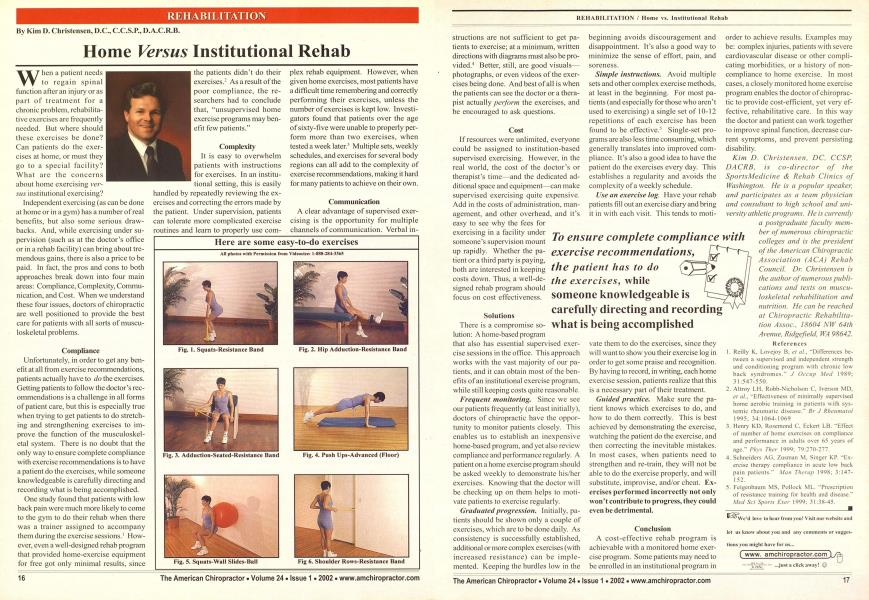
W hen ;i patient needs to regain spinal function after an injury or as part of treatment for a chronic problem, rehabilitative exercises are frequently needed. But where should these exercises be done? Can patients do the exercises at home, or must they go to a special facility? What are the concerns about home exercising versus institutional exercising? Independent exercising (as can be done at home or in a gym) has a number of real benefits, but also some serious drawbacks. And, while exercising under supervision (such as at the doctor's office or in a rehab facility) can bring about tremendous gains, there is also a price to be paid. In fact, the pros and cons to both approaches break down into four main areas: Compliance, Complexity, Communication, and Cost. When we understand these four issues, doctors of chiropractic are well positioned to provide the best care for patients with all sorts of muscu-loskeletal problems. Compliance Unfortunately, in order to get any benefit at all from exercise recommendations, patients actually have to do the exercises. Getting patients to follow the doctor's recommendations is a challenge in all forms of patient care, but this is especially true when trying to get patients to do stretching and strengthening exercises to improve the function of the musculoskel-etal system. There is no doubt that the only way to ensure complete compliance with exercise recommendations is to have a patient do the exercises, while someone knowledgeable is carefully directing and recording what is being accomplished. One study found that patients with low back pain were much more likely to come to the gym to do their rehab when there was a trainer assigned to accompany them during the exercise sessions.' However, even a well-designed rehab program that provided homc-cxercisc equipment for free got only minimal results, since the patients didn't do their exercises.2 As a result of the poor compliance, the researchers had to conclude that, "unsupervised home exercise programs may benefit few patients." Complexity It is easy to overwhelm patients with instructions for exercises. In an institutional setting, this is easily handled by repeatedly reviewing the exercises and correcting the errors made by the patient. Under supervision, patients can tolerate more complicated exercise routines and leam to properly use com- plex rehab equipment. However, when given home exercises, most patients have a difficult time remembering and correctly performing their exercises, unless the number of exercises is kept low. Investigators found that patients over the age of sixty-five were unable to properly perform more than two exercises, when tested a week later.1 Multiple sets, weekly schedules, and exercises for several body regions can all add to the complexity of exercise recommendations, making it hard for many patients to achieve on their own. Communication A clear advantage of supervised exercising is the opportunity for multiple channels of communication. Verbal in- Here are some easy-to-do exercises All photos tvith I'crmlMinn from Vidcocizc: 1-888-284-336* structions arc not sufficient to get patients to exercise; at a minimum, written directions with diagrams must also be provided.4 Better, still, are good visuals— photographs, or even videos of the exercises being done. And best of all is when the patients can sec the doctor or a therapist actually perform the exercises, and be encouraged to ask questions. Cost If resources were unlimited, everyone could be assigned to institution-based supervised exercising. However, in the real world, the cost of the doctor's or therapist's time—and the dedicated additional space and equipment—can make supervised exercising quite expensive. Add in the costs of administration, management, and other overhead, and it's easy to see why the fees for exercising in a facility under someone's supervision mount up rapidly. Whether the patient or a third party is paying, both are interested in keeping costs down. Thus, a well-designed rehab program should focus on cost effectiveness. Solutions There is a compromise solution: A home-based program that also has essential supervised exercise sessions in the office. This approach works with the vast majority of our patients, and it can obtain most of the benefits of an institutional exercise program, while still keeping costs quite reasonable. Frequent monitoring. Since we see our patients frequently (at least initially), doctors of chiropractic have the opportunity to monitor patients closely. This enables us to establish an inexpensive home-based program, and yet also review compliance and performance regularly. A patient on a home exercise program should be asked weekly to demonstrate his/her exercises. Knowing that the doctor will be checking up on them helps to motivate patients to exercise regularly. Graduated progression. Initially, patients should be shown only a couple of exercises, which arc to be done daily. As consistency is successfully established, additional or more complex exercises (with increased resistance) can be implemented. Keeping the hurdles low in the beginning avoids discouragement and disappointment. It's also a good way to minimize the sense of effort, pain, and' soreness. Simple instructions. Avoid multiple sets and other complex exercise methods, at least in the beginning. For most patients (and especially for those who aren't used to exercising) a single set of 10-12 repetitions of each exercise has been found to be effective.5 Single-set programs are also less time consuming, which generally translates into improved compliance. It's also a good idea to have the patient do the exercises every day. This establishes a regularity and avoids the complexity of a weekly schedule. Use an exercise log. Have your rehab patients fill out an exercise diary and bring it in with each visit. This tends to moti- vate them to do the exercises, since they will want to show you their exercise log in order to get some praise and recognition. By having to record, in writing, each home exercise session, patients realize that this is a necessary part of their treatment. Guided practice. Make sure the patient knows which exercises to do, and how to do them correctly. This is best achieved by demonstrating the exercise, watching the patient do the exercise, and then correcting the inevitable mistakes. In most cases, when patients need to strengthen and re-train, they will not be able to do the exercise properly, and will substitute, improvise, and/or cheat. Exercises performed incorrectly not only won't contribute to progress, they could even be detrimental. Conclusion A cost-effective rehab program is achievable with a monitored home exercise program. Some patients may need to be enrolled in an institutional program in order to achieve results. Examples may be: complex injuries, patients with severe cardiovascular disease or other complicating morbidities, or a history of non-compliance to home exercise. In most cases, a closely monitored home exercise program enables the doctor of chiropractic to provide cost-efficient, yet very effective, rehabilitative care. In this way the doctor and patient can work together to improve spinal function, decrease current symptoms, and prevent persisting disability. Kim D. Christensen, DC, CCSP. DACRB, is co-director of the SportsMedicine & Rehab Clinics of Washington. Me is a popular speaker, and participates as a team physician and consultant to high school and university athletic programs. He is currently a postgraduate faculty member of numerous chiropractic colleges and is the president of the American Chiropractic Association (ACA} Rehab Council. Dr. Christensen is the author of numerous publications and texts on muscu-loskeletal rehabilitation and nutrition. He can be reached at Chiropractic Rehabilitation Assoc, 1X604 N\V 64th Avenue, Ridgefield, WA 98642. References Rcilly K. Lovejoy B. ci nl.. "Differences be tween a supervised and independent strength and conditioning program with chronic low back syndromes." J Occup Med 1989: 31:547-550. Altroy LH. Robb-Nicholson C. Iverson MD. el ill.. "Effectiveness of minimally supervised home aerobic training in patients with sys temic rheumatic disease." Br J Rhcumalol 1995; 34:1064-1069 Henry KD. Rosemond C. Eckert LB. "Effect of number of home exercises on compliance and performance in adults over 65 years of age." Pins Ther 1999; 79:270-277. Schneiders AG. Zusman M. Singer K.P. "Ex ercise therapy compliance in acute low back pain patients." Man Thcrap 1998; 3:147- 152. I'eigcnbaum MS. Pollock ML. "Prescription of resistance training for health and disease." Mcil Sci Spans Excr 1999: 31:38-45. To ensure complete compliance with exercise recom m en dations, the patient has to do the exercises, while someone knowledgeable is carefully directing and recording what is being accomplished