Be a “Go-To” Office with Advanced Low-Level Laser Therapy (LLLT)
TECHNOLOGY
By James W. Gregg, DC, FICPA
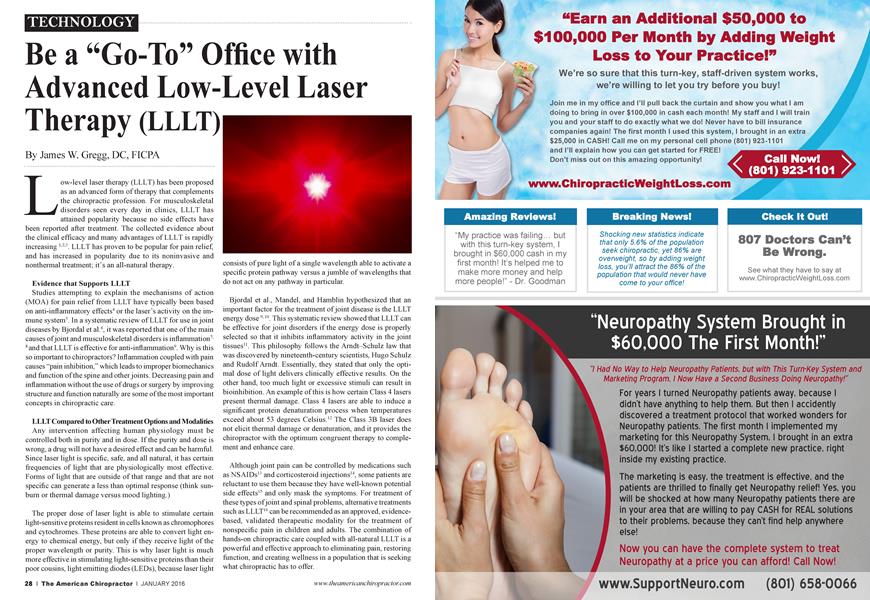
Low-level laser therapy (LLLT) has been proposed as an advanced form of therapy that complements the chiropractic profession. For musculoskeletal disorders seen every day in clinics, LLLT has attained popularity because no side effects have been reported after treatment. The collected evidence about the clinical efficacy and many advantages of LLLT is rapidly increasing 12 3. LLLT has proven to be popular for pain relief, and has increased in popularity due to its noninvasive and nonthermal treatment; it’s an all-natural therapy.
Evidence that Supports LLLT
Studies attempting to explain the mechanisms of action (MOA) for pain relief from LLLT have typically been based on anti-inflammatory effects4 or the laser’s activity on the immune system5. In a systematic review of LLLT for use in joint diseases by Bjordal et al.6, it was reported that one of the main causes of joint and musculoskeletal disorders is inflammation7 8 and that LLLT is effective for anti-inflammation9. Why is this so important to chiropractors? Inflammation coupled with pain causes “pain inhibition,” which leads to improper biomechanics and function of the spine and other joints. Decreasing pain and inflammation without the use of drugs or surgery by improving structure and function naturally are some of the most important concepts in chiropractic care.
LLLT Compared to Other Treatment Options and Modalities
Any intervention affecting human physiology must be controlled both in purity and in dose. If the purity and dose is wrong, a drug will not have a desired effect and can be harmful. Since laser light is specific, safe, and all natural, it has certain frequencies of light that are physiologically most effective. Forms of light that are outside of that range and that are not specific can generate a less than optimal response (think sunbum or thermal damage versus mood lighting.)
The proper dose of laser light is able to stimulate certain light-sensitive proteins resident in cells known as chromophores and cytochromes. These proteins are able to convert light energy to chemical energy, but only if they receive light of the proper wavelength or purity. This is why laser light is much more effective in stimulating light-sensitive proteins than their poor cousins, light emitting diodes (LEDs), because laser light
consists of pure light of a single wavelength able to activate a specific protein pathway versus a jumble of wavelengths that do not act on any pathway in particular.
Bjordal et al., Mandel, and Hamblin hypothesized that an important factor for the treatment of joint disease is the LLLT energy dose9-10. This systematic review showed that LLLT can be effective for joint disorders if the energy dose is properly selected so that it inhibits inflammatory activity in the joint tissues11. This philosophy follows the Amdt-Schulz law that was discovered by nineteenth-century scientists, Hugo Schulz and Rudolf Arndt. Essentially, they stated that only the optimal dose of light delivers clinically effective results. On the other hand, too much light or excessive stimuli can result in bioinhibition. An example of this is how certain Class 4 lasers present thermal damage. Class 4 lasers are able to induce a significant protein dénaturation process when temperatures exceed about 53 degrees Celsius.12 The Class 3B laser does not elicit thermal damage or dénaturation, and it provides the chiropractor with the optimum congruent therapy to complement and enhance care.
Although joint pain can be controlled by medications such as NS AIDs13 and corticosteroid injections14, some patients aie reluctant to use them because they have well-known potential side effects15 and only mask the symptoms. For treatment of these types of joint and spinal problems, alternative treatments such as LLLT16 can be recommended as an approved, evidencebased, validated therapeutic modality for the treatment of nonspecific pain in children and adults. The combination of hands-on chiropractic care coupled with all-natural LLLT is a powerful and effective approach to eliminating pain, restoring function, and creating wellness in a population that is seeking what chiropractic has to offer.
With more than 3,000 studies on LLLT, there is evidences of the effectiveness of LLLT in treating low back pain17, arthritis1819, myofascial pain20, plantar fasciitis21, lateral epicondylitis22, neuropathic pain23, TMJ disorder24, and in delaying the onset of muscle soreness25 26. All of these conditions and many more are reasons that patients choose a “go-to” chiropractor that has the tools to help them. Patients who have pain or perceive that chiropractors don’t help these conditions are seeking care from other providers when a chiropractor should be their first thought. Being a “go-to” chiropractor offering LLLT can improve patient retention, stimulate referrals, and grow practices all from within.
Key Considerations for LLLT in Chiropractic Practice
In order to consistently achieve these results clinically, it is important that the provider control not only the wavelength, but also the dose of light energy. This is a very important consideration for the chiropractor looking to use LLLT. Is it optimum, effective, and efficient in delivering care time-wise? Does the treatment take 20 to 30 minutes, thus limiting the use in office? Or can it be applied in three to six minutes per visit to maximize the number of patients who can have access to LLLT and increase the office’s efficiency?
The key parameters for LLLT technologies, in accordance with the first law (Grotthuss-Draper law) and the second law (Stark-Einstein law) of photochemistry to provide the highest clinical efficacy, the laser therapy device must:
• Provide light of the correct wavelength (to activate the correct cytochrome or chromophore).
• Penetrate tissue to the required depth (to provide healing light energy to the damaged tissue).
• Deliver the required dose to the tissue of interest (to provide the correct dose of photons).
• Stimulate a biological response (fulfill the first and second laws of photochemistry).
In 1960, Gordon and Surrey found that cells exposed to light at a wavelength of660 mn showed enhanced adenosine triphosphate (ATP) synthesis27. In 2005, these original observations were confirmed by A mat et al.28, and then in 2011, by Alghamdi and colleagues29. Recent research has shown that only 905 mn superpulsed laser technology increases the production of nitric oxide (NO) by more than 700% compared to other wavelengths, or even the same 905 mn applied in continuous wave mode30. Thus, superpulsing at 905 mn, at the correct treatment parameters, is required to elicit this response. NO is well known to have effects on increasing vasodilation and decreasing inflammation. It has been published that when the cellular membrane of nerve cells is subjected to 905 mn superpulsed light, the porosity of the cellular membrane is increased, which allows for an accelerated reabsorption of sodium ions and for the expulsion of potassium ions across the membrane, thus rebalancing the sodium-potassium pump and removing the pain signal at the source31.
These findings led to the development of the highest efficacy advanced LLLT systems that encompass potent and complementary bioregulatory mechanisms of 660 mn (red) laser light and 905 mn (near infrared) superpulsed laser light
at a particular therapeutic mode of administration. Increased ATP speeds up healing, increased NO reduces inflammation, and rebalancing the ion pump in neurons decreases pain (and pain inhibition)—all naturally and innately, which is where the art, science, and philosophy of chiropractic meet. This helps chiropractors achieve greater success, faster results, and see more conditions, which can only help generate referrals and increase retention in their offices.
Every patient possesses different tissue characteristics and a unique optical profile. An optical profile varies by specific anatomical location and is determined by skin coloration, subcutaneous fat, muscle content, bone density, water hydration levels, oxygen perfosion levels, and vascular density, to name a few. To further complicate the matter, each patient’s unique optical profile may change over time due to aging, physical activity, and dietary choices. Taking all of these parameters into consideration, the permutations of light attenuation in tissue are virtually infinite, just like fingerprints. Therefore, the difference in the actual dose of light received at the target tissue from the tissue surface will vary dramatically among individual patients. Knowing this, how can any clinical practice take all of these variations into account, unless the light source automatically adjusts to these nuances in tissue attenuation?
What if:
• We could accurately predict the target tissue depth for the specific diagnosis of each individual patient?
• We could accurately measure light attenuation in the patient’s tissue at the time of treatment?
• We could adjust the dose of laser light output to compensate for the light energy lost during tissue penetration?
Result: (Hint: We can!)
If we could automatically adjust the light source’s characteristics to adjust for tissue variations and deliver an exact dose of optimized laser light energy to reach a specific depth of target injured tissue every time, then we would achieve what we seek—the maximum treatment efficacy possible for a given patient’s physical characteristics and associated condition!
Exciting new technology recently approved by the FDA features “biofeedback” technology that automatically adjusts the laser dose based on a patient’s physical characteristics and condition, providing optimized, repeatable, and reproducible LLLT treatments to a broad patient population. This technology, which automatically adjusts the laser dose to the specific patient’s physical characteristics, ensures optimal energy dosing to the target tissue for the highest efficacy possible. This major breakthrough in LLLT technology will quickly bring this technology into the mainstream of health care and to the forefront as the primary technology to eliminate pain, reduce inflammation, and accelerate tissue healing. It’s a breakthrough that all chiropractors from different kinds of practices can use with confidence to be the “go-to” chiropractor in their communities.
Reference:
1 Doyle AT, LauberC, Sabine K. The Effects of LLLT on Pain Associated With Tendinopathy:
A Critically Appraised Topic. J Sport Rehabilitation. 2015 Jan 5.
2 Leal-Junior EC, Johnson DS, Saltniarche A, Demchak T. Adjunctive use of combination of
super-pulsed laser and light-emitting diodes phototherapy on nonspecific knee pain: Doubleblinded randomized placebo-controlled trial. LasersMed Sei. 2014 Nov;29(6):1839-47.
3 Gross AR, Dziengo S, Boers O, Goldsmith CH, Graham N, Lüge L, Bumie S, White R. Low
Level Laser Therapy (LLLT) for Neck Pain: A Systematic Review and Meta-Regression. Open Orthopedic J. 2013 Sep 20;7:396-419.
4HonmuraA, YanaseM, ObataJ, HarukiE. LasersSwgetyMedicine, 1992; 12(4):441-9.
5 TadakumaT. Possible application of the laser in immunobiology’. Keio J. Med.1993;42:180-182.
6 BjotdalJM, Couppe C, ChowRT, Tuner J, Ljunggren EA. A systematic review of low level
laser therapy with location-specific doses for pain from chronic joint disorders. Aust. J. Physiotherapy. 2003;49:107-116.
7 Greene M4, Loeser RF. Aging-related inflammation in osteoarthritis. Osteoarthritis
Cartilage. 2015 Nov;23(ll):1966-71.
8 Abdelhamid RE, Sluka KA. ASICs Mediate Pain and Inflammation in Musculoskeletal
Diseases. Physiology (Bethesda). 2015 Nov;30(6):449-59.
9 HwangMH, ShinJH, Kim KS, Yoo CM, Jo GE, KimJH, ChoiH. Low level light therapy modu-
lates inflammatory mediators secreted by human annulusfibrosus cells during intervertebral disc degeneration in vitro. Photochemistry Photobiology. 2015 Mar-Apr;91 (2) :403-l 0.
10 Mandel A, Hamblin M. A Renaissance in Low-Level Laser (Light) Therapy - LLLT, Photonics and Lasers in Medicine. 11/2012;1(4) :231-235. DOI: 10.1515/plm-2012-0044.
11 Haslerud S, Magnussen LH, Joensen J, Lopes-Martins R4, Bjordcil JM. The efficacy of low-level laser therapyfor shoulder tendinopathy: A systematic review and meta-analysis of randomized controlled trials. Physiotherapy Res Int. 2015 Jun;20(2):108-25.
12 Zhou J, Chen JK, Zhang Y. Theoretical analysis of thermal damage in biological tissues caused by laser irradiation. Molecular Cell Biomechanics. 2007Mar;4(l):27-39.
13 Zayat US, Conaghan PG, Sharif M, et al. Do non-steroidal anti-inflammatory drugs have a significant effect on detection and grading of ultrasound-detected synovitis in patients with rheumatoid arthritis? Results from a randomised study. Arm. Rheum. Dis. 2011;70:1746-1751.
14 Leung A, Liew D, Lim J, etal. The effect of joint aspiration and corticosteroid injections in osteoarthritis of the knee. Int. J. Rheum. Dis. 2011;14:384-389.
15 Scanzello CR, MoskowitzNK, GibofskyA. The post-NSAID era: What to use now for the pharmacologic treatment of pain and inflammation in osteoarthritis. Curt: Rheumatology. Rep. 2008;10:49-56.
16ShenX, Zhao L, Ding G, et al. Effect of combined laser acupuncture on knee osteoarthritis: A pilotstudy. Lasers Med. Sei. 2009;24:129-136.
17 BarbosaRI, Fonseca MC, Rodrigues EK, Tamanini G, MarcolinoAM, MazzerN, Guirro RR, MacDetmid J. Efficacy of low-level laser therapy associated to orthosesfor patients with carpal tunnel syndrome: A randomized single-blinded controlled trial. J Back Musculoskeletal Rehabilitation. 2015 Sep 25.
18 Ip D. Does addition of low-level laser therapy (LLLT) in conservative care of bree arihr tis
successfullypostpone the needforjoint replacement? LasersMed Sci. 2015Dec;30(9):2335-9.
19 Ferreira de Metieses SR, Hunter DJ, YotingDockoE, PasqualMarquesA. Effect of low-level laser therapy (904 nm) and static shetching in patients with knee osteoarthritis: a protocol of randomised controlled trial. BMC Musculoskeletal Disorders. 2015 Sep 14 ;16:252.
20 DemirkolN, SariF, BulbulM, DentirkolM, SinisekI, UstimezA. Effectiveness of occlusal splints and low-level laser therapy on myofascial pain. LasersMed Sei. 2015 Apr;30(3):1007-12.
21 Alacias DM, Coughlin MJ, Zang K, Stevens FR, Jastifer JR, Doty JF. Low-Level Laser Therapy at 635 nm for Treatment of Chronic Plantar Fasciitis: A Placebo-Controlled, Randomized Study. J Foot Ankle Surg. 2015 Sep-Oct;54(5):768-72.
22 Oktini I, Usingóme N, Hatada T, Ohshiro T, Musya Y, Sekiguchi M. Low Level Laser Therapy (LLLT) for chronic joint pain of the elbow, wrist and fingers. Laser Therapy. 2012 Mar 28; 21(1): 15-4.
23 Bashiti H. Evaluation of low level laser therapy in reducing diabetic polyneuropathy related pain and sensorimotor disorders. Acta Med Iran. 2013 Sep 9;51 (8):543-7.
24 Fomaini C, Pelosi A, Queirolo V, Vescovi P, Metigo E. The "at-home LLLT" in tempommandibular disorders pain control: A pilot study. Laser Therapy. 2015 Mar 31;24(l):47-52.
25 Sancakli E, Gôkçen-Rôhlig B, Balik A, Ongiil D, Kipirdi S, Keskin H. Early results of low-level laser application for masticatory muscle pain: A double-blind randomized clinical study. BMC Oral Health. 2015 Oct 23;15(1):131.
26 Rodrigues R, Freire BB, Franke Rde A, Gerenna JM, Vaz A14. Effect of low-level laser therapy on muscle adaptation to knee extensor eccentric training. European J Applied Physiology: 2015Mar;115(3):639-47.
27 Gordon SU, Surrey K. Red and far-red action on oxidative phosphorylation. Apr 1960, Radiation Res, Vol. 12, pp. 325-339.
28 Ama t A, etal. Modification of the intrinsic fluorescence and the biochemical behavior of ATP after irradiation with visible and near-infrared laser light. Oct 3, 2005, Photochemistry Photobiologv, Vol. 81, pp. 26-32.
29Alghamdi KM, Kumar A, Atoussa NA. Low-level laser therapy: A useful technique for enhancing the proliferation of various cultured cells. Jan 2011, Lasers Ated Science, 1 bl. 28.
30Moriyama etal. In vivo effects of low level laser therapy on inducible nitric oxide synthase. Alarch 2009, Lasers Surgery Medicine, Vol. 41, pp. 227-231.
31 van leen, RLP, Sterenborg HJCAI., Pifferi A, Torricelli A, Cubeddu R. Determination of IISNIR absorption coefficients of mammalian fat, with timeand spatially resolved diffuse reflectance and transmission spectroscopy, 2000, Optical Society of America.
Dr. James W. Gregg, DC, FICPA G ¡»-'I Dr. Gregg has been running his own practice for 20 years and has successfully utilized laser technology to help V grow his practice. Dr. Gregg will be sharing his practical experience at 10:00 am on Friday, January 15, in the Speakers Zone at Parker Seminar in Las Vegas.