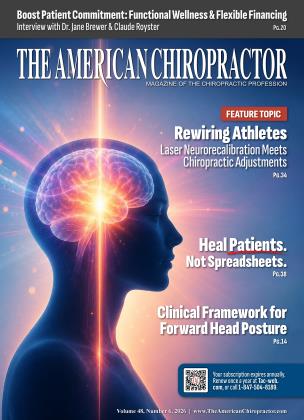
Rewiring the Athlete with Laser Neurorecalibration and Chiropractic Adjustments
Rewiring the Athlete with Laser Neurorecalibration and Chiropractic Adjustments

Most approaches to sports performance still chase the muscle.
Stronger. Faster. More explosive.
But here’s the problem — muscles don’t make decisions. The brain does.
For years, chiropractors and elite athletes have known that adjustments can have a huge impact on injury recovery, performance, and nervous system function. Reaction time, coordination, balance, timing, and precision all originate in the nervous system. If the brain is even slightly inefficient, the athlete is leaving performance on the table — no matter how strong they are.
This is where high-energy, nonthermal laser therapy, when applied correctly, becomes a performance tool — not just a recovery modality.
Performance Starts in the Brain
• Every athletic movement is a neurological event.
• Before a muscle contracts, the brain must:
• Process sensory input.
• Predict movement.
• Coordinate timing.
• Send a precise motor signal.
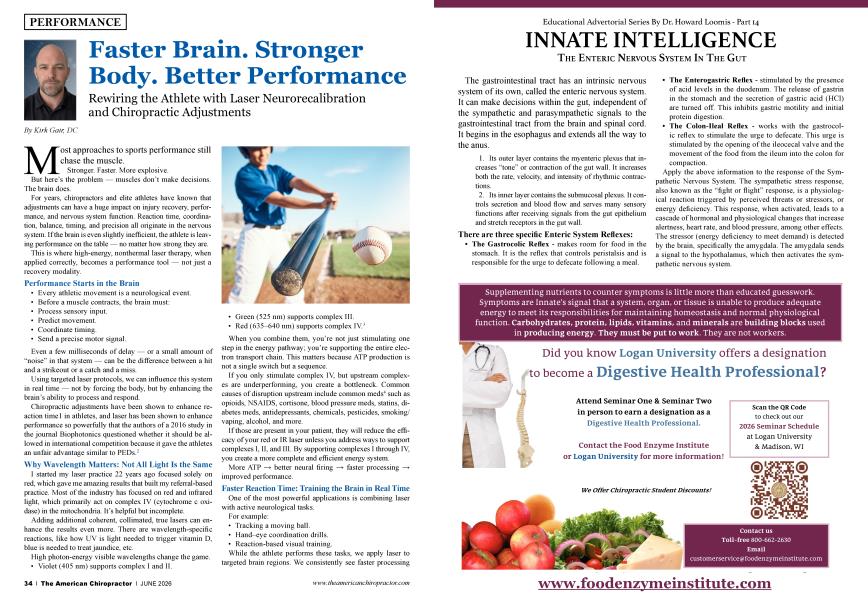
Even a few milliseconds of delay — or a small amount of “noise” in that system — can be the difference between a hit and a strikeout or a catch and a miss.
Using targeted laser protocols, we can influence this system in real time — not by forcing the body, but by enhancing the brain’s ability to process and respond.
Chiropractic adjustments have been shown to enhance reaction timel in athletes, and laser has been shown to enhance performance so powerfully that the authors of a 2016 study in the journal Biophotonics questioned whether it should be allowed in international competition because it gave the athletes an unfair advantage similar to PEDs.2
I started my laser practice 22 years ago focused solely on red, which gave me amazing results that built my referral-based practice. Most of the industry has focused on red and infrared light, which primarily act on complex IV (cytochrome c oxidase) in the mitochondria. It’s helpful but incomplete.
Adding additional coherent, collimated, true lasers can enhance the results even more. There are wavelength-specific reactions, like how UV is light needed to trigger vitamin D, blue is needed to treat jaundice, etc.
High photon-energy visible wavelengths change the game.
• Violet (405 nm) supports complex I and II.
• Green (525 nm) supports complex III.
• Red (635-640 nm) supports complex IV.3
When you combine them, you’re not just stimulating one step in the energy pathway; you’re supporting the entire electron transport chain. This matters because ATP production is not a single switch but a sequence.
If you only stimulate complex IV, but upstream complexes are underperforming, you create a bottleneck. Common causes of disruption upstream include common meds4 such as opioids, NSAIDS, cortisone, blood pressure meds, statins, diabetes meds, antidepressants, chemicals, pesticides, smoking/ vaping, alcohol, and more.
If those are present in your patient, they will reduce the efficacy of your red or IR laser unless you address ways to support complexes I, II, and III. By supporting complexes I through IV, you create a more complete and efficient energy system.
More ATP better neural firing faster processing —> improved performance.
One of the most powerful applications is combining laser with active neurological tasks.
For example:
• Tracking a moving ball.
• Hand-eye coordination drills.
• Reaction-based visual training.
While the athlete performs these tasks, we apply laser to targeted brain regions. We consistently see faster processing speeds, improved timing, and cleaner movement execution.
This isn’t passive therapy. It’s active neuro-training with enhanced energy availability. You’re not just practicing the skill; you’re upgrading the system that performs it.
I created a protocol over a decade ago when I was working at the Dodgers/Angels fantasy camp to enhance batting. If a player is in a slump, this protocol will usually get them out of it with one to two sessions.
It is very simple and involves applying the laser transcranially while mock pitches in their weak spot are performed with a ball. I have done this for hundreds of athletes and consistently get them back to their normal hitting and usually better than before.
Balance is not just a musculoskeletal issue; it’s a brain integration problem.
We often place athletes on a vibration plate to challenge proprioception while applying laser simultaneously. Then we layer in cross-crawl patterns, gait training, and coordinated movement drills.
This creates a powerful combination:
• Increased sensory input (vibration)
• Active motor output (movement)
• Enhanced neural energy (laser)
The result is a more adaptable and resilient system. Athletes don’t just “get stronger.” They become more stable, more efficient, and harder to disrupt under pressure.
This is the method I used to help Zack Shinnick come back from a chronic hamstring injury that plagued his track career to win state and national titles in 2017 while also winning Gold and Bronze at the Pan Am Juniors games and setting a world record in the 4x400.
One of the most overlooked uses of laser is preactivation. Applied correctly, laser can:
• Improve motor unit recruitment.
• Increase muscle firing efficiency.
• Enhance strength output immediately.
We often apply laser to the muscle belly and the nerve root supplying that muscle. This is not a thermal effect. We’re not heating tissue. We’re changing how the nervous system communicates with the muscle.
Patients can feel the change in real time. We will have them squat, lunge, or lift something before laser and immediately afterward. The result:
• Stronger contractions
• Better coordination
• Less inhibition
Athletes often feel this instantly and are shocked and excited. This reaction got me the reputation as the “voodoo doctor” and led to teammates and coaches coming in not just for injuries but also to play at the top of their game. It’s not hype. It’s not voodoo. It’s not a parlor trick. It’s neurology.
Injuries often create protective inhibition. The brain downregulates a muscle or movement to avoid perceived threat. Traditional approaches often try to override this mechanically.
Laser allows us to do something different. By applying laser to injured tissue, surrounding neural structures, and stimulating a particular nerve pathway, we can reduce threat perception without numbing or blocking function. This is key. We’re not shutting the system down; we’re restoring proper signaling.
Athletes can move more freely, maintain strength, and avoid compensation patterns, all without relying on a thermal or destructive approach or temporary pain relief approach.
Recovery is not just about tissue repair; it’s about restoring cellular energy.
When the mitochondria are supported across all complexes:
• ATP production improves.
• Oxidative stress is better managed.
• Cellular signaling becomes more efficient.
Clinically, this translates to:
• Faster recovery between sessions.
• Reduced soreness.
• Improved readiness for the next performance.
And because we’re working at the cellular and neurological level, the effects extend beyond the local tissue.
The biggest mistake is using laser passively. Passive is good, and what I started with in 2004 after seeing a Dr. Dan Murphy seminar. Then in 2006, I went to a Dr. Jeff Spencer seminar, and everything changed because I learned from that the real breakthroughs happen when you stack laser with movement.
Examples:
• Laser + cross-crawl patterns
• Laser + gait retraining
• Laser + visual tracking drills
• Laser + balance challenges
• Laser + resisted muscle testing
This is what I call “neurorecalibration.” You’re not just treating tissue; you’re upgrading the software while the system is running. That’s where lasting changes occur.
This is where athletes set themselves up on continuous plans without you having to convince them of the need. They feel the results and experience them on the field when you stack lasers and chiropractic.
For decades, performance has been built from the outside in. More reps. More weight. More force.
However, the future is built from the inside out. Better processing. Better coordination. Better energy.
Laser — especially when using high photon-energy visible wavelengths — gives us a tool to influence the system at its source by enabling adaptation, not forcing it.
If you improve the brain, the body follows. Faster reactions. Stronger contractions. Better balance. Quicker recovery.
This isn’t about replacing traditional training. It’s about enhancing the system that makes training effective.
When you combine targeted laser protocols with movement, coordination, and real-time feedback, you’re training smarter at the level where performance actually begins.
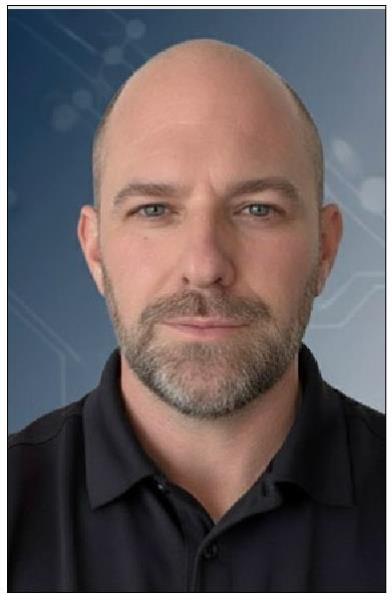
Dr. Kirk Gair has been in private practice since 1999 and using Ercho-nia cold lasers since 2004. He has treated elite athletes, including Su-per Bowl and MLB champions, as well as national record holders. His expertise in cold laser therapy and training in functional medicine and neurology attract patients from across the U.S. Dr. Gair has been fea-tured in the documentary The Thyroid Secret, as well as on major health platforms and podcasts. To contact Dr. Gair, call (626) 9221414, email [email protected], or visit LaserChiropractic.net.
1. DeVocht JW, Vining R, Smith DL, Long C, Jones T, Goertz C. Effect of chiropractic manipulative therapy on reaction time in special operations forces military personnel: a randomized controlled trial. Trials. 2019 Jan 3;20(l):5. doi: 10.1186/sl3063-018-3133-2. PMID: 30606225; PMCID: PMC6318970.
2. Ferraresi C, Huang YY, Hamblin MR. Photobiomodulation in human muscle tissue: an advantage in sports performance? J Biophotonics. 2016 Dec;9(ll-12):1273-1299. doi: 10.1002/jbio.201600176. Epub 2016 Nov 22. PMID: 27874264; PMCID: PMC5167494.
3. Wainio WW. The mammalian mitochondrial respiratory chain. New York: Academic Press, 1970.
4. Chan K, Truong D, Shangari N, O'Brien PJ. Drug-induced mitochondrial toxicity. Expert Opin Drug Metab Toxicol. 2005 Dec; 1(4):655-69. doi: 10.1517/17425255.1.4.655. PMID: 16863431.