Call for Fiber to be a New Essential Nutrient
FUNCTIONAL MEDICINE
Lynn Toohey
PhD
IN JANUARY 2026, IT WAS REPORTED THAT Nutrition experts are calling for dietary fiber to be officially recognized internationally as an essential nutrient, making it the first “new” essential nutrient in more than 50 years.
Researchers said fiber should sit alongside nutrients already considered essential for humans, such as certain amino acids and vitamins. Coauthor of the January 2026 article, Associate Professor Andrew Reynolds, said increasing our dietary fiber intake would deliver greater health benefits than increasing any other essential nutrient, given that our current fiber intake is below the World Health Organization’s (WHO) recommendations.1
Approximately 95% of American adults and children fail to consume the recommended amounts of fiber, with over 90% of women and 97% of men falling short. The average intake is roughly 10 to 15 grams daily, far below the recommended 25 to 38 grams.2
“To be recognized as essential, the nutrient must a) be beneficial to human health and b) not be produced by the body itself.”
The authors of that study (Reynolds AN et al. 2026) also claim that with an increase in fiber, much of the health dysfunction in our society could be “appreciably reduced by such a dietary change.” To be recognized as essential, the nutrient must a) be beneficial to human health and b) not be produced by the body itself Also, the absence of the nutrient would result in a measurable deficiency state.
Why the call to make fiber an essential nutrient? A lot of that comes from the recent attention on the importance of the gut microbiome and the microbiome-gut-brain (M-G-B) connection. Major signaling peptides come from the enteroendocrine cells of the gut. Soluble fiber produces short-chain fatty acids (SCFAs) that have a major influence on signaling pathways.
The main SCFAs that are produced are acetate, propionate, and butyrate. Of those three SCFAs, butyrate is the most essential when it comes to signaling power, and higher soluble fiber intake is associated with more butyrate-producing bacteria and related SCFA changes, especially in older adults.
Butyrate deserves its own mention because it is such a powerful signaling tool within the body. It is a primary energy source, supplying 60% to 70% of the energy for all colon cells.
Butyrate supports an anti-inflammatory environment, a strong epithelial barrier, mucus production (via goblet cells) for a strong mucosal barrier, reduced antigen and endotoxin (LPS) translocation, food allergies/sensitivities (by mechanism of its effects on intestinal barrier integrity), enteric nervous system signaling, sugar balance, and GLP-1 natural secretion. It also helps when chronic inflammation has suppressed GLP1 signaling.3=4’5-6-7
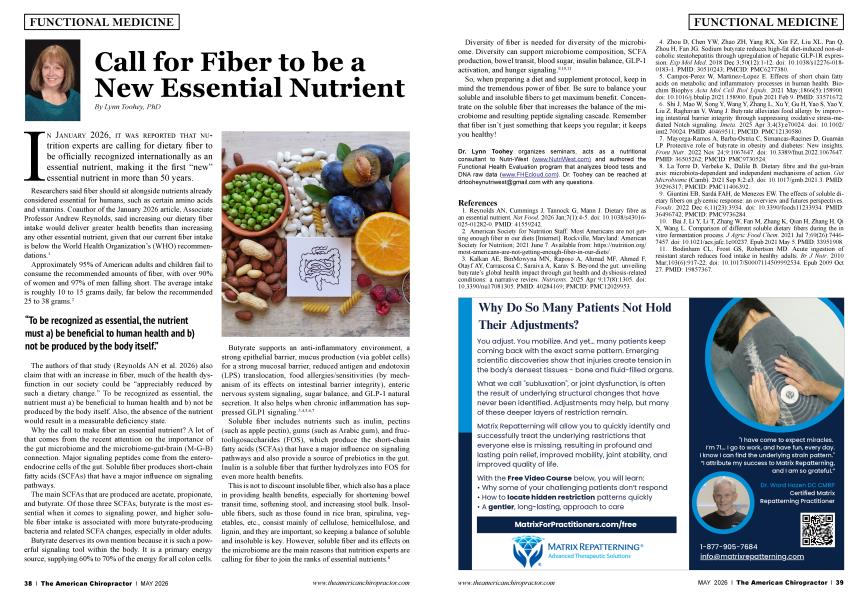
Soluble fiber includes nutrients such as inulin, pectins (such as apple pectin), gums (such as Arabic gum), and fructooligosaccharides (FOS), which produce the short-chain fatty acids (SCFAs) that have a major influence on signaling pathways and also provide a source of prebiotics in the gut. Inulin is a soluble fiber that further hydrolyzes into FOS for even more health benefits.
This is not to discount insoluble fiber, which also has a place in providing health benefits, especially for shortening bowel transit time, softening stool, and increasing stool bulk. Insoluble fibers, such as those found in rice bran, spirulina, vegetables, etc., consist mainly of cellulose, hemicellulose, and lignin, and they are important, so keeping a balance of soluble and insoluble is key. However, soluble fiber and its effects on the microbiome are the main reasons that nutrition experts are calling for fiber to join the ranks of essential nutrients.8
Diversity of fiber is needed for diversity of the microbiome. Diversity can support microbiome composition, SCFA production, bowel transit, blood sugar, insulin balance, GLP-1 activation, and hunger signaling.9-1011
So, when preparing a diet and supplement protocol, keep in mind the tremendous power of fiber. Be sure to balance your soluble and insoluble fibers to get maximum benefit. Concentrate on the soluble fiber that increases the balance of the microbiome and resulting peptide signaling cascade. Remember that fiber isn’t just something that keeps you regular; it keeps you healthy!
Dr. Lynn Toohey organizes seminars, acts as a nutritional consultant to Nutri-West (www.NutriWest.com) and authored the Functional Health Evaluation program that analyzes blood tests and DNA raw data (www.FHEcloud.com). Dr. Toohey can be reached at [email protected] with any questions.
References
1. Reynolds AN, Cummings J, Tannock G, Mann J. Dietary fibre as an essential nutrient. Nat Food. 2026 Jan;7(l):4-5. doi: 10.1038/s43016025-01282-0. PMID: 41559242.
2. American Society for Nutrition Staff. Most Americans are not getting enough fiber in our diets [Internet], Rockville, Maryland: American Society for Nutrition; 2021 June 7. Available from: https://nutrition.org/ most-americans-are-not-getting-enough-fiber-in-our-diets/.
3. Kalkan AE, BinMowyna MN, Raposo A, Ahmad MF, Ahmed F, Otayf AY, Carrascosa C, Saraiva A, Karav S. Beyond the gut: unveiling butyrate's global health impact through gut health and dysbiosis-related conditions: a narrative review. Nutrients. 2025 Apr 9; 17(8): 1305. doi: 10.3390/nul7081305. PMID: 40284169; PMCID: PMC12029953.
4. Zhou D, Chen YW, Zhao ZH, Yang RX, Xin FZ, Liu XL, Pan Q, Zhou H, Fan JG. Sodium butyrate reduces high-fat diet-induced non-alcoholic steatohepatitis through upregulation of hepatic GLP-1 R expression. Exp Mol Med. 2018 Dec 3;50(12):l-12. doi: 10.1038/sl2276-0180183-1. PMID: 30510243; PMCID: PMC6277380.
5. Campos-Perez W, Martinez-Lopez E. Effects of short chain fatty acids on metabolic and inflammatory processes in human health. Biochim Biophys Acta Mol Cell Biol Lipids. 2021 May;1866(5): 158900. doi: 10.1016/j.bbalip.202L158900. Epub 2021 Feb 9. PMID: 33571672.
6. Shi J, Mao W, Song Y, Wang Y, Zhang L, Xu Y, Gu H, Yao S, Yao Y, Liu Z, Raghavan V, Wang J. Butyrate alleviates food allergy by improving intestinal barrier integrity through suppressing oxidative stress-mediated Notch signaling. Imeta. 2025 Apr 3;4(3):e70024. doi: 10.1002/ imt2.70024. PMID: 40469511; PMCID: PMC12130580.
7. Mayorga-Ramos A, Barba-Ostria C, Simancas-Racines D, Guaman LP. Protective role of butyrate in obesity and diabetes: New insights. Front Nutr. 2022 Nov 24;9:1067647. doi: 10.3389/fiiut.2022.1067647. PMID: 36505262; PMCID: PMC9730524.
8. La Torre D, Verbeke K, Dalile B. Dietary fibre and the gut-brain axis: microbiota-dependent and independent mechanisms of action. Gut Microbiome (Camb). 2021 Sep 8;2:e3. doi: 10.1017/gmb.2021.3. PMID: 39296317; PMCID: PMC11406392.
9. Giuntini EB, Sarda FAH, de Menezes EW. The effects of soluble dietary fibers on glycemic response: an overview and futures perspectives. Foods. 2022 Dec 6;11(23):3934. doi: 10.3390/foodsl 1233934. PMID: 36496742; PMCID: PMC9736284.
10. Bai J, Li Y, Li T, Zhang W, Fan M, Zhang K, Qian H, Zhang H, Qi X, Wang L. Comparison of different soluble dietary fibers during the in vitro fermentation process. J Agric Food Chem. 2021 Jul 7;69(26):74467457. doi: 10.1021/acs.jafc.lc00237. Epub 2021 May 5. PMID: 33951908.
11. Bodinham CL, Frost GS, Robertson MD. Acute ingestion of resistant starch reduces food intake in healthy adults. Br J Nutr. 2010 Mar;103(6):917-22. doi: 10.1017/S0007114509992534. Epub 2009 Oct 27. PMID: 19857367.