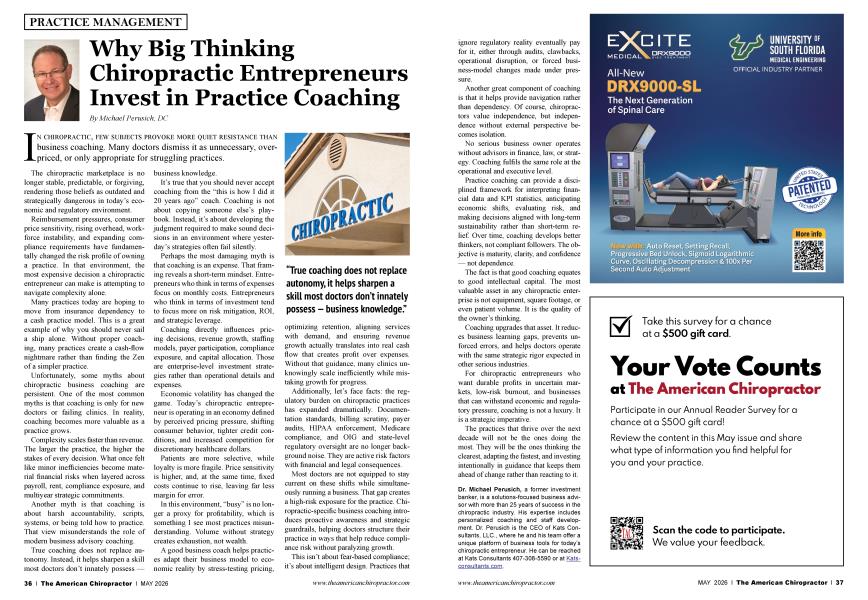
Why Big Thinking Chiropractic Entrepreneurs Invest in Practice Coaching
PRACTICE MANAGEMENT
Michael Perusich
DC
“True coaching does not replace autonomy, it helps sharpen a skill most doctors don’t innately possess - business knowledge.”
IN CHIROPRACTIC, FEW SUBJECTS PROVOKE MORE QUIET RESISTANCE THAN business coaching. Many doctors dismiss it as unnecessary, overpriced, or only appropriate for struggling practices.
The chiropractic marketplace is no longer stable, predictable, or forgiving, rendering those beliefs as outdated and strategically dangerous in today’s economic and regulatory environment.
Reimbursement pressures, consumer price sensitivity, rising overhead, workforce instability, and expanding compliance requirements have fundamentally changed the risk profile of owning a practice. In that environment, the most expensive decision a chiropractic entrepreneur can make is attempting to navigate complexity alone.
Many practices today are hoping to move from insurance dependency to a cash practice model. This is a great example of why you should never sail a ship alone. Without proper coaching, many practices create a cash-flow nightmare rather than finding the Zen of a simpler practice.
Unfortunately, some myths about chiropractic business coaching are persistent. One of the most common myths is that coaching is only for new doctors or failing clinics. In reality, coaching becomes more valuable as a practice grows.
Complexity scales faster than revenue. The larger the practice, the higher the stakes of every decision. What once felt like minor inefficiencies become material financial risks when layered across payroll, rent, compliance exposure, and multiyear strategic commitments.
Another myth is that coaching is about harsh accountability, scripts, systems, or being told how to practice. That view misunderstands the role of modern business advisory coaching.
True coaching does not replace autonomy. Instead, it helps sharpen a skill most doctors don’t innately possess — business knowledge.
It’s true that you should never accept coaching from the “this is how I did it 20 years ago” coach. Coaching is not about copying someone else’s playbook. Instead, it’s about developing the judgment required to make sound decisions in an enviromnent where yesterday’s strategies often fail silently.
Perhaps the most damaging myth is that coaching is an expense. That framing reveals a short-term mindset. Entrepreneurs who think in terms of expenses focus on monthly costs. Entrepreneurs who think in terms of investment tend to focus more on risk mitigation, ROI, and strategic leverage.
Coaching directly influences pricing decisions, revenue growth, staffing models, payer participation, compliance exposure, and capital allocation. Those are enterprise-level investment strategies rather than operational details and expenses.
Economic volatility has changed the game. Today’s chiropractic entrepreneur is operating in an economy defined by perceived pricing pressure, shifting consumer behavior, tighter credit conditions, and increased competition for discretionary healthcare dollars.
Patients are more selective, while loyalty is more fragile. Price sensitivity is higher, and, at the same time, fixed costs continue to rise, leaving far less margin for error.
In this environment, “busy” is no longer a proxy for profitability, which is something I see most practices misunderstanding. Volume without strategy creates exhaustion, not wealth.
A good business coach helps practices adapt their business model to economic reality by stress-testing pricing, optimizing retention, aligning services with demand, and ensuring revenue growth actually translates into real cash flow that creates profit over expenses. Without that guidance, many clinics unknowingly scale inefficiently while mistaking growth for progress.
Additionally, let’s face facts: the regulatory burden on chiropractic practices has expanded dramatically. Documentation standards, billing scrutiny, payer audits, HIPAA enforcement, Medicare compliance, and OIG and state-level regulatory oversight are no longer background noise. They are active risk factors with financial and legal consequences.
Most doctors are not equipped to stay current on these shifts while simultaneously running a business. That gap creates a high-risk exposure for the practice. Chiropractic-specific business coaching introduces proactive awareness and strategic guardrails, helping doctors structure their practice in ways that help reduce compliance risk without paralyzing growth.
This isn’t about fear-based compliance; it’s about intelligent design. Practices that ignore regulatory reality eventually pay for it, either through audits, clawbacks, operational disruption, or forced business-model changes made under pressure.
Another great component of coaching is that it helps provide navigation rather than dependency. Of course, chiropractors value independence, but independence without external perspective becomes isolation.
No serious business owner operates without advisors in finance, law, or strategy. Coaching fulfils the same role at the operational and executive level.
Practice coaching can provide a disciplined framework for interpreting financial data and KPI statistics, anticipating economic shifts, evaluating risk, and making decisions aligned with long-term sustainability rather than short-term relief Over time, coaching develops better thinkers, not compliant followers. The objective is maturity, clarity, and confidence — not dependence.
The fact is that good coaching equates to good intellectual capital. The most valuable asset in any chiropractic enterprise is not equipment, square footage, or even patient volume. It is the quality of the owner’s thinking.
Coaching upgrades that asset. It reduces business learning gaps, prevents unforced errors, and helps doctors operate with the same strategic rigor expected in other serious industries.
For chiropractic entrepreneurs who want durable profits in uncertain markets, low-risk burnout, and businesses that can withstand economic and regulatory pressure, coaching is not a luxury. It is a strategic imperative.
The practices that thrive over the next decade will not be the ones doing the most. They will be the ones thinking the clearest, adapting the fastest, and investing intentionally in guidance that keeps them ahead of change rather than reacting to it.
Dr. Michael Perusich, a former investment banker, is a solutions-focused business advisor with more than 25 years of success in the chiropractic industry. His expertise includes personalized coaching and staff development. Dr. Perusich is the CEO of Kats Consultants, LLC., where he and his team offer a unique platform of business tools for today’s chiropractic entrepreneur. He can be reached at Kats Consultants 407-308-5590 or at Katsconsultants.com.