The Functional Movement Evaluation
FEATURE
Brian Jensen
DC
Over the past 20 years, functional movement assessment has become a common tool used for screening fundamental movement patterns in participation or placement screenings. It’s also used to help determine readiness to return to athletic activity or to identify completion of rehabilitation after an injury or surgery1, and it can be a very useful tool as part of a chiropractic evaluation. Many of the common conditions our patients seek care for are the result of the breakdown in the efficiency of the proprioceptive input and its influence on efficient neuromuscular function. Our job is to see if we can identify the weak link in the kinetic chain.
The importance of functional movement was made very clear to me one Sunday afternoon while driving through a neighborhood with my wife and seeing a man lying in his yard. My initial thought was that something tragic had just happened because he was on the ground next to his walker and electric hedge trimmer.
I pulled into his driveway, jumped out of the car, and asked him if he was hurt. He responded that he didn’t think he was hurt, but he couldn’t get up off the ground. The 80-year-old explained that he was out trimming a bush, took a step back to observe his work, lost his balance, and fell. Unable to get the attention of a neighbor, he had laid there helpless for nearly 30 minutes. We helped him to his wheelchair and got him back to level ground. He was lucky that he wasn’t injured severely, but the mere fact that he didn’t have the strength and flexibility to get up without help left a lasting impression on me. One of the most important physical skills we can maintain is the ability to get up off the floor. It requires strength, balance, and coordination, which are a struggle for the aging population.
Functional movement assessment has spawned the development of corrective exercises to address specific distortion patterns, as seen in the textbook, NASM Essentials of Corrective Exercise Training. The idea is that when a postural distortion or movement disorder is identified, you can prescribe an exercise to strengthen the underactive muscle. The concept is simple, but my experience using the functional squat test has revealed some interesting results that made me rethink the process.
When a patient performs the functional squat test, I instruct patients to stand with their feet shoulder-width apart, arms straight out in front of them, and squat as if they are sitting in a chair. Ideally, the foot, knee, and hip should remain directly under the hip, and the arms should remain vertical. The functional squat is videotaped using the Posture Screen mobile app. Distortion patterns are identified in the report, including the overactive and underactive muscles and the potential injuries.
Common distortions include knees moving outward or inward, feet turning out or in, and arms falling forward.
When a knee turns outward, the NASM Essentials of Corrective Exercise identifies possible overactive muscles as the piriformis, biceps femoris, TFL, and gluteus minimus. Possible underactive muscles include the adductor complex, medial hamstring, and gluteus maximus. The potential injuries from these distortions include patellar tendinopathy, patellofemoral syndrome, ACL injury, and IT band tendonitis.
When a foot turns outward, the soleus, lateral gastrocnemius, biceps femoris, piriformis, and TFL can become overactive, and the medial gastrocnemius, hamstring, gluteus medius/maximus, gracilis, popliteus, and sartorius become underactive. Possible injuries include plantar fasciitis, Achilles tendinopathy, medial tibial stress syndrome, ankle sprains, and patellar tendinopathy. Based on concepts in the NASM Essentials of Corrective Exercise, the distortion patterns could be corrected with exercises to strengthen the underactive muscles.
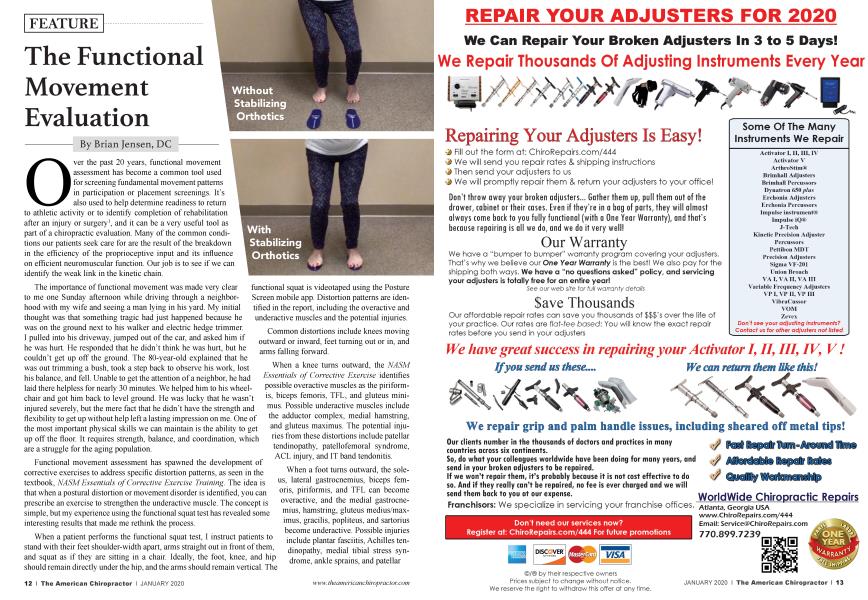
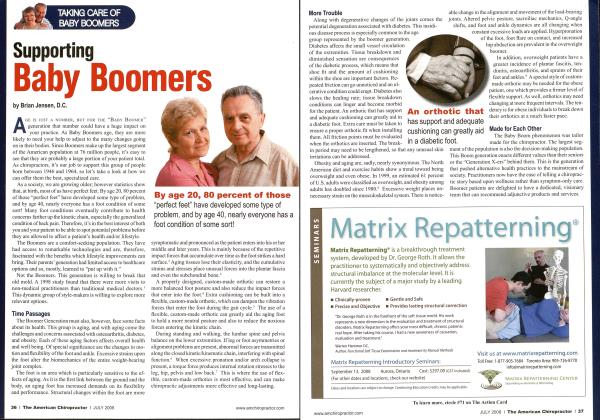
My experience evaluating patients for excessive, asymmetrical pronation has led me to check to see if they move and feel different standing on a sample pair of orthotics. We need to determine if the feet are a source of aberrant proprioceptive input. If they are, we have an opportunity to influence the motor output of the patient in the entire kinetic chain. If we ignore this cause of movement disorders and postural inhibition, our patients will struggle to function at optimal levels.
Proprioceptive input is altered when the pedal foundation is asymmetrical. Proprioception encompasses the sensation of joint movement and joint position. Each segment of the kinetic chain must function properly for efficient movement patterns to occur. Proprioceptive input provides the basis for efficient motor control and movement. When movement distortions occur, it tells me that proprioception is altered, and postural tone is inhibited.
The functional squat test is part of each new-patient evaluation. One exam revealed the turning out of one knee and both feet. The patient’s primary complaint was sciatic pain and piriformis syndrome. I reevaluated the patient standing on a pair of proprioceptive test orthotics from Foot Levelers, and the software in the app showed no distortion patterns, no overactive muscles, no underactive muscles, and no potential injuries. The patient experienced less pain while squatting, and it was easier. It was evident that the patient’s feet were contributing to the distortion patterns in the functional squat, and that the proprioceptive test orthotics helped create a more efficient proprioceptive response resulting in easier movement and less pain.
Proprioceptive input changed, functional movement improved, and the patient experienced less pain during the examination without any corrective exercises. This does not mean that rehabilitative exercises are not important. I believe they are a powerful tool to create new neural networks and strong posture, but efficient proprioceptive input is essential for exercises to be effective. If the feet are a source of neuromuscular inhibition, it is reasonable to recommend an orthotic that creates a symmetrical foundation and enhances the proprioceptive response.
It’s interesting to me that some of my athletic patients who perform at very high levels during competition are unable to perform these simple movements. They have become dependent on utilizing compensatory movement patterns during their activities, sacrificing efficient movements for inefficient ones in order to perform at high levels. When poor or inefficient movement patterns are reinforced, this can lead to poor biomechanics and ultimately increase the potential for injury.
The neurology of proprioception is the same for athletes and elderly alike. It is the basis for all motor control and human movement. Using a functional movement assessment as part of the examination with a proprioceptive test orthotic can help us determine if pedal imbalances are creating the movement distortions that contribute to pain, injury, and degeneration.
Reference
1. Cook, G, Burton, L, Hoogenboom, B, Voight, M, Functional Movement Screening: The Use of Fundamental Movements as an Assessment of Function, Part 1. Int J Sports Phys Ther. 2014 May; 9(3): 396-409.
Dr. Brian Jensen, a graduate of Palmer College of Chiropractic, is the owner of Cave Spring Chiropractic in Roanoke, Virginia. In practice for over 30 years, Dr. Jensen is a highly sought-after Chiropractic lecturer and educator. When he's not practicing, Dr. Jensen speaks on behalf of Foot Levelers on a regular basis.