And Why Chiropractors Who Ignore Them Are Quietly Losing Authority, Revenue, and Referrals
And Why Chiropractors Who Ignore Them Are Quietly Losing Authority, Revenue, and Referrals
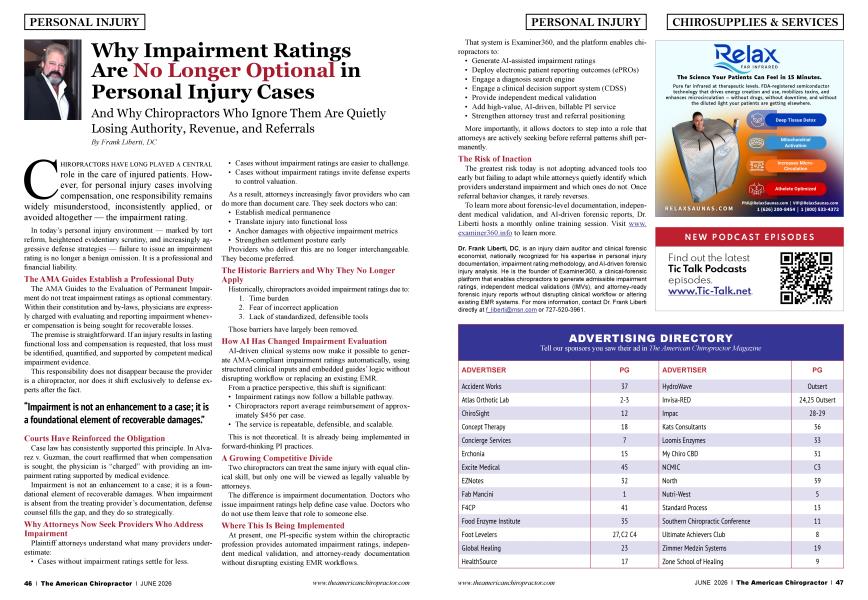
CHIROPRACTORS HAVE LONG PLAYED A CENTRAL role in the care of injured patients. However, for personal injury cases involving compensation, one responsibility remains widely misunderstood, inconsistently applied, or avoided altogether — the impairment rating.
In today’s personal injury environment — marked by tort reform, heightened evidentiary scrutiny, and increasingly aggressive defense strategies — failure to issue an impairment rating is no longer a benign omission. It is a professional and financial liability.
The AMA Guides to the Evaluation of Permanent Impairment do not treat impairment ratings as optional commentary. Within their constitution and by-laws, physicians are expressly charged with evaluating and reporting impairment whenever compensation is being sought for recoverable losses.
The premise is straightforward. If an injury results in lasting functional loss and compensation is requested, that loss must be identified, quantified, and supported by competent medical impairment evidence.
This responsibility does not disappear because the provider is a chiropractor, nor does it shift exclusively to defense experts after the fact.
“Impairment is not an enhancement to a case; it is a foundational element of recoverable damages.”
Case law has consistently supported this principle. In Alvarez v. Guzman, the court reaffirmed that when compensation is sought, the physician is “charged” with providing an impairment rating supported by medical evidence.
Impairment is not an enhancement to a case; it is a foundational element of recoverable damages. When impairment is absent from the treating provider’s documentation, defense counsel fills the gap, and they do so strategically.
Plaintiff attorneys understand what many providers underestimate:
• Cases without impairment ratings settle for less.
• Cases without impairment ratings are easier to challenge.
• Cases without impairment ratings invite defense experts to control valuation.
As a result, attorneys increasingly favor providers who can do more than document care. They seek doctors who can:
• Establish medical permanence
• Translate injury into functional loss
• Anchor damages with objective impairment metrics
• Strengthen settlement posture early
Providers who deliver this are no longer interchangeable. They become preferred.
Historically, chiropractors avoided impairment ratings due to:
1. Time burden
2. Fear of incorrect application
3. Lack of standardized, defensible tools
Those barriers have largely been removed.
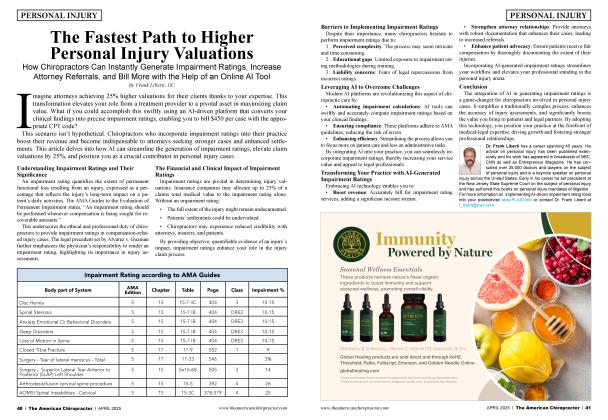
Al-driven clinical systems now make it possible to generate AMA-compliant impairment ratings automatically, using structured clinical inputs and embedded guides’ logic without disrupting workflow or replacing an existing EMR.
From a practice perspective, this shift is significant:
• Impairment ratings now follow a billable pathway.
• Chiropractors report average reimbursement of approximately $456 per case.
• The service is repeatable, defensible, and scalable.
This is not theoretical. It is already being implemented in forward-thinking PI practices.
Two chiropractors can treat the same injury with equal clinical skill, but only one will be viewed as legally valuable by attorneys.
The difference is impairment documentation. Doctors who issue impairment ratings help define case value. Doctors who do not use them leave that role to someone else.
At present, one Pl-specific system within the chiropractic profession provides automated impairment ratings, independent medical validation, and attorney-ready documentation without disrupting existing EMR workflows.
That system is Examiners60, and the platform enables chiropractors to:
• Generate Ai-assisted impairment ratings
• Deploy electronic patient reporting outcomes (ePROs)
• Engage a diagnosis search engine
• Engage a clinical decision support system (CDSS)
• Provide independent medical validation
• Add high-value, Al-driven, billable PI service
• Strengthen attorney trust and referral positioning
More importantly, it allows doctors to step into a role that attorneys are actively seeking before referral patterns shift permanently
The greatest risk today is not adopting advanced tools too early but failing to adapt while attorneys quietly identify which providers understand impairment and which ones do not. Once referral behavior changes, it rarefy reverses.
To learn more about forensic-level documentation, independent medical validation, and Al-driven forensic reports, Dr. Liberti hosts a monthly online training session. Visit www.examiners60.info to learn more.

Dr. Frank Liberti, DC, is an injury claim auditor and clinical forensic economist, nationally recognized for his expertise in personal injury documentation, impairment rating methodology, and Al-driven forensic injury analysis. He is the founder of Examiner360, a clinical-forensic platform that enables chiropractors to generate admissible impairment ratings, independent medical validations (IMVs), and attorney-ready forensic injury reports without disrupting clinical workflow or altering existing EMR systems. For more information, contact Dr. Frank Liberti directly at f [email protected] or 727-520-3961.