"Progress in science depends on new techniques, new discoveries, and new ideas, probably in that order. ” — Sydney Brenner
FOR DECADES, ADOLESCENT IDIOPATHIC SCOLIOSIS (AIS) has been treated as a structural anomaly — an orthopedic curve to be braced, monitored, or surgically corrected. What if scoliosis is more than a curve? What if it reflects a systems-level disruption in cellular signaling, connective tissue dynamics, and neurochemical regulation?
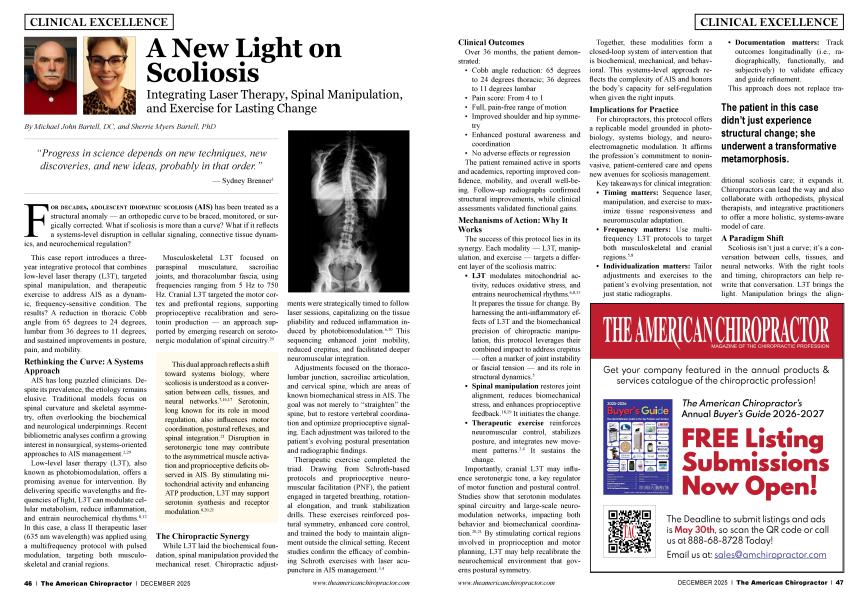
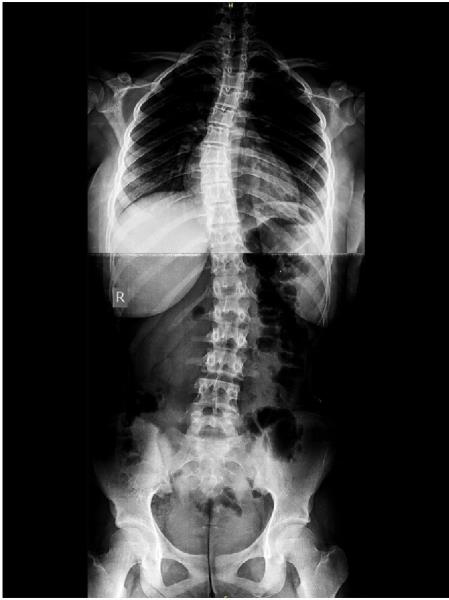
This case report introduces a threeyear integrative protocol that combines low-level laser therapy (L3T), targeted spinal manipulation, and therapeutic exercise to address AIS as a dynamic, frequency-sensitive condition. The results? A reduction in thoracic Cobb angle from 65 degrees to 24 degrees, lumbar from 36 degrees to 11 degrees, and sustained improvements in posture, pain, and mobility.
AIS has long puzzled clinicians. Despite its prevalence, the etiology remains elusive. Traditional models focus on spinal curvature and skeletal asymmetry, often overlooking the biochemical and neurological underpinnings. Recent bibliometric analyses confirm a growing interest in nonsurgical, systems-oriented approaches to AIS management.2
Low-level laser therapy (L3T), also known as photobiomodulation, offers a promising avenue for intervention. By delivering specific wavelengths and frequencies of light, L3T can modulate cellular metabolism, reduce infl aimnation, and entrain neurochemical rhythms.812 In this case, a class II therapeutic laser (635 nm wavelength) was applied using a multifrequency protocol with pulsed modulation, targeting both musculoskeletal and cranial regions.
Musculoskeletal L3T focused on paraspinal musculature, sacroiliac joints, and thoracolumbar fascia, using frequencies ranging from 5 Hz to 750 Hz. Cranial L3T targeted the motor cortex and prefrontal regions, supporting proprioceptive recalibration and serotonin production — an approach supported by emerging research on serotonergic modulation of spinal circuitry.20
This dual approach reflects a shift towaid systems biology, where scoliosis is understood as a conversation between cells, tissues, and neural networks.71617 Serotonin, long known for its role in mood regulation, also influences motor coordination, postural reflexes, and spinal integration.21 Disruption in serotonergic tone may contribute to the asymmetrical muscle activation and proprioceptive deficits observed in AIS. By stimulating mitochondrial activity and enhancing ATP production, L3T may support serotonin synthesis and receptor modulation.8,20’21
While L3T laid the biochemical foundation, spinal manipulation provided the mechanical reset. Chiropractic adjustments were strategically timed to follow laser sessions, capitalizing on the tissue pliability and reduced inflammation induced by photobiomodulation.6-10 This sequencing enhanced joint mobility, reduced crepitus, and facilitated deeper neuromuscular integration.
Adjustments focused on the thoracolumbar junction, sacroiliac articulation, and cervical spine, which are areas of known biomechanical stress in AIS. The goal was not merely to “straighten” the spine, but to restore vertebral coordination and optimize proprioceptive signaling. Each adjustment was tailored to the patient’s evolving postural presentation and radiographic findings.
Therapeutic exercise completed the triad. Drawing from Schroth-based protocols and proprioceptive neuromuscular facilitation (PNF), the patient engaged in targeted breathing, rotational elongation, and trunk stabilization drills. These exercises reinforced postural symmetry, enhanced core control, and trained the body to maintain alignment outside the clinical setting. Recent studies confirm the efficacy of combining Schroth exercises with laser acupuncture in AIS management.3-4
Over 36 months, the patient demonstrated:
• Cobb angle reduction: 65 degrees to 24 degrees thoracic; 36 degrees to 11 degrees lumbar
• Pain score: From 4 to 1
• Full, pain-free range of motion
• Improved shoulder and hip symmetry
• Enhanced postural awareness and coordination
• No adverse effects or regression
The patient remained active in sports and academics, reporting improved confidence, mobility, and overall well-being. Follow-up radiographs confirmed structural improvements, while clinical assessments validated functional gains.
The success of this protocol lies in its synergy. Each modality — L3T, manipulation, and exercise — targets a different layer of the scoliosis matrix:
• L3T modulates mitochondrial activity, reduces oxidative stress, and entrains neurochemical rhythms.6-813 It prepares the tissue for change. By harnessing the anti-inflammatory effects of L3T and the biomechanical precision of chiropractic manipulation, this protocol leverages their combined impact to address crepitus — often a marker of joint instability or fascial tension — and its role in structural dynamics.5
• Spinal manipulation restores joint alignment, reduces biomechanical stress, and enhances proprioceptive feedback.1819 It initiates the change.
• Therapeutic exercise reinforces neuromuscular control, stabilizes posture, and integrates new movement patterns.3-4 It sustains the change.
Importantly, cranial L3T may influence serotonergic tone, a key regulator of motor function and postural control. Studies show that serotonin modulates spinal circuitry and large-scale neuromodulation networks, impacting both behavior and biomechanical coordination.20-21 By stimulating cortical regions involved in proprioception and motor planning, L3T may help recalibrate the neurochemical enviromnent that governs postural symmetry.
Together, these modalities form a closed-loop system of intervention that is biochemical, mechanical, and behavioral. This systems-level approach reflects the complexity of AIS and honors the body’s capacity for self-regulation when given the right inputs.
For chiropractors, this protocol offers a replicable model grounded in photobiology, systems biology, and neuroelectromagnetic modulation. It affirms the profession’s commitment to noninvasive, patient-centered care and opens new avenues for scoliosis management.
Key takeaways for clinical integration:
• Timing matters: Sequence laser, manipulation, and exercise to maximize tissue responsiveness and neuromuscular adaptation.
• Frequency matters: Use multifrequency L3T protocols to target both musculoskeletal and cranial regions.5-8
• Individualization matters: Tailor adjustments and exercises to the patient’s evolving presentation, not just static radiographs.
• Documentation matters: Track outcomes longitudinally (i.e., radiographically, functionally, and subjectively) to validate efficacy and guide refinement.
The patient in this case didn’t just experience structural change; she underwent a transformative metamorphosis.
ditional scoliosis care; it expands it. Chiropractors can lead the way and also collaborate with orthopedists, physical therapists, and integrative practitioners to offer a more holistic, systems-aware model of care.
Scoliosis isn’t just a curve; it’s a conversation between cells, tissues, and neural networks. With the right tools and timing, chiropractors can help rewrite that conversation. L3T brings the light. Manipulation brings the alignment. Exercise brings the integration.
This case challenges the notion that AIS must be braced or surgically corrected. It invites chiropractors to see scoliosis not as a fixed deformity but as a dynamic condition responsive to frequency, movement, and intention.
The patient in this case didn’t just experience structural change; she underwent a transformative metamorphosis. Her posture improved, her pain diminished, and her confidence soared. She became an active participant in her own healing, guided by a protocol that honored her body’s complexity and innate capacity for restoration.
As chiropractors, we are uniquely positioned to lead this paradigm shift. We understand the interplay of structure and function, the power of manual therapy, and the promise of emerging modalities like L3T. By integrating these tools, we can offer patients not just relief but renewal.
Let this case be a beacon that casts a new light on scoliosis, illuminating a regenerative path forward that helps unravel its deeper complexities.
Dr. Michael J. Bartell, DC, founder of Bartell Healthcare Center, brings 50 years of clinical experience to his integrative chiropractic practice. His approach blends natural therapies to achieve systemic correction and whole-body balance. He developed a non-bracing protocol for adolescent idiopathic scoliosis, reflecting his commitment to innovative care and compassionate, patient-centered healing. For more informationvisitbartell-healthcare.net, call 717697-8030 or email [email protected].
Dr. Sherrie M. Bartell, PhD, co-owns Bartell Healthcare Center, where she leads administration, policy analysis, and research. She advocates for patients and tracks healthcare policy developments nationally and within Pennsylvania. She earned her doctorate in Public Administration from Penn State, specializing in learning organizations and public management. Sherrie is also an adjunct instructor for the MBA program at University of the People. For more information email [email protected] or call 717-697-8030.
References
1. Robinson M. Biology in the 1980s, plus or minus a decade. Nature. 1980;285(5764):358359. https://doi.org/10.1038/285358...
2. Xu J, Chen M, Wang X, Xu L, Luo X. Global research hotspots and trends in nonsurgical treatment of adolescent idiopathic scoliosis: A bibliometric study. Front Pediatr. 2024:11:1308889. https://doi.org/10.3389/ fped.2023.1308889
3. Wang Z, Lu L, Wang L. Observation on the therapeutic effect of laser acupuncture combined with Schroth therapy on adolescent idiopathic scoliosis. Pak J Med Sci. 2024 Jul;40(6): 1174-9. Available from: https://www. pj ms. org. pk/index. php/pj ms/article/view/8636
4. Fu G. Effect of Schroth exercises combined with laser acupuncture therapy in adolescent idiopathic scoliosis [Internet], ClinicalTrials.gov; 2023 [cited 2025 Aug 30], Available from: https://clinicaltrials.gov/ct2... show/NCT05 823493
5. Rerucha J. Low-level laser therapy protocol book [Internet], Performance Chiropractic and Wellness; 2011 [cited 2025 Aug 30], Available from: https://www.performancepractic. com
6. de Almeida P, Lopes-Martins RAB, Tomazoni SS, Silva Jr JA, de Carvalho PdTC, Bjordal JM, Leal Junior ECP. Low-level laser therapy improves skeletal muscle performance, decreases skeletal muscle damage, and modulates mRNA expression of COX-1 and COX2 in a dose-dependent manner. Photochem Photobiol. 2011;87(6):1411-7. https://doi. org/lO.llll/j. 1751-1097.2011.00968.x
7. Kell DB. Metabolomics, modeling, and machine learning in systems biology — towards an understanding of the languages of cells. FEES J. 2006:273(5): 873-94. https://doi. org/lO.llll/j. 1742-4658.2006.05136.x
8. Hamblin MR, Demidova TN. Mechanisms of low-level light therapy. In: Hamblin MR, Waynant RW, Anders J, editors. Mechanisms for low-level light therapy. Proc SPIE. 2006:6140:614001. https://doi. org/10.1117/12.646294
9. Demchak T, Carraway C, Miles D. Treating amplified musculoskeletal pain syndrome with photobiomodulation. Pract Pain Manag. 2021:21(3). Available from: https://www.practicalpainmanag... treating-amplified-musculoskeletal-pain-syndrome-photobiomodulation
10. Ghigiarelli JJ. Photobiomodulation therapy and its effects on muscle damage recovery. Research Outreach. 2021 Mar 16. Available from: https://researchoutreach.org/a...
photobiomodulation-therapy-muscle-damage-recovery/
11. Navarro-Ledesma S, Carroll JD, Gonzalez-Munoz A & Burton P (2024) Outcomes of whole-body photobiomodulation on pain, quality of life, leisure physical activity, pain catastrophizing, kinesiophobia, and self-efficacy: a prospective randomized triple-blinded clinical trial with 6 months of follow-up. Front. Neurosci. 18:1264821. https:// doi.org/10.3389/ffiins.2024.1264821
12. Son Y, Lee H, Yu S, Kim HJ, Park J, Woo S, Lee H, Fond G, Boyer L, Rahmati M, Smith L, Lopez Sanchez GF, Dragioti, E, Kang J, Kim T, Yon DK. Effects of photobiomodulation on multiple health outcomes: an umbrella review of randomized clinical trials. Syst Rev 14, 160 (2025). https://doi.org/10.1186/sl3643...
13. Sutherland JC. Biological effects of polychromatic light. Photochem Photobiol. 2007;76(2):164-70. https://doi.org/10.1562/00 31-8655(2002)0760164BEOPL2.0.C02
14. Zhou D, Zhang X, Lv J, Mei Y, Luo Y, Li F, Liu Z. Analysis of key differential metabolites in intervertebral disc degeneration based on untargeted metabolomics. JOR Spine. 2025;8(l):e70032. https://doi.org/10.1002/ jsp2.70032
15. Pan J, Lacroix D, Zhou Y, Wang B. Biomechanical and biochemical regulation of the musculoskeletal system. Front Bioeng Biotechnol. 2023:11:1192638. https://doi.org/10.3389/ fbioe.2023.1192638
16. Kirschner MW. The meaning of systems biology. Cell. 2005;121(4):503-4. https://doi. org/10.1016/j.cell.2005.05.005
17. Potters G. Systems biology of the cell. Nature Educ. 2010;3(9):33. Available from: https://www.nature.com/scitabl...
18. Langevin HM, Sherman KJ. Pathophysiological model for chronic low back pain integrating connective tissue and nervous system mechanisms. Med Hypotheses. 2006;66(5):798-803. https://pubmed.ncbi.nlm. nih.gov/16919887/
19. Oschman JL. Energy medicine: The scientific basis. Edinburgh: Churchill Livingstone: 2000.
20. Walvekar M, Ghosh S, Singh A. Serotonergic modulation of spinal circuitry restores motor function after chronic spinal cord injury. bioRxiv. 2022 Oct 4. https://doi. org/10.1101/2022.10.04.510858
21. Salvan P, Foulkes L, Leech R, Kievit RA, Whitaker KJ, Vdries PE, et al. Serotonin regulation of behavior via large-scale neuromodulation of serotonin receptor networks. Nat Neurosci. 2022;25(5):617-29. https://doi. org/10.103 8/s415 93 -022-01213 -3
22. Oliveira DAA Pires, de Oliveira RF, Zangaro RA, Soares CP. Evaluation of low-lev -el laser therapy of osteoblastic cells. Photomed Laser Surg. 2008;26(4):315-20. https://doi. org/10.1089/pho.2007.2101
23. Adey WR, Bawin SM. Brain interactions with weak electric and magnetic fields. Neurosci BiobehavRev. 1977;1(1):1-15. Available from: https://www.emf-portal.org/en/...
24. Deans JK, Powell AD, Jefferys JGR. Sensitivity of coherent oscillations in rat hippocampus to AC electric fields. J Physiol. 2007;583(Pt2):555-65. https://doi.org/10.1113/ jphysiol.2007.137711
25. Putri DE, Srilestari A, Abdurrohim K, Mangunatmadja I, Wahyuni EK. The effect of laser acupuncture on spasticity in children with spastic cerebral palsy. J Acupunct Meridian Stud. 2020:13(5): 152-156. https://doi. org/10.1016/j.jams.2020.09.001
26. Wong LPK, Cheung PWH, Cheung JPY. Curve type, flexibility, correction, and rotation are predictors of curve progression in patients with adolescent idiopathic scoliosis undergoing conservative treatment: a systematic review. Bone Joint J. 2022;104-B(4):424-432. https:// doi. org/10.1302/0301-620X. 104B4.BJJ-2021 -1677.R1
27. Stedman TL. Stedman's medical dictionary for the health professions and nursing. 28th ed. Philadelphia: Lippincott Williams & Wilkins; 2005.
28. Cold P, Kreitz BG, Cassidy JD, Dzus AK, Martel J. A study of the diagnostic accuracy and reliability of the Scoliometer and Adam's forward bend test. Spine (Phila Pa 1976). 1998;23(7):796-802. Available from: https: //j ournals. 1 ww. com/ spinej ournal/Abstract/1998/04010/A_Study of the DiagnosticAccuracyandReliability. 11. aspx
29. Zheng X, Han W, Gao S, Jia M, Liu L, Yu L. Global visualization of adolescent idiopathic scoliosis treatment: A bibliometric analysis. Front Pediatr. 2025:13:1526459. https://doi. org/10.3389/fped,2025.1526459