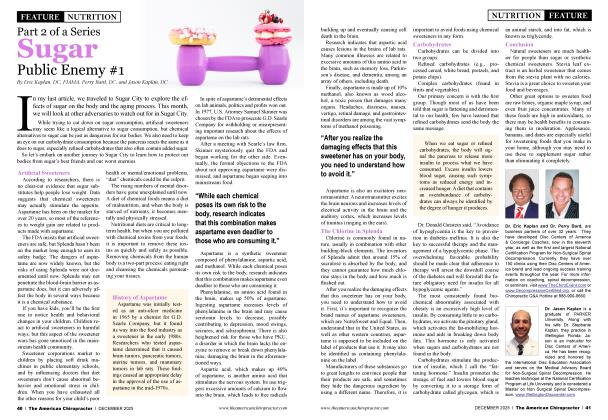
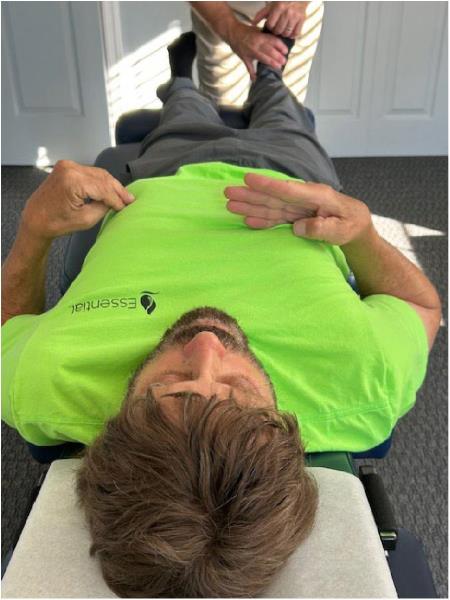
 Patient demonstrating both the Liver and Pancreas Neurolymphatic reflexes.
WHEN I ATTENDED PALMER COLLEGE back in the early 1980s, I remember being perplexed by the fact that the pathognomonic sign of gouty arthritis was acute painful swelling of the great toe, usually on the right foot.
“Why is that?” I wondered. Why not the right knee or the left shoulder? Asking my instructor about it after class, he answered, “I don’t know, and I don’t really care. Just memorize it because it will most likely be a question on the national boards!” He was right, it was a question on the national boards, but I doubt that the examiner who wrote the question knew why either.
After being in private practice for a decade or so, I was once again intrigued by the number of older patients who were missing toes. When I would ask what happened to their missing toe, the answer was usually something such as, “I had an infection of that toe that just wouldn’t heal, so my doctor thought it was best to just amputate it.” Very interesting, but once again, why that particular toe?
Fast forward another decade or so, when one of my patients brought in his 3 8-year-old wife with excruciating right sciatica. She was scheduled for lumbar disc surgery, and her loving husband wanted her to exhaust every other alternative before she went under the knife.
She presented with all the typical orthopedic signs of discal irritation, as well as multiple muscle weaknesses of her right hip, leg, and foot, such as the right gluteus medius, peroneus longus, extensor digitorum longus, anterior tibialis, and extensor hallucis longus. My treatment approach to her problem included the Cox technique (I had a Chiro-Manis table at that time) in conjunction with the Diversified technique and some A-K muscle balancing.
After three weeks of seeing her three times per week, her symptoms had completely resolved, and she asked if she could be “done” with care because she felt great and had to drive nearly an hour to my office. All of her orthopedic signs had resolved, and all of her previously weak muscles were now testing strong, with the exception of the extensor hallucis longus.
Knowing that the EHL was innervated by the deep peroneal nerve (L4/L5 nerve roots), as was the anterior tibialis, which now tested very strong, I was perplexed that two muscles sharing a common innervation could test very differently with manual muscle testing. Then a thought came to me: what if the EHL weakness isn’t related to the lumbar nerve root issue, but to something else? What could that be?
“No neurology textbook that I am aware of would say to hold an organ-specific supplement in your hand to eliminate a weakness of a specific muscle related to a lumbar nerve root lesion!”
Being mostly self-taught in traditional Chinese medicine (TCM), I knew that the great toe had two meridians running through it, namely, the liver and the spleen/pancreas meridians. So I instructed the patient to place three fingers of her right hand over the left seventh intercostal space (the pancreas neurolymphatic reflex), and I retested the right EHL. No change was noted.
I then instructed her to place the same fingers over the right fifth intercostal space below her breast, which is the neurolymphatic reflex for the liver. I retested the EHL and noted a complete locking of the muscle. While she held contact on the liver NL reflex, I began to test various Standard Process liver-specific supplements until one of them canceled the weakness over the reflex point, which turned out to be Cataplex A.
I then instructed her to release the contact of the NL reflex, and I retested the strength of the EHL muscle, which now tested 100% strong. No neurology textbook that I am aware of would say to hold an organ-specific supplement in your hand to eliminate a weakness of a specific muscle related to a lumbar nerve root lesion!
I then asked her to take a certain dosage of Cataplex A for one week and to return for a follow-up visit to see if that would eliminate the EHL weakness. She agreed, and when she returned a week later, the EHL muscle was now testing very strong, and she reported feeling even better than the previous week.
After that intriguing experience, I began to test all of my lower back pain and sciatica patients for meridian involvement.
The following week, a 57-year-old male presented with left-leg sciatica that he had been dealing with for six months. He was wearing a soft foot boot brace, which he said was due to an “infected second toe” that began around the same time as the sciatica.
He had been prescribed a different antibiotic every month for six months to no avail. When I asked to examine the toe, I found the second toe to be swollen, bigger than the great toe and purple in color all the way back to the ankle joint, with a pustule oozing pus out of the medial side of the toe.
Even more interesting was the fact that he reported that the same toe was affected on the opposite foot but to a lesser degree. I told him that I thought that he was experiencing a stomach issue because the second toe is the stomach meridian.
He then confessed to eating every meal from a McDonald’s drive-through because he was single and lived 30 minutes from the store he owned near my office. I had him hold contact on the stomach NL reflex on the left sixth intercostal space and then tested him for stomach supplements related to both hyperacidity and to hypoacidity. He tested strongly with SP Gastrex and with our own brand of aloe vera juice.
I had him take both supplements with each meal, which was no longer going to be at McDonald’s, and instructed him to eat only steamed vegetables and salads until further notice. Over the course of the next two weeks, both toes completely healed, and his sciatica resolved.
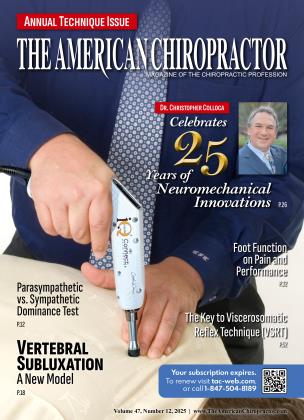
I knew that I had stumbled onto something and proceeded to search for a system of analysis to screen for organ involvement in every musculoskeletal situation. I have named the system that I have developed over the past 30 years the viscerosomatic reflex technique (VSRT).
VSRT gives the doctor the ability to determine if there is a visceral component to a patient’s symptomatology and then link it to a specific organ, vertebral level of involvement, and to a specific supplement to support that VSC and the involved organ.
D.D. Palmer was also perplexed by the problem of “recidivism” or the recurrent subluxation. He reasoned that, besides physical trauma and postural strain, subluxations could be induced and perpetuated by “poisoning and auto-suggestion.”
In today’s world of constant xenobiotic bombardment and processed foods, I think that D.D. Palmer would agree that organ malnutrition and viscerosomatic reflexes could also be a cause of recurrent subluxations.
It’s something to think about, my friends, as you treat your patients this week. While you are at it, also start checking those great toes!

Dr. John Wohar graduated Summa Cum Laude from Palmer College of Chiropractic in Davenport, Iowa in 1981. He and his wife, Linda, are the proud parents of ten children and twenty grandchildren. He practices now from his home office in California, PA where he continues to develop his Viscero-Somatic Reflex Technique. He can be reached at [email protected].