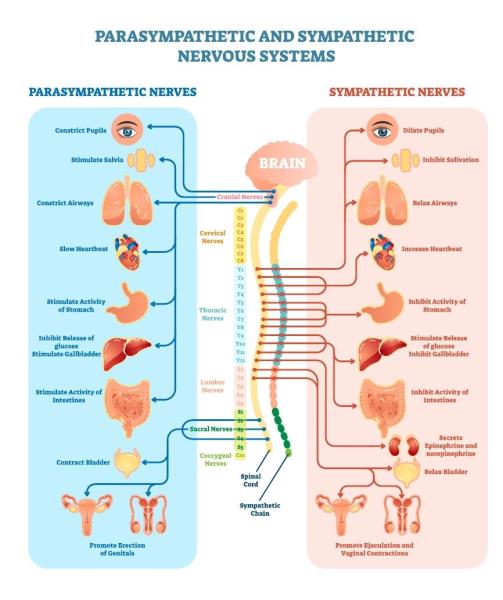
ONE MAJOR BENEFIT OF YOUR CHIROPRACTIC adjustments is the improvement in autonomic nerve function, or sympathetic/parasympathetic nerve strength and balance.
Is there a way to monitor your patients’ sympathetic/parasympathetic balance as they progress through your treatment regimen? There certainly is.
In the September 2025 issue of The American Chiropractor, you were offered a quick test to measure your patients’ autonomic nerve function. The test consists of simply checking a patient’s pulse rate while sitting, then counting it again between 30 and 60 seconds after lying supine.
“That test has almost perfect specificity as a determinant of vagal strength.”
That test has almost perfect specificity as a determinant of vagal strength.
• If the pulse rate drops by three while under the vagal influence that is activated when supine, your patient has a strong vagus, even perhaps an excessively strong vagus (and would be devastated by any popular therapeutic modalities promising to “strengthen the vagus”).
• If the 30-second pulse rate drops between one and three (e.g., from 34 to 32), your patient likely has perfectly capable parasympathetic function with the vagus in perfect balance with sympathetic reactivity.
• If the supine heart rate does not drop, or even rises, then you have two possibilities. Either your patient’s parasympathetic response is truly weak, or the sympathetic reactivity (fight-or-flight respouse) is dominant in your patient.
Now add one simple step to your analysis that will make it nearly infallible to identify if your patients are either sympathetic or parasympathetic dominant. During that first 30 seconds, your patient is supine, count the breath rate.
Next, you can calculate a critical metric — the pulse-rate breath-rate ratio (PER). The PER is the supine pulse rate divided by the breath rate (after normalizing your pulse and breath rates to one minute by doubling them). Finally, subtract the supine pulse rate from the sitting pulse rate (your measure of parasympathetic tone) from the PER. For example:
• PR1 - PR2, e.g., 64 - 60 = 4
• PR2 - ER = PER, e.g., 60 - 12 = 5
• PER - (PR1 - PR2), e.g., 5-4=1
If this metric is (-3) or less, your patient has parasympathetic dominance and needs (along with your chiropractic adjustments) nutrition supplementation providing the opposite of “vagal support.”
If this parameter is (-2) or higher, your patient does not have parasympathetic dominance.
If this parameter is +4 or more, your patient has sympathetic dominance and must supplement accordingly to support your chiropractic adjustments.

Dr. Guy Schenker, a Pennsylvania chiropractor since 1978, is the developer of the Nutri-Spec System of Clinical Nutrition, which eschews symptom-based nutrition in favor of individualized metabolic therapy. Nutri-Spec offers a Stage of Life Diphasic Nutrition Plan (SOLID DNP), empowering each patient to live stronger longer. Contact information: 800-736-4320, [email protected], or through Nutri-Spec.net.